• HOME
  • NEWS
  • EXPLORE
    • CAREER
      • Companies
      • Jobs
    • EVENTS
    • iGEM
      • News
      • Team
    • PHOTOS
    • VIDEO
    • WIKI
  • BLOG
  • COMMUNITY
    • FACEBOOK
    • INSTAGRAM
    • TWITTER
Monday, May 11, 2026
BIOENGINEER.ORG
No Result
View All Result
  • Login
  • HOME
  • NEWS
  • EXPLORE
    • CAREER
      • Companies
      • Jobs
        • Lecturer
        • PhD Studentship
        • Postdoc
        • Research Assistant
    • EVENTS
    • iGEM
      • News
      • Team
    • PHOTOS
    • VIDEO
    • WIKI
  • BLOG
  • COMMUNITY
    • FACEBOOK
    • INSTAGRAM
    • TWITTER
  • HOME
  • NEWS
  • EXPLORE
    • CAREER
      • Companies
      • Jobs
        • Lecturer
        • PhD Studentship
        • Postdoc
        • Research Assistant
    • EVENTS
    • iGEM
      • News
      • Team
    • PHOTOS
    • VIDEO
    • WIKI
  • BLOG
  • COMMUNITY
    • FACEBOOK
    • INSTAGRAM
    • TWITTER
No Result
View All Result
Bioengineer.org
No Result
View All Result
Home NEWS Science News Chemistry

PETA Science Group contributes to first non-animal 3D lung alveolar model of its kind

Bioengineer by Bioengineer
March 24, 2020
in Chemistry
Reading Time: 3 mins read
0
IMAGE
Share on FacebookShare on TwitterShare on LinkedinShare on RedditShare on Telegram

MatTek Life Sciences launches model of the human lower respiratory tract
IMAGE

Credit: PETA International Science Consortium Ltd.


Ashland, Massachusetts – Researchers can now buy a first-of-its-kind human cell-based alveolar model to study the effects of chemicals and other substances on the deepest part of the lungs without forcing animals to inhale them.

The PETA International Science Consortium Ltd. provided MatTek Life Sciences with funding to develop EpiAlveolar – a three-dimensional model composed of human cells from the lower respiratory tract (the alveolar region). On one of its sides, the tissue can be exposed to the test material in the air, and on the other, it receives nutrients from a blood-like liquid – similar to the workings of a human lung.

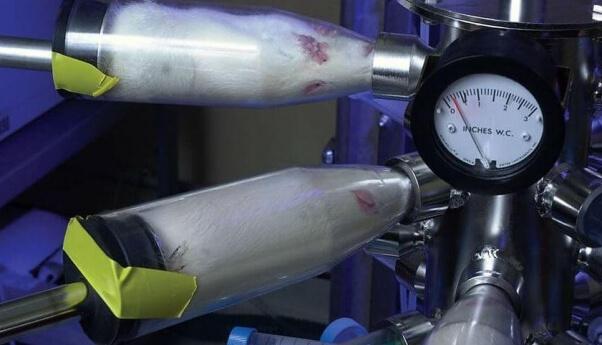
EpiAlveolar can be used to study the effects of inhaling different kinds of substances, such as chemicals, nanomaterials, pathogens, (e-)cigarette smoke, and other respirable materials, instead of conducting tests in which animals are confined to small tubes and forced to inhale them for hours or months before being killed.

A report describing the EpiAlveolar model and its application to test the effects of nanomaterials – carried out at the Adolphe Merkle Institute at the University of Fribourg in Switzerland and Heriot-Watt University in Scotland – has been published in ACS Nano. The model is being further assessed under the EU Horizon 2020 project PATROLS as a promising tool to predict the health effects of long-term and repeated exposure to nanomaterials.

“EpiAlveolar is the latest example of how modern technology can replace animal tests and give us a better understanding of the human body,” says Dr Amy Clippinger, president of the Science Consortium. “We are proud to have partnered with MatTek on the development of this model and look forward to its contribution to life-saving research.”

“Part of our mission at MatTek is expanding the use of non-animal test methods through the development of human-relevant tissue models and test methods,” says Alex Armento, president and CEO of MatTek Life Sciences. “We were glad to have the PETA International Science Consortium’s support for the development of EpiAlveolar and look forward to future collaborations.”

As part of its larger initiative to replace animals in inhalation toxicity testing, the Science Consortium has also awarded international researchers inhalation exposure devices designed to be used with such cell-based models.

The PETA International Science Consortium Ltd. works to accelerate the development, validation, and global implementation of animal-free testing. It was established in 2012 to coordinate the scientific and regulatory expertise of its members – PETA US, PETA UK, PETA Germany, PETA India, PETA Netherlands, PETA France, PETA Asia, and PETA Australia. The Science Consortium and its members have donated millions of pounds towards helping to reduce and replace animal use.

Founded in 1985, MatTek Life Sciences is an in vitro life-science company based in the Boston area. The privately held company is an industry leader in the production of innovative three-dimensional in vitro human tissues used worldwide for non-animal testing across the cosmetics, chemical, and pharmaceutical industries. As an in vitro expert, MatTek has expanded its products and services to include the highest-quality glass-bottom cultureware, primary cells and media, and contract testing.

For more information, please visit PISCLtd.org.uk or MatTek.com.

###

Media Contact
Tasgola Bruner
[email protected]
404-907-4172

Original Source

https://www.peta.org/media/news-releases/peta-science-group-funding-contributes-to-first-non-animal-3-d-lung-alveolar-mode-of-its-kind/

Related Journal Article

http://dx.doi.org/10.1021/acsnano.9b06860

Tags: Animal Research/RightsBiomedical/Environmental/Chemical EngineeringMedical/Scientific EthicsMedicine/HealthNanotechnology/MicromachinesToxicology
Share12Tweet8Share2ShareShareShare2

Related Posts

Humans and Zebra Finches Share Similar Speech Learning Techniques #ASA190 — Chemistry

Humans and Zebra Finches Share Similar Speech Learning Techniques #ASA190

May 11, 2026
Unveiling Dark Matter Through Molecular Insights — Chemistry

Unveiling Dark Matter Through Molecular Insights

May 11, 2026

From Touch to Sight: A Bioinspired Multisensory Framework Endows Robots with Human-Like Perception

May 11, 2026

Announcing the 2026 Carbon Future Young Investigator Award Winners

May 11, 2026
Please login to join discussion

POPULAR NEWS

  • Research Indicates Potential Connection Between Prenatal Medication Exposure and Elevated Autism Risk

    841 shares
    Share 336 Tweet 210
  • New Study Reveals Plants Can Detect the Sound of Rain

    728 shares
    Share 290 Tweet 182
  • Salmonella Haem Blocks Macrophages, Boosts Infection

    62 shares
    Share 25 Tweet 16
  • Breastmilk Balances E. coli and Beneficial Bacteria in Infant Gut Microbiomes

    57 shares
    Share 23 Tweet 14

About

We bring you the latest biotechnology news from best research centers and universities around the world. Check our website.

Follow us

Recent News

Humans and Zebra Finches Share Similar Speech Learning Techniques #ASA190

New Study Uncovers How Fungal Parasites Attack Strawberries and Raspberries

City of Hope Researchers to Present Groundbreaking Immunotherapy and Precision Medicine Advances Across Multiple Cancer Types at ASCO 2026

Subscribe to Blog via Email

Enter your email address to subscribe to this blog and receive notifications of new posts by email.

Join 82 other subscribers
  • Contact Us

Bioengineer.org © Copyright 2023 All Rights Reserved.

Welcome Back!

Login to your account below

Forgotten Password?

Retrieve your password

Please enter your username or email address to reset your password.

Log In
No Result
View All Result
  • Homepages
    • Home Page 1
    • Home Page 2
  • News
  • National
  • Business
  • Health
  • Lifestyle
  • Science

Bioengineer.org © Copyright 2023 All Rights Reserved.