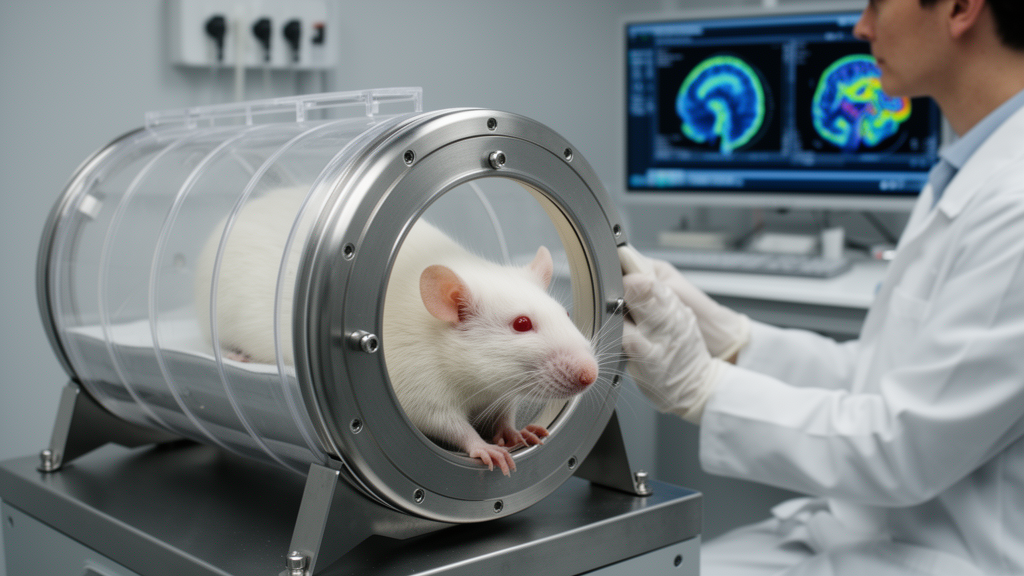
Quantifying a PET tracer that images synaptic density in the living brain has long demanded an uncomfortable trade-off in animal research: accurate measurement requires repeated arterial blood samples, a procedure that in rodents is essentially terminal. A new study in EJNMMI Physics reports that this invasive step may no longer be necessary for [18F]SynVesT-1, a radiotracer that binds synaptic vesicle glycoprotein 2A (SV2A), a protein widely used as a marker of synapse density.
The research team, led by Ruth H. Asch and Zhengxin Cai with senior author Richard E. Carson among the collaborators, evaluated two non-invasive substitutes for arterial sampling: an image-derived input function (IDIF), which extracts the blood time-activity curve directly from the PET images themselves, and a population-based metabolite correction (PBMC), which replaces each animal’s individual radiometabolite measurements with a population average curve.
In the study, eight male and nine female rats received infusions of [18F]SynVesT-1. Arterial blood sampling with metabolite analysis was performed in 13 studies, and dynamic PET data were acquired for 60 minutes post-injection in 16 scans on FOCUS 220 and NeuroEXPLORER cameras. The kinetic parameters of interest were the volume of distribution (VT), which reflects tracer binding, and the delivery rate constant K1, which describes transfer of tracer from blood to tissue.
The researchers compared estimates from the IDIF-PBMC approach against the gold-standard arterial input function (AIF) in the nine scans where both were available. They tested both one-tissue compartment (1TC) and two-tissue compartment (2TC) kinetic models and found that the 1TC model produced higher confidence estimates for VT and K1, so all subsequent analyses used the simpler model.
When each animal’s own metabolite data corrected the image-derived input function, the resulting VT values underestimated the arterial-based values by an absolute difference of 24.5 ± 8.1 percent. Despite this bias, the IDIF and AIF VT values were significantly correlated, with an R² of 0.92 and p < 0.001, meaning the non-invasive method tracked the invasive one closely across scans even though it ran systematically lower.
A key complication emerged from sex differences in radiotracer metabolism. Because male and female rats broke down the tracer differently, the team applied a sex-specific population-based metabolite correction. With this correction in place, the correlation between IDIF-PBMC and AIF VT values remained statistically significant, though weaker, at R² = 0.39 with p < 0.001.
The IDIF-PBMC approach also delivered the highest confidence parameter estimates among the methods tested. In a test-retest assessment in four rats, the method showed a test-retest variability of −7.0 ± 15.5 percent and an absolute test-retest variability of 15.7 ± 6.0 percent, figures that indicate the measurements are reasonably repeatable within the same animal.
The significance of these results lies in what arterial sampling prevents. Because drawing arterial blood from a rodent is an invasive, almost necessarily terminal procedure, longitudinal designs—in which the same animal’s synaptic density is tracked over weeks or months—have been difficult or impossible with this tracer. A validated non-invasive input function removes that barrier, opening the door to repeated imaging of the same rats across time.
The authors conclude that their data add to growing evidence supporting the IDIF-PBMC as a suitable, non-invasive method for PET quantification of [18F]SynVesT-1 in rats, one that would enable longitudinal evaluation of SV2A density. The findings are consistent with a broader research effort, reflected in related recent publications on non-invasive quantification of SV2A tracers in rats and on image-derived input functions in mouse studies, to replace arterial catheterization with image-based and population-based alternatives.
Limitations remain worth noting. The residual bias of roughly 25 percent under individual metabolite correction, the drop in correlation strength when population-based correction was applied, and the modest sample sizes—nine paired scans and four test-retest animals—mean the method is a promising approximation rather than a perfect replacement for arterial sampling. Even so, for researchers seeking to follow synaptic changes in the same animals over time, the study offers a practical path forward: read the input function from the images, borrow the metabolite profile from the population, and keep the animal alive for the next scan.
Subject of Research: Non-invasive PET quantification of the synaptic vesicle glycoprotein 2A tracer [18F]SynVesT-1 in rats using an image-derived input function and population-based metabolite correction.
Article Title: Evaluation of an image-derived input function and population-based metabolite correction for quantification of synaptic density with [18F]SynVesT-1 and PET in male and female rats
Article References: Asch, R. H., Balayeva, T., Zhuang, Z. W., Fowels, K., Carson, R. E., Toyonaga, T., & Cai, Z. (2026). Evaluation of an image-derived input function and population-based metabolite correction for quantification of synaptic density with [18F]SynVesT-1 and PET in male and female rats. EJNMMI Physics. https://doi.org/10.1186/s40658-026-00938-5
Image Credits: AI Generated
DOI: 10.1186/s40658-026-00938-5
Keywords: PET, [18F]SynVesT-1, synaptic vesicle glycoprotein 2A, image-derived input function, metabolite correction, rats, synaptic density, kinetic modeling, test-retest reproducibility, longitudinal imaging, neuroimaging, Evaluation
News Source: Denise Maddox. (October 29, 2026). PET Imaging of Synaptic Density in Rats Without Arterial Blood Sampling. Scienmag.