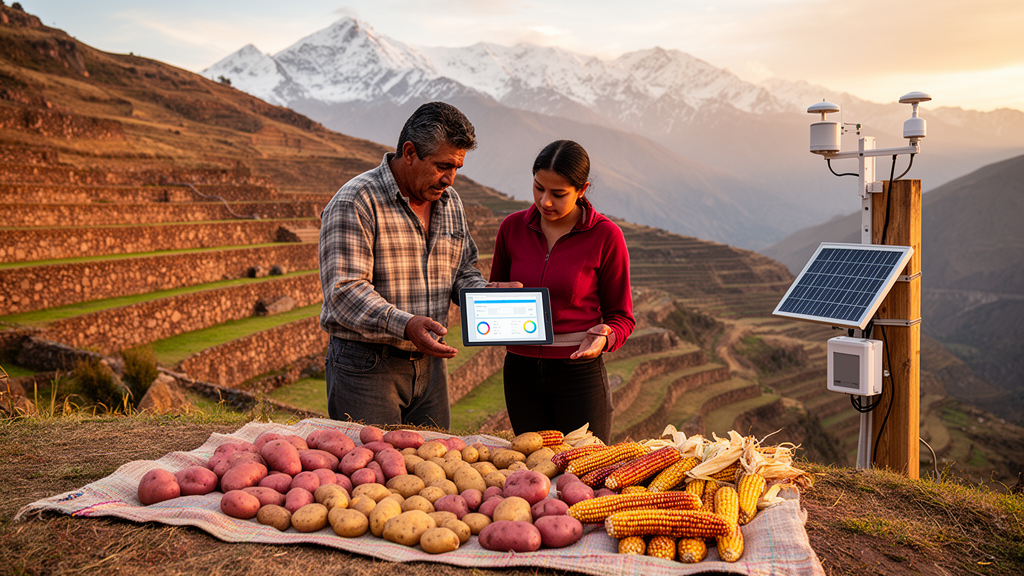
In the high Andes of Peru, the survival of native potatoes, oca, ulluco, and mashua depends on far more than seed banks and breeding programs. It depends on whether farmers keep planting diverse varieties, whether families eat them, whether markets reward them, and whether communities pass on the knowledge of how to grow them.
The research team, led by Cristina Quintana Palacios of the Universidad Nacional Agraria La Molina and Peru’s National Institute for Agrarian Innovation, worked in two stages. First, experts from Peru’s Agrobiodiversity Technical Group, a multi-institutional body coordinated by INIA under the National Commission on Biological Diversity, assessed 67 candidate indicators across six pillars: consumption and markets, production systems, genetic resources conservation, governance, livelihoods, and culture. During a workshop held on October 10, 2025, representatives from 20 of the group’s 21 member institutions scored each candidate on scientific relevance, technical feasibility, usefulness for public policy, and sociocultural relevance, then deliberated in plenary to merge overlapping indicators and sharpen wording. The result was a core set of 30 indicators, five per pillar.
Second, the team took that core to the field. In the Apurímac region of south-central Peru, which at the time of study design held the largest number of recognized ZABD, 120 participants were recruited: farmers, community authorities, and members of ZABD management committees from the four recognized territories of Paymakis, Chacoche, Circa, and Andahuaylas. Thirty participants came from each zone, a deliberately balanced design that prevented any single territory from dominating the summaries. Each person rated all 30 indicators twice, once for relevance to local reality and once for comprehension, using yes, partially, or no responses, and each territory produced a consensus ranking of the five indicators within every pillar.
The headline numbers are strong. The overall Relevance Validation Index reached 80.71 on a 100-point scale, with a 95 percent bootstrap confidence interval of 77.46 to 83.79, and the Comprehension Validation Index reached 78.61, with a confidence interval of 74.61 to 82.28. Internal consistency was high, with Cronbach’s alpha of 0.915 for the 30 relevance items and 0.947 for the 30 comprehension items. Relevance and comprehension were strongly associated overall, with a Spearman correlation of 0.862 and a p-value below 0.001, meaning that indicators participants understood well were also the ones they judged most relevant to their lives.
At the level of individual indicators, the highest combined scores went to concepts rooted in everyday practice: traditional practices supporting agrobiodiversity conservation scored 87.50 for relevance and 86.67 for comprehension, community work scored 86.25 and 83.75, diversity of species and varieties in consumption scored 87.08 and 81.67, gender equity in participation and decision-making scored 87.50 and 81.25, and sustainable agricultural soil management scored 83.33 and 84.17. The lowest scores clustered around administrative or abstract constructs. Multisectoral partnerships scored 75.83 for relevance but only 69.58 for comprehension, compensation for ecosystem services scored 72.50 for relevance, and use of underutilized species retained high relevance at 84.58 while comprehension lagged at 73.33. The authors stress that these low-comprehension items should not be discarded but rewritten with local examples and observable verification criteria.
The territorial comparison revealed meaningful heterogeneity. Chacoche recorded the highest overall values, with a relevance index of 88.00 and comprehension of 86.72, followed by Circa at 83.67 and 83.22 and Paymakis at 81.61 and 75.72. Andahuaylas trailed at 69.56 and 68.78, and pairwise tests confirmed that Andahuaylas differed significantly from the other three zones for both indices after adjustment for multiple comparisons. An exploratory model controlling for age, sex, and actor type still found Andahuaylas roughly 18 points lower than Chacoche on both indices, suggesting the gap is not explained by sample composition alone, though the purposive, non-probabilistic design prevents generalization to the wider population. The authors interpret this variation as a signal for adapting implementation, not as a sustainability classification, since the study measured the instrument rather than the territories.
One of the most instructive findings concerns where experts and communities disagree. Agreement between the expert ranking and the four territorial consensus rankings was perfect for livelihoods, with a rank correlation of 1.000, and high for culture at 0.821, with moderate-to-high agreement for production systems, governance, and genetic resources conservation. But for consumption and markets the correlation was low and inverse, at minus 0.205, and overall concordance was statistically nonsignificant. Communities assigned greater relative importance to the diversity they actually eat and to market access, while experts ranked the use of underutilized species highly, likely reflecting its nutritional and conservation value. The lesson, the authors argue, is that accepting an indicator does not mean weighting it the same way, and that national comparability and territorial decision-making must be kept distinct.
Building on the validated core, the team parameterized a prototype composite metric, the Sustainability Index for Agrobiodiversity Zones, or IS-ZABD, on a 0-to-100 scale. Each of the six pillars receives an equal weight of one-sixth, a deliberate choice that avoids imposing an untested hierarchy among dimensions. Within each pillar, indicator weights derived from the expert and territorial rankings through a reverse Borda rule range from 6.67 to 33.33 percent, so the highest-weighted indicators contribute at most 5.56 percentage points to the overall score. The highest weights went to ecosystems conserved for water, pastures, and forests, traditional conservation practices, and diversity of species and varieties in production and conservation. A minimum-performance rule prevents compensation: a zone cannot be placed in the two highest classification bands if any pillar scores below 40 points, so strong markets could not mask a collapse in genetic diversity or cultural transmission.
The authors are explicit about what the study does and does not establish. No territorial sustainability values were calculated, because the IS-ZABD remains a parameterized prototype lacking observed data, baselines, and thresholds for its 30 indicators. The relevance and comprehension indices document acceptance and comprehensibility of the framework, not performance, and must not be mistaken for evidence that any zone is sustainable in a given domain. Other limitations include group-level rather than individual expert assessments, some unrecovered expert scoring matrices, a single Andean region, and the assessment of content and face validity rather than predictive validity, temporal reliability, or inter-rater reproducibility. A sensitivity analysis did show that missing expert information did not materially alter the architecture, with 28 of 30 indicator selections stable under recalculation.
The framework’s significance for Andean roots and tubers lies in connecting genetic resources and breeding outcomes with the territorial processes that determine whether diverse materials are maintained, circulated, adopted, consumed, and valued. On-farm persistence of native potato, oca, ulluco, and mashua depends on access to planting material, farmer seed networks, crop-management knowledge, culinary demand, and livelihood opportunities. The study did not measure varietal performance, seed health, adoption rates, or responses to climate stress, and the authors emphasize that the monitoring core should complement rather than replace crop-specific agronomic and breeding assessments. Future work includes developing standardized technical sheets for all 30 indicators, agreeing on thresholds, conducting cognitive interviews, testing measurement over at least two agricultural cycles, and expanding piloting to Amazonian and coastal zones. If those steps succeed, the framework could give communities, managers, and policymakers a shared, measurable picture of the ecological, economic, institutional, and biocultural conditions that keep Andean agrobiodiversity alive.
Subject of Research: Participatory development and validation of a sustainability monitoring framework for Peru's Agrobiodiversity Zones
Article Title: Agrobiodiversity as the central axis of territorial management: a participatory sustainability framework supporting underutilized and climate-resilient Andean roots and tubers in Peru's agrobiodiversity zones
Article References: Quintana Palacios, C., Estrada-Carmona, N., Amasifuen Guerra, C. A., & Sotomayor, D. A. (2026). Agrobiodiversity as the central axis of territorial management: a participatory sustainability framework supporting underutilized and climate-resilient Andean roots and tubers in Peru's agrobiodiversity zones. Frontiers in Sustainable Food Systems, 10, Article 1972964. https://doi.org/10.3389/fsufs.2026.1972964
Image Credits: AI Generated
DOI: 10.3389/fsufs.2026.1972964
Keywords: agrobiodiversity, Andean roots and tubers, Peru, participatory monitoring, sustainability indicators, native potato, oca, ulluco, mashua, climate resilience, Indigenous knowledge, composite index
News Source: Sloane Callahan. (October 29, 2026). Peru builds a participatory sustainability monitor for Andean agrobiodiversity zones. Scienmag.