• HOME
  • NEWS
  • EXPLORE
    • CAREER
      • Companies
      • Jobs
    • EVENTS
    • iGEM
      • News
      • Team
    • PHOTOS
    • VIDEO
    • WIKI
  • BLOG
  • COMMUNITY
    • FACEBOOK
    • INSTAGRAM
    • TWITTER
Sunday, December 21, 2025
BIOENGINEER.ORG
No Result
View All Result
  • Login
  • HOME
  • NEWS
  • EXPLORE
    • CAREER
      • Companies
      • Jobs
        • Lecturer
        • PhD Studentship
        • Postdoc
        • Research Assistant
    • EVENTS
    • iGEM
      • News
      • Team
    • PHOTOS
    • VIDEO
    • WIKI
  • BLOG
  • COMMUNITY
    • FACEBOOK
    • INSTAGRAM
    • TWITTER
  • HOME
  • NEWS
  • EXPLORE
    • CAREER
      • Companies
      • Jobs
        • Lecturer
        • PhD Studentship
        • Postdoc
        • Research Assistant
    • EVENTS
    • iGEM
      • News
      • Team
    • PHOTOS
    • VIDEO
    • WIKI
  • BLOG
  • COMMUNITY
    • FACEBOOK
    • INSTAGRAM
    • TWITTER
No Result
View All Result
Bioengineer.org
No Result
View All Result
Home NEWS Science News Chemistry

Performance of methane conversion solid catalyst is predicted by theoretical calculation

Bioengineer by Bioengineer
March 4, 2021
in Chemistry
Reading Time: 2 mins read
0
IMAGE
Share on FacebookShare on TwitterShare on LinkedinShare on RedditShare on Telegram

Accelerating search for various materials to achieve a carbon-free society
IMAGE

Credit: Atsushi Ishikawa

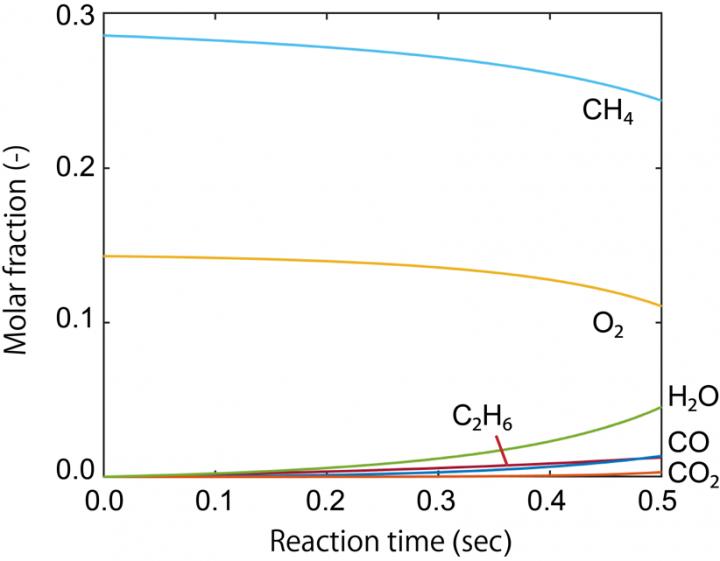
Japanese researchers have developed a simulation method to theoretically estimate the performance of heterogeneous catalyst by combining first-principles calculation (1) and kinetic calculation techniques. Up to now, simulation studies mainly focused on a single or limited number of reaction pathways, and it was difficult to estimate the efficiency of a catalytic reaction without experimental information.

Atsushi Ishikawa, Senior Researcher, Center for Green Research on Energy and Environmental Materials, National Institute for Materials Science (NIMS), performed computation of reaction kinetic information from first-principles calculations based on quantum mechanics, and developed methods and programs to carry out kinetic simulations without using experimental kinetic results. Then he applied the findings to the oxidative coupling of methane (OCM) reaction, which is an important process in the use of natural gas. He could successfully predict the yield of the products, such as ethane, without experimental information on the reaction kinetics. He also predicted changes in yield depending on the temperature and partial pressure, and the results reproduced faithfully the existing experimental results.

This research shows that the computer simulation enables the forecasting the conversion of reactant and the selectivity of products, even if experimental data are unavailable. The search for catalytic materials led by theory and calculation is expected to speed up. Furthermore, this method is highly versatile and can be applied not only to methane conversion catalysts but also to other catalyst systems such as for automobile exhaust gas purification, carbon dioxide reduction and hydrogen generation, and is expected to contribute to the realization of a carbon-free society.

###

The research was supported by JST’s Strategic Basic Research Program, Precursory Research for Embryonic Science and Technology (PRESTO) Program.

(1) First-principles calculation
A theoretical calculation method for solving quantum mechanical equations without using empirical parameters, which is often applied to atomic, molecular, solid, and interface systems.

Media Contact
Atsushi Ishikawa
[email protected]

Original Source

https://www.jst.go.jp/pr/info/info1488/index_e.html

Related Journal Article

http://dx.doi.org/10.1021/acscatal.0c04104

Tags: Atomic PhysicsAtomic/Molecular/Particle PhysicsChemistry/Physics/Materials SciencesMaterialsMolecular Physics
Share13Tweet8Share2ShareShareShare2

Related Posts

Cutting Electrolyte Reduction Boosts High-Energy Battery Performance

Cutting Electrolyte Reduction Boosts High-Energy Battery Performance

December 19, 2025
Microenvironment Shapes Gold-Catalysed CO2 Electroreduction

Microenvironment Shapes Gold-Catalysed CO2 Electroreduction

December 11, 2025

Photoswitchable Olefins Enable Controlled Polymerization

December 11, 2025

Cation Hydration Entropy Controls Chloride Ion Diffusion

December 10, 2025
Please login to join discussion

POPULAR NEWS

  • Nurses’ Views on Online Learning: Effects on Performance

    Nurses’ Views on Online Learning: Effects on Performance

    70 shares
    Share 28 Tweet 18
  • NSF funds machine-learning research at UNO and UNL to study energy requirements of walking in older adults

    71 shares
    Share 28 Tweet 18
  • Unraveling Levofloxacin’s Impact on Brain Function

    53 shares
    Share 21 Tweet 13
  • Exploring Audiology Accessibility in Johannesburg, South Africa

    51 shares
    Share 20 Tweet 13

About

We bring you the latest biotechnology news from best research centers and universities around the world. Check our website.

Follow us

Recent News

Examining Flood Vulnerability and Evacuation Challenges

Revolutionary Neural Network Tackles Hepatitis C Dynamics

Fruquintinib and Sintilimab Treat Advanced Endometrial Cancer

Subscribe to Blog via Email

Enter your email address to subscribe to this blog and receive notifications of new posts by email.

Join 70 other subscribers
  • Contact Us

Bioengineer.org © Copyright 2023 All Rights Reserved.

Welcome Back!

Login to your account below

Forgotten Password?

Retrieve your password

Please enter your username or email address to reset your password.

Log In
No Result
View All Result
  • Homepages
    • Home Page 1
    • Home Page 2
  • News
  • National
  • Business
  • Health
  • Lifestyle
  • Science

Bioengineer.org © Copyright 2023 All Rights Reserved.