• HOME
  • NEWS
  • EXPLORE
    • CAREER
      • Companies
      • Jobs
    • EVENTS
    • iGEM
      • News
      • Team
    • PHOTOS
    • VIDEO
    • WIKI
  • BLOG
  • COMMUNITY
    • FACEBOOK
    • INSTAGRAM
    • TWITTER
Friday, May 29, 2026
BIOENGINEER.ORG
No Result
View All Result
  • Login
  • HOME
  • NEWS
  • EXPLORE
    • CAREER
      • Companies
      • Jobs
        • Lecturer
        • PhD Studentship
        • Postdoc
        • Research Assistant
    • EVENTS
    • iGEM
      • News
      • Team
    • PHOTOS
    • VIDEO
    • WIKI
  • BLOG
  • COMMUNITY
    • FACEBOOK
    • INSTAGRAM
    • TWITTER
  • HOME
  • NEWS
  • EXPLORE
    • CAREER
      • Companies
      • Jobs
        • Lecturer
        • PhD Studentship
        • Postdoc
        • Research Assistant
    • EVENTS
    • iGEM
      • News
      • Team
    • PHOTOS
    • VIDEO
    • WIKI
  • BLOG
  • COMMUNITY
    • FACEBOOK
    • INSTAGRAM
    • TWITTER
No Result
View All Result
Bioengineer.org
No Result
View All Result
Home NEWS Science News Chemistry

Perfect diamagnetism observation of high-temperature superconductivity in compressed H2S

Bioengineer by Bioengineer
June 13, 2019
in Chemistry
Reading Time: 2 mins read
0
IMAGE
Share on FacebookShare on TwitterShare on LinkedinShare on RedditShare on Telegram

IMAGE

Credit: ©Science China Press

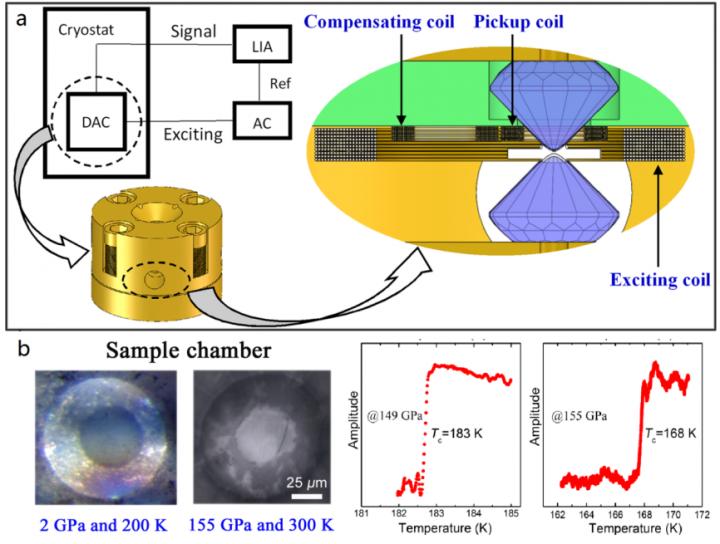
The discovery of the extremely high superconducting temperature (Tc) of ~200 K reported in the sulfur hydride system above 100 GPa, has broken the high-temperature superconductivity record for the copper oxides. The zero resistance superconducting measurements of sulfur hydride system have been reported by Eremets et al.. Direct, complete and many pressure-point Meissner effect measurements under high pressures are urgently needed. Motivated by this, the research group of Prof. Tian Cui from Jilin University has made a breakthrough in fulfilling the perfect diamagnetism of sulfur hydride system under high pressure, using a highly sensitive magnetic susceptibility technique adapted for a megabar-pressure diamond anvil cell (DAC).

Through theoretical calculation and experimental research, scientists have found that some hydrogen-rich compounds show very high superconducting transition temperature under high pressure. For example, the superconducting transition temperature of sulfur hydride at 155 GPa is 203 K, and that of lanthanum hydride at 170 GPa is 250 K. However, the experimental studies on the superconductivity of hydrogen-rich compounds are focused on the characterization of the superconducting zero resistance characteristics. As is known to all, perfect diamagnetism is another essential characteristic of superconductors, but the experimental measurement of perfect diamagnetism in hydrogen-rich compounds at ultra-high pressure is extremely challenging. Megabar presures or even higher can be generated by the diamond anvil cell, but the sample size is less than 0.05×0.05×0.01 mm3. The very small sample dimension and sensitive metal parts of the cell lead to very low signal-to-noise ratio when performing magnetic measurement, so it is very difficult to extract weak sample signals from huge noise signals.

By suppressing the noise of signal source, shielding the transmission noise and improving the sensitivity of signal extraction, the authors optimize the magnetic measurement method based on DAC, build the magnetic susceptibility measurement system with high sensitivity, and measures the alternating current magnetic susceptibility of sulfur hydrogen sample under high pressure. They firstly sealed liquid hydrogen sulfide into a DAC using cryogenic technology. The target sample H3S was prepared by low temperature compression path and the superconducting transition was observed at 183 K and 149 GPa. The trend of superconducting transition temperature under different pressures was obtained, and the superconducting phase diagram of hydrogen sulfide was improved.

The research results show that it is feasible to measure the alternating current susceptibility in the hydrogen-rich compounds above megarbar pressure. The above research confirms the high-temperature superconductivity and determined the superconducting phase diagram of sulfur hydrogen system from magnetic susceptibility data, which opens up a broad research prospect for the experimental research of hydrogen-rich superconductors under ultra-high pressure.

###

See the article:

High-temperature superconductivity in sulfur hydride evidenced by alternating-current magnetic susceptibility

Xiaoli Huang, Xin Wang, Defang Duan, Bertil Sundqvist, Xin Li, Yanping Huang, Hongyu Yu, Fangfei Li, Qiang Zhou, Bingbing Liu, Tian Cui

Natl Sci Rev, 2019, https://doi.org/10.1093/nsr/nwz061

Media Contact
Tian Cui
[email protected]

Related Journal Article

http://dx.doi.org/10.1093/nsr/nwz061

Tags: Chemistry/Physics/Materials Sciences
Share12Tweet8Share2ShareShareShare2

Related Posts

How Materials Chemistry is Transforming the Future of Catalysis — Chemistry

How Materials Chemistry is Transforming the Future of Catalysis

May 29, 2026
New Research Reveals Fish Gut Microbe’s Role in Regulating Ocean Health — Chemistry

New Research Reveals Fish Gut Microbe’s Role in Regulating Ocean Health

May 29, 2026

Phosphonate Group Addition Enhances Organic Electrochemical Transistor Performance

May 29, 2026

Single-Atom “Camera” Visualizes Light Intensity and Polarization Beyond Optical Microscope Limits

May 29, 2026
Please login to join discussion

POPULAR NEWS

  • ESMO 2025: mRNA COVID Vaccines Enhance Efficacy of Cancer Immunotherapy

    318 shares
    Share 127 Tweet 80
  • Multi-Hospital Study Reveals Long Covid Burden Is Twice as High as Current Estimates

    78 shares
    Share 31 Tweet 19
  • Common Food Preservatives Associated with Elevated Blood Pressure and Increased Heart Disease Risk

    56 shares
    Share 22 Tweet 14
  • New Study Reveals Plants Can Detect the Sound of Rain

    736 shares
    Share 294 Tweet 184

About

We bring you the latest biotechnology news from best research centers and universities around the world. Check our website.

Follow us

Recent News

CLPTM1L Alters Lipid Rafts to Drive Glioblastoma Progression

Minimally Invasive Ultrasound-Guided Endoscopic Retrieval of Deeply Embedded Cervical Fish Bone Following Unsuccessful Open Surgery

How Materials Chemistry is Transforming the Future of Catalysis

Subscribe to Blog via Email

Enter your email address to subscribe to this blog and receive notifications of new posts by email.

Join 82 other subscribers
  • Contact Us

Bioengineer.org © Copyright 2023 All Rights Reserved.

Welcome Back!

Login to your account below

Forgotten Password?

Retrieve your password

Please enter your username or email address to reset your password.

Log In
No Result
View All Result
  • Homepages
    • Home Page 1
    • Home Page 2
  • News
  • National
  • Business
  • Health
  • Lifestyle
  • Science

Bioengineer.org © Copyright 2023 All Rights Reserved.