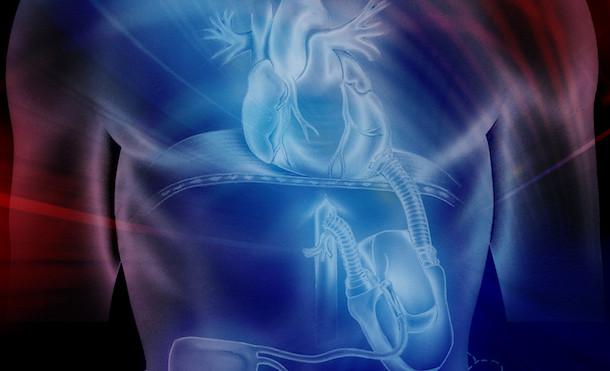
Credit: Penn State
Two Penn State biomedical engineering faculty members have received a two-year, $200,000 grant from the American Heart Association (AHA) to explore potential solutions to thrombosis, or blood clot formation, a prevalent issue with blood-contacting medical devices such as heart valves, blood pumps and cardiac stents.
Keefe Manning, professor of biomedical engineering and associate dean for academic affairs for Schreyer Honors College, and Yong Wang, professor of biomedical engineering, were recipients of the AHA’s 2019 Innovation Project Award. The Innovation Project Award is unique because it promotes unexplored ideas; unlike many grants, preliminary data is not required and not accepted as part of the grant proposal. It seeks to support highly innovative, high-impact research that could ultimately lead to paradigm shifts, critical discoveries or major cardiovascular and cerebrovascular advancements.
“This is sort of a high-risk, high-reward type of research we are planning, something this grant is designed to encourage,” Manning said. “If our idea works, it could result in a paradigm shift in how we think about dealing with anticoagulation in cardiovascular devices.”
Currently, preventing thrombosis in blood-contacting medical devices requires frequent administration of antithrombotic drugs, also known as blood thinners. However, systemic delivery of these drugs is not specific to the area with the medical devices, and this causes side effects such as bleeding and low drug concentration in the implantation area. While doctors can insert drug-eluting stents to decrease side effects and increase drug concentration, the coatings only accommodate a limited quantity of drugs.
Manning and Wang propose preventing thrombosis via a new method of surface modification of nanoparticles using synthetic ligands to specifically recognize the surface of medical devices for local drug delivery.
This idea came about during a lunchtime chat one day between Manning and Wang, where they discussed their research. Manning’s lab focuses on medical devices such as artificial hearts, while Wang’s lab does work in nanoparticles.
“I didn’t see his work as being in my space and he kind of was aware of what I did in his lab, but as we had our conversation it occurred to me his expertise in nanoparticles could help in solving the thrombosis issue with medical devices,” Manning said.
The potential reward of the grant is a new solution for preventing thrombosis in medical devices, which would be very positive news for people such as cardiac transplant patients who need artificial hearts to survive until they can receive a donor heart. The potential risks for the study include whether the surface modification stays intact in the very active and dynamic environment of the human body and how to successfully time a drug release in such an environment. Manning and Wang have a series of laboratory experiments planned to test their theories.
Manning said the grant, which the AHA designed for such high-risk, high-reward research on the cutting edge, could enable the two researchers to attempt something unprecedented.
“We’re pairing two different types of biomedical engineering expertise to tackle the very challenging problem of thrombosis in medical devices,” Manning said. “This grant will allow us to gather some preliminary data in a first step to what could be something that revolutionizes anticoagulation.”
###
Media Contact
A’ndrea Elyse Messer
[email protected]