Plants encounter microbes all the time, in the air, water, and soil. Some cause disease, others are neutral, but a few microbes promote plant health and growth. Beneficial bacteria, called rhizobia, form an intimate interaction with legumes, inducing the formation of symbiotic root nodules in which bacteria fix nitrogen and provide the plant with an internal source of fertilizer. As a result of this ready supply of nitrogen, legumes, such as peanuts, are valued for their protein-rich seeds and are an important part of the food supply world-wide.
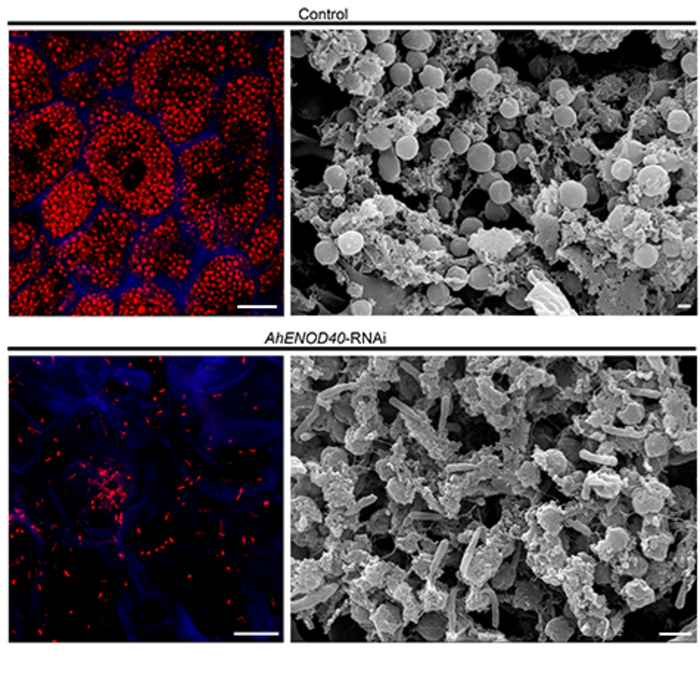
Credit: Pritha Ganguly, Dipan Roy, Troyee Das, Anindya Kundu, Fabienne Cartieaux, Zhumur Ghosh, and Maitrayee DasGupta
Plants encounter microbes all the time, in the air, water, and soil. Some cause disease, others are neutral, but a few microbes promote plant health and growth. Beneficial bacteria, called rhizobia, form an intimate interaction with legumes, inducing the formation of symbiotic root nodules in which bacteria fix nitrogen and provide the plant with an internal source of fertilizer. As a result of this ready supply of nitrogen, legumes, such as peanuts, are valued for their protein-rich seeds and are an important part of the food supply world-wide.
Dr. Maitrayee DasGupta’s lab has focused on revealing the molecular mechanisms of early nodule development in peanut. In a recently published paper, Pritha Ganguly, of the DasGupta lab, and colleagues investigate the function of the peanut ENOD40 gene, which is required for the earliest steps of symbiotic nodule development. ENOD40 encodes two short peptides, but the RNA itself has a function independent of its coding ability.
One of the biggest surprises of the last 20 years has been the thorough upending of the central dogma that RNA exclusively functions to encode proteins. We now know that many different classes of RNAs are never translated and act as key regulators in multiple processes in plants and animals, including their interactions with microbes.
But the surprises continue! As Ganguly and coworkers investigated the mechanism of ENOD40 function in peanut, they found that this long non-coding RNA itself had an antisense long-noncoding RNA, revealing layers upon layers of regulation mediated by functional RNAs. They found that this antisense RNA, which they named DONE40, specifically bound AhASHR3 (ABSENT SMALL HOMEOTIC DISC1 RELATED3), a member of the Trithorax group of proteins. Trithorax, originally identified in the fruitfly, functions in epigenetic control of target gene expression to set up an activated state that can be inherited. This epigenetic state is typically associated with histone modifications, and Ganguly found that the ENOD40 loci undergo dynamic histone H3 modifications during symbiosis, indicating an evolutionarily conserved function.
”It is amazing to note the conserved involvement of the Polycomb/Trithorax superfamily of proteins in developmental processes of both plant and animals,” said DasGupta, who notes that this is the first sense-antisense long non-coding RNA pair identified in plants, opening up a possible mechanism of ENOD40 action and providing an entrypoint into understanding epigenetic mechanisms in plants.
Learn more by reading “The Natural Antisense Transcript DONE40 Derived from the lncRNA ENOD40 Locus Interacts with SET Domain Protein ASHR3 During Inception of Symbiosis in Arachis hypogaea” published in the open access MPMI journal.
Journal
Molecular Plant-Microbe Interactions
DOI
10.1094/MPMI-12-20-0357-R
Method of Research
Experimental study
Subject of Research
Not applicable
Article Title
The Natural Antisense Transcript DONE40 Derived from the lncRNA ENOD40 Locus Interacts with SET Domain Protein ASHR3 During Inception of Symbiosis in Arachis hypogaea
Article Publication Date
29-Nov-2021