• HOME
  • NEWS
  • EXPLORE
    • CAREER
      • Companies
      • Jobs
    • EVENTS
    • iGEM
      • News
      • Team
    • PHOTOS
    • VIDEO
    • WIKI
  • BLOG
  • COMMUNITY
    • FACEBOOK
    • INSTAGRAM
    • TWITTER
Sunday, August 16, 2026
BIOENGINEER.ORG
No Result
View All Result
  • Login
  • HOME
  • NEWS
  • EXPLORE
    • CAREER
      • Companies
      • Jobs
        • Lecturer
        • PhD Studentship
        • Postdoc
        • Research Assistant
    • EVENTS
    • iGEM
      • News
      • Team
    • PHOTOS
    • VIDEO
    • WIKI
  • BLOG
  • COMMUNITY
    • FACEBOOK
    • INSTAGRAM
    • TWITTER
  • HOME
  • NEWS
  • EXPLORE
    • CAREER
      • Companies
      • Jobs
        • Lecturer
        • PhD Studentship
        • Postdoc
        • Research Assistant
    • EVENTS
    • iGEM
      • News
      • Team
    • PHOTOS
    • VIDEO
    • WIKI
  • BLOG
  • COMMUNITY
    • FACEBOOK
    • INSTAGRAM
    • TWITTER
No Result
View All Result
Bioengineer.org
No Result
View All Result
Home NEWS Science News Biology

Paving the way for hydrogen from algae enzymes

Bioengineer by Bioengineer
June 3, 2024
in Biology
Reading Time: 2 mins read
0
Group of authors
Share on FacebookShare on TwitterShare on LinkedinShare on RedditShare on Telegram

Ligands on the cluster facilitate hydrogen production
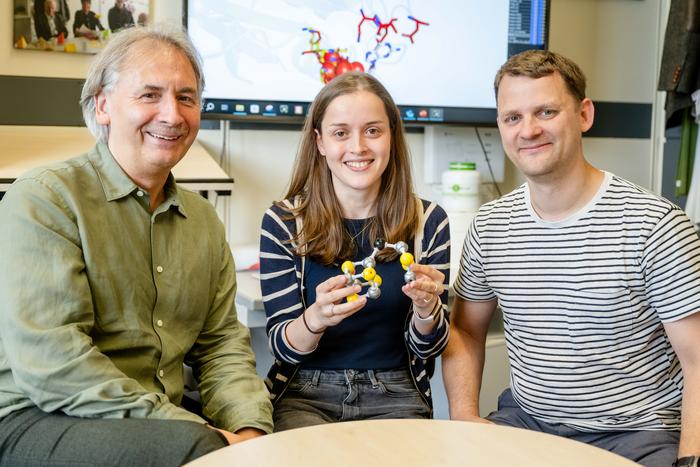
Group of authors

Credit: RUB, Marquard

Ligands on the cluster facilitate hydrogen production

“Iron-sulphur ([FeS]) clusters are essential, widely distributed protein cofactors that perform a wide variety of functions in the cell,” explains lead author Rieke Haas from the Photobiotechnology research group headed by Professor Thomas Happe at Ruhr University Bochum. They are involved, for example, in catalyzing chemical reactions, transferring of electrons, sensing changing environmental conditions and synthesizing other complex metal cofactors.

The hydrogen-producing [FeFe] hydrogenases of algae also have an [FeS] cluster – a unique catalytic center. The fact that it facilitates the production of the green energy carrier hydrogen under mild reaction conditions makes it a key research priority for future-oriented energy production. “In addition to iron and sulphur atoms, its cofactor contains other ligands that make the conversion of hydrogen possible,” explains Rieke Haas. “This means that the biosynthesis of the cofactor requires a complex sequence of different synthesis steps in order to provide all the necessary components.” To to this, the organism needs a biosynthetic apparatus tailored to this process, which includes three enzymes that are responsible for the main synthesis steps. In particular, the role of the enzyme HydF, which is involved in the final assembly steps, has remained largely unexplained.

Which role do individual amino acids play?

The researchers used site-specific mutagenesis to gain new insights into how the cofactor precursor is integrated into the enzyme and how individual amino acids are involved in anchoring and synthesis. HydF plays a role during the synthesis of a ligand that is essential for the delivery of protons for hydrogen turnover. Using methods such as hydrogen production measurements and ATR-FTIR spectroscopy, the team gathered a more detailed understanding of how HydF works and, in particular, the role of specific amino acids. By providing insights into the previously unknown function of the maturation enzyme HydF, these new findings may help to shed light on the biosynthesis of the unique cofactor of [FeFe]-hydrogenases.


Journal

Journal of the American Chemical Society

DOI

10.1021/jacs.4c01635

Method of Research

Experimental study

Subject of Research

Cells

Article Title

A Conserved Binding Pocket in HydF is Essential for Biological Assembly and Coordination of the Diiron Site of [FeFe]-Hydrogenases

Article Publication Date

31-May-2024

Share12Tweet8Share2ShareShareShare2

Related Posts

Strubbelig–NHL3 Receptor Complex Helps Arabidopsis Respond to Cellulose Deficiency

Strubbelig–NHL3 Receptor Complex Helps Arabidopsis Respond to Cellulose Deficiency

August 15, 2026
Bombyx mori Satellitome Analysis Reveals Evolutionary Stability, Dispersed Chromosomal Organization, Transposon Origins

Bombyx mori Satellitome Analysis Reveals Evolutionary Stability, Dispersed Chromosomal Organization, Transposon Origins

August 15, 2026

Synthetic pyrenoid reconstruction reveals EPYC1-driven carbon concentration mechanisms and evolution

August 15, 2026

Endophytic Flavobacterium boosts root hairs and drought tolerance through ERF–CEP5 signaling

August 15, 2026

POPULAR NEWS

  • KAIST develops semiconductor neuron that harnesses noise to selectively process signals

    29 shares
    Share 12 Tweet 7
  • Imagining natural and extra robotic thumbs together strengthens kinesthetic sensorimotor networks

    29 shares
    Share 12 Tweet 7
  • PARP1 Drives Neuropathic Pain Through GPX4-Dependent Ferroptosis in Injured Mice’s Sensory Neurons

    29 shares
    Share 12 Tweet 7
  • Strubbelig–NHL3 Receptor Complex Helps Arabidopsis Respond to Cellulose Deficiency

    29 shares
    Share 12 Tweet 7

About

We bring you the latest biotechnology news from best research centers and universities around the world. Check our website.

Follow us

Recent News

KAIST develops semiconductor neuron that harnesses noise to selectively process signals

Imagining natural and extra robotic thumbs together strengthens kinesthetic sensorimotor networks

PARP1 Drives Neuropathic Pain Through GPX4-Dependent Ferroptosis in Injured Mice’s Sensory Neurons

Subscribe to Blog via Email

Success! An email was just sent to confirm your subscription. Please find the email now and click 'Confirm' to start subscribing.

Join 85 other subscribers
  • Contact Us

Bioengineer.org © Copyright 2023 All Rights Reserved.

Welcome Back!

Login to your account below

Forgotten Password?

Retrieve your password

Please enter your username or email address to reset your password.

Log In
No Result
View All Result
  • Homepages
    • Home Page 1
    • Home Page 2
  • News
  • National
  • Business
  • Health
  • Lifestyle
  • Science

Bioengineer.org © Copyright 2023 All Rights Reserved.