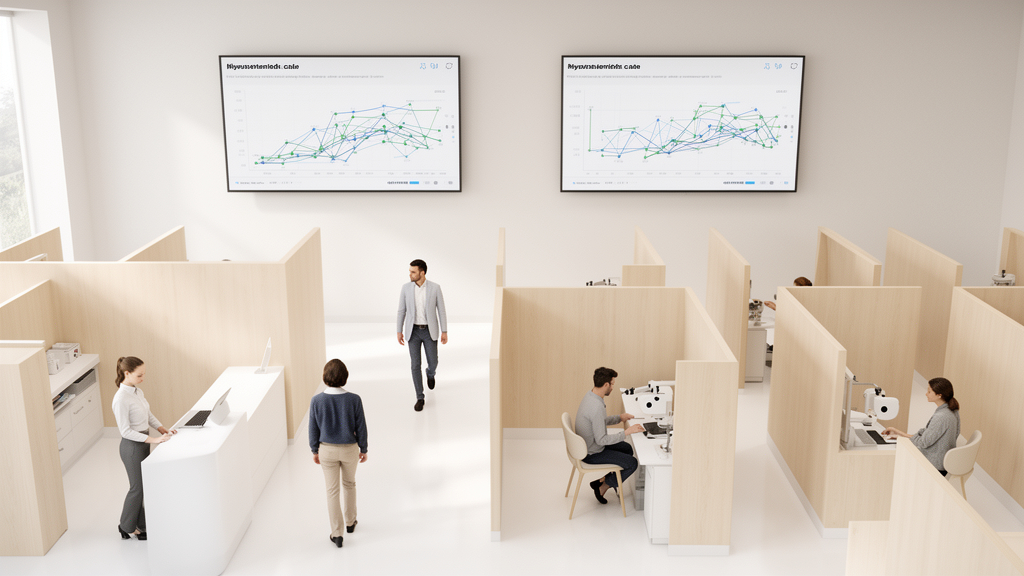
Patient-flow data can identify which services in an eye outpatient clinic are closely connected and translate those relationships into candidate building layouts. A study in one specialist eye clinic within a public hospital analyzed patient visits to quantify movement patterns and interaction frequencies among service stations. The researchers converted the findings into a weighted adjacency matrix, constructed a maximal planar graph with a modified greedy heuristic algorithm and produced two block-layout concepts informed by clinical and operational input from the hospital team.
Eye outpatient visits can involve multiple sequential diagnostic tests, making the connections among examination, testing, consultation and discharge stations central to the facility-planning problem. The authors noted that inefficient layouts can increase patient fatigue, staff workload and safety risks, while data-driven approaches for outpatient clinic layout planning remain limited. Their framework was designed to retain evidence from observed patient journeys while allowing hospital personnel to impose functional requirements on the resulting spatial concepts.
Technically, the weighted adjacency matrix represented interaction frequencies between service stations as weighted connections. From this matrix, the team constructed a maximal planar graph using a modified greedy heuristic algorithm to approximate optimal spatial connectivity. The planar structure was then converted into block layouts that accounted for both workflow relationships and practical design constraints.
Clinical and operational input from the hospital team was incorporated to ensure that the candidate arrangements remained functionally relevant rather than being products of the mathematical representation alone. Analysis of patient flows revealed strong connectivity among stations involved in visual assessment, diagnostic testing, consultation and discharge. These linked services shaped two alternative concepts.
The first used a linear, sequential configuration intended for clinics with existing structural constraints. The second used a centralized consultation-core design for new facilities, emphasizing connectivity, flexibility and efficient patient circulation. Both concepts were based on real patient journeys and refined through stakeholder engagement, but they remained planning designs rather than validated geometric floor plans.
The work demonstrates how patient-flow records can inform adjacency decisions during outpatient facility planning, but its evidence base is limited to a framework applied in a single specialist eye clinic. The proposed layouts were not presented as tested interventions, and the supplied findings do not establish operational performance after construction or construction. The authors described the approach as potentially adaptable to other outpatient settings where patients require multiple sequential investigations, while emphasizing that the immediate outputs were stakeholder-informed planning concepts.
Whether either concept improves patient flow, staff workload, safety or patient experience would require evaluation beyond the reported graph-based design process.
Subject of Research: Graph-based facility-layout planning using patient-flow data in an eye outpatient clinic
Article Title: Designing eye outpatient clinics using patient flow data: a graph-theoretic framework for facility layout planning
Article References: Meng, F., Agrawal, R., Teow, K. L., Lim, M. L., Quek, L. Y., Jin, X., Chiang, G., & Abisheganaden, J. A. (2026). Designing eye outpatient clinics using patient flow data: a graph-theoretic framework for facility layout planning. BMC Health Services Research. https://doi.org/10.1186/s12913-026-15872-6
Image Credits: AI Generated
DOI: 10.1186/s12913-026-15872-6
Keywords: patient flow, eye outpatient care, facility layout, graph theory, weighted adjacency matrix, planar graphs, healthcare design, service stations, outpatient clinics, stakeholder input, Designing, outpatient
News Source: Ophelia Keating. (October 21, 2026). Patient-flow data guides two conceptual layouts in one eye clinic. Scienmag.