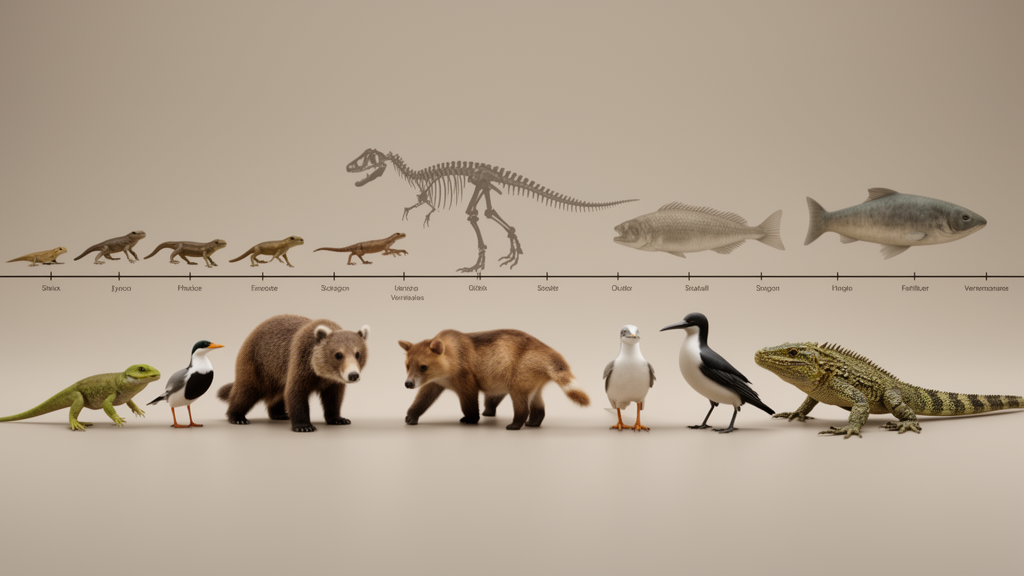
Global patterns of terrestrial vertebrate diversity appear to be shaped far more by present-day conditions than by the deep history of biome change, according to a new reconstruction of ecosystems across the entire Cenozoic era, the 66-million-year stretch since the dinosaurs’ extinction.
Scientists have long debated whether the size of biomes through geological time leaves a lasting imprint on biodiversity, or whether species richness instead tracks current climate and energy availability so quickly that historical dynamics fade away. Testing these competing hypotheses has been difficult because fossil and geological proxy records are sparse, and existing paleoclimate models are too coarse to resolve biome boundaries reliably.
To overcome this, the research team reconstructed global biome histories for the whole Cenozoic by downscaling five different paleoclimate simulations to fine spatial resolution. Their estimates of how biome areas expanded and contracted over time were broadly consistent across the alternative climate models and matched the empirical proxy record, giving them confidence in the reconstructions.
When the researchers compared predictors of vertebrate diversity, present-day biome area and energy consistently outperformed historical measures, even after accounting for variation among the different climate models. In other words, today’s species-rich regions are best explained by the ecological limits set by today’s environments rather than by the accumulated legacy of ancient biome dynamics.
The findings suggest that biodiversity responds rapidly enough to environmental change that shifting biomes of the past leave only a sparse signature in modern diversity patterns. The authors emphasize that integrating multiple paleoclimate reconstructions, rather than relying on a single simulation, is essential for rigorously assessing the historical drivers of biodiversity, because conclusions about past ecosystem change hold up best when alternative models agree.
Subject of Research: Cenozoic paleobiome reconstructions and their weak legacy in global terrestrial vertebrate diversity
Article Title: High-resolution paleobiome reconstructions highlight ecological and historical dynamics underpinning global terrestrial vertebrate diversity
Article References: Skeels, A., Rogger, J., Cardillo, M., Farnsworth, A., Lunt, D. J., & Karger, D. N. (2026). High-resolution paleobiome reconstructions highlight ecological and historical dynamics underpinning global terrestrial vertebrate diversity. PLOS Biology, 24(10), e3004077. https://doi.org/10.1371/journal.pbio.3004077
Image Credits: AI Generated
DOI: 10.1371/journal.pbio.3004077
Keywords: paleobiomes, Cenozoic, vertebrate diversity, paleoclimate models, biodiversity, biome area, climate change, macroecology, downscaling, historical biogeography, High-resolution, paleobiome
News Source: Drew Townsend. (October 23, 2026). Past Biome Shifts Leave Little Mark on Today’s Vertebrate Diversity. Scienmag.