• HOME
  • NEWS
  • EXPLORE
    • CAREER
      • Companies
      • Jobs
    • EVENTS
    • iGEM
      • News
      • Team
    • PHOTOS
    • VIDEO
    • WIKI
  • BLOG
  • COMMUNITY
    • FACEBOOK
    • INSTAGRAM
    • TWITTER
Friday, January 16, 2026
BIOENGINEER.ORG
No Result
View All Result
  • Login
  • HOME
  • NEWS
  • EXPLORE
    • CAREER
      • Companies
      • Jobs
        • Lecturer
        • PhD Studentship
        • Postdoc
        • Research Assistant
    • EVENTS
    • iGEM
      • News
      • Team
    • PHOTOS
    • VIDEO
    • WIKI
  • BLOG
  • COMMUNITY
    • FACEBOOK
    • INSTAGRAM
    • TWITTER
  • HOME
  • NEWS
  • EXPLORE
    • CAREER
      • Companies
      • Jobs
        • Lecturer
        • PhD Studentship
        • Postdoc
        • Research Assistant
    • EVENTS
    • iGEM
      • News
      • Team
    • PHOTOS
    • VIDEO
    • WIKI
  • BLOG
  • COMMUNITY
    • FACEBOOK
    • INSTAGRAM
    • TWITTER
No Result
View All Result
Bioengineer.org
No Result
View All Result
Home NEWS Science News

Paris Agreement target critical for preserving fisheries

Bioengineer by Bioengineer
December 22, 2016
in Science News
Reading Time: 2 mins read
0
Share on FacebookShare on TwitterShare on LinkedinShare on RedditShare on Telegram
IMAGE

Credit: Lindsay Lafreniere

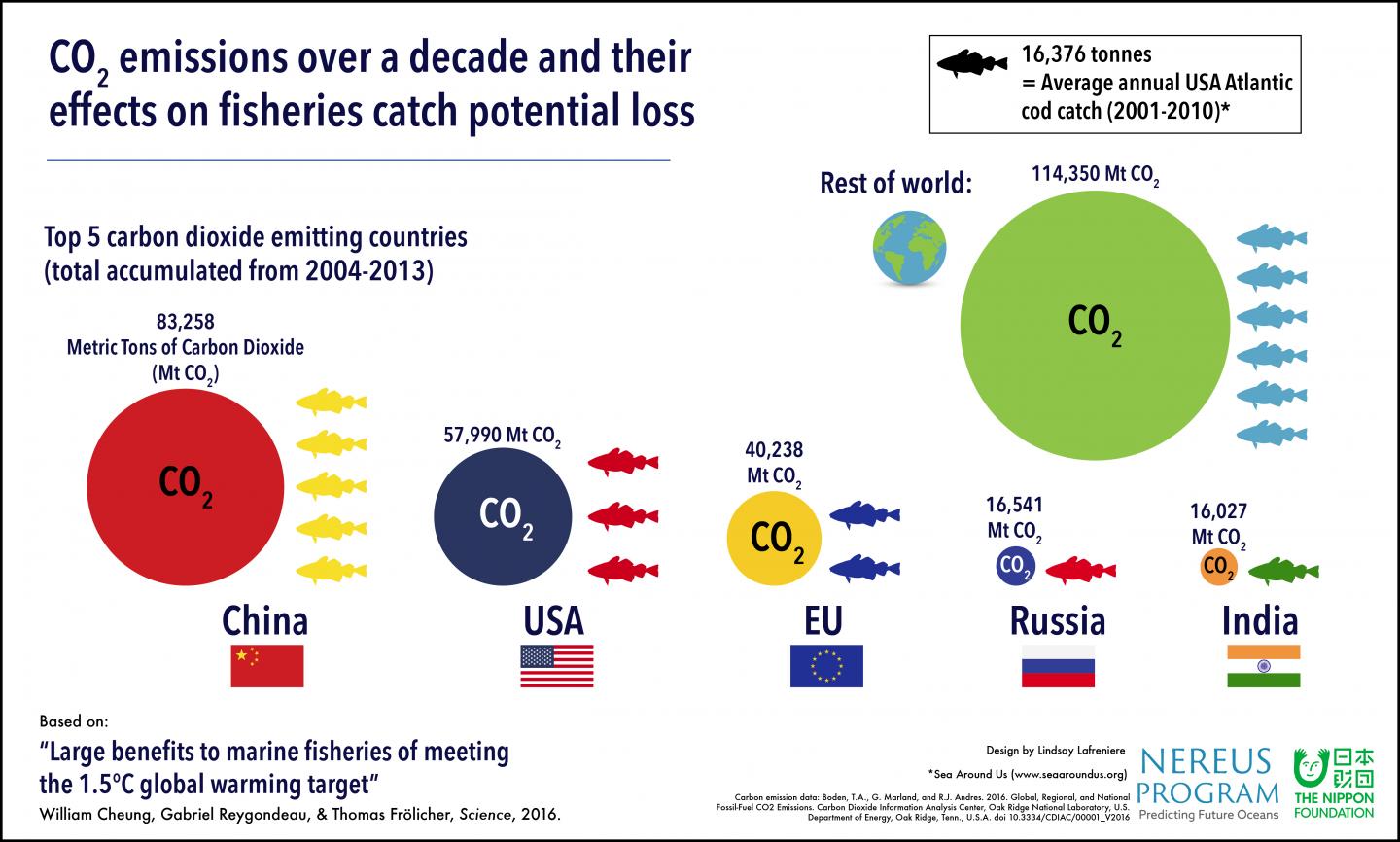
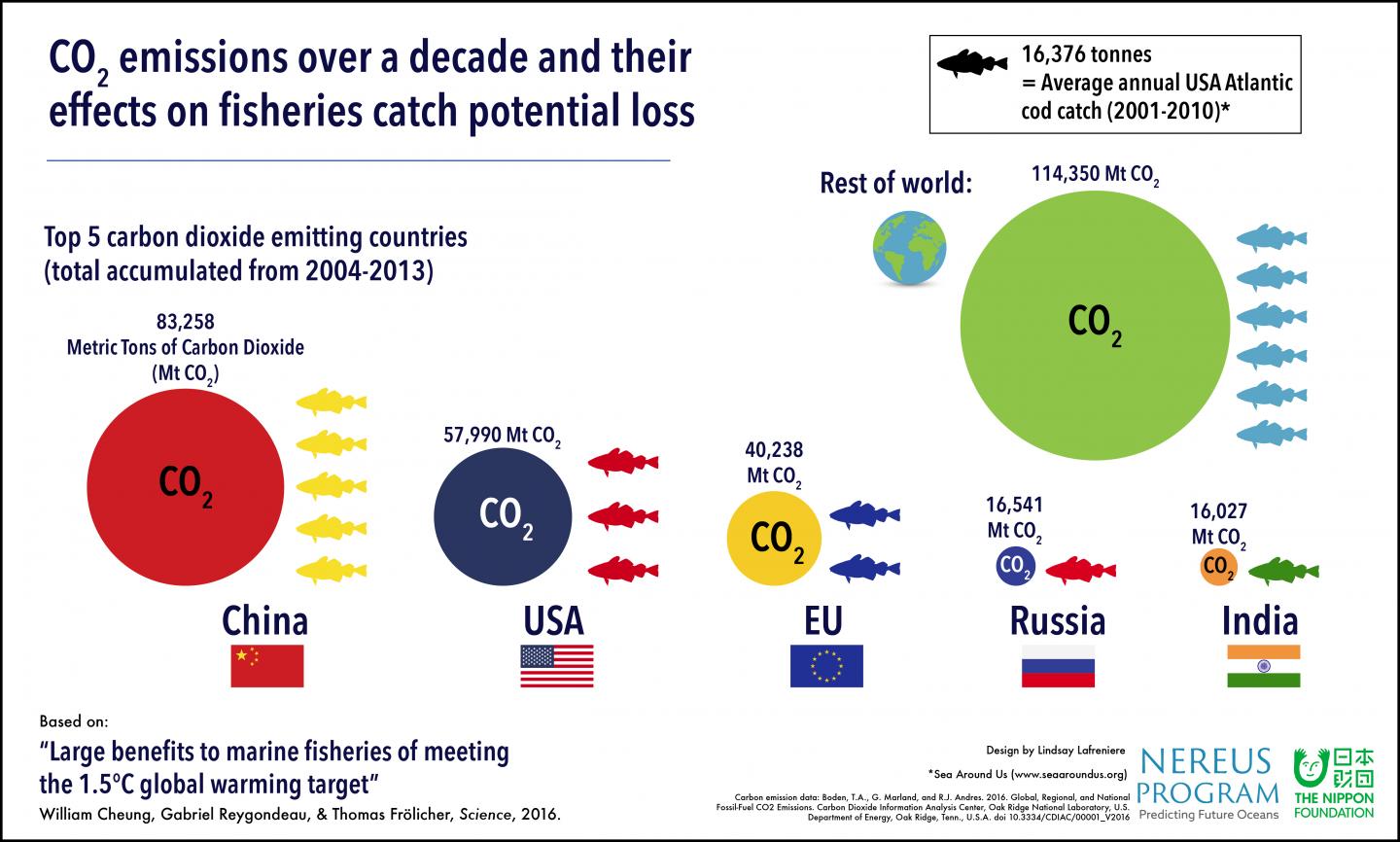
Limiting temperature increases to 1.5°C over pre-industrial levels, as outlined in the Paris Agreement, will significantly minimize the impact of global warming on the catch potential of marine ecosystems and limit the turnover of harvested species, a new study reports. The results highlight the urgent need for the global community to adhere to the recommended target of 1.5°C, since hitting temperature increases of 3.5°C could result in an additional three-fold decline in marine biomass for the fishing industry. To better understand how different warming scenarios will impact marine ecosystems, William Cheung and colleagues analyzed data from 19 Earth system models, testing responses to situations where strong mitigation efforts are applied, or high emissions scenarios continue into the future. They applied their model to 892 species of exploited marine fishes and invertebrates. The results estimate that a warming increase of 3.5°C will decrease the maximum catch potential on a global level by 8%, compared to temperature increases of 1.5°C that will decrease maximum catch potential by 2.5%. Some regions will be hit significantly harder under the more dramatic warming condition, however; for example, the maximum catch potential may decrease as much as 47% in the Indo-Pacific region, which includes the Bay of Bengal, Gulf of Thailand, South China Sea, and Sulu-Celebes Sea. Species turnover can also vary depending on global temperatures changes, where, under 3.5°C increase conditions, species turnover is projected to be about 22% of the average species richness observed between 1950 and 1969, compared to 8% if warming is restricted to 1.5°C. The authors also highlight other region-specific projections. They note a few assumptions in their model, but emphasize that these, if anything, mean that their projections are an underestimation. A Perspective by Elizabeth A. Fulton discusses these results in greater detail.

###

Media Contact

Science Press Package
[email protected]
202-326-6440
@AAAS

http://www.aaas.org

############

Story Source: Materials provided by Scienmag

Share12Tweet8Share2ShareShareShare2

Related Posts

Multi-Omics Reveal Cuproptosis Genes in Parkinson’s

January 16, 2026
Robust Phase Sensing with Nonlinear PT-Symmetric System

Robust Phase Sensing with Nonlinear PT-Symmetric System

January 16, 2026

Fathers’ Attitudes Influence Parenting of Disabled Children

January 16, 2026

Central Amygdala’s Role in Stress Relief Sex Differences

January 16, 2026
Please login to join discussion

POPULAR NEWS

  • Enhancing Spiritual Care Education in Nursing Programs

    155 shares
    Share 62 Tweet 39
  • PTSD, Depression, Anxiety in Childhood Cancer Survivors, Parents

    147 shares
    Share 59 Tweet 37
  • Robotic Ureteral Reconstruction: A Novel Approach

    77 shares
    Share 31 Tweet 19
  • Study Reveals Lipid Accumulation in ME/CFS Cells

    54 shares
    Share 22 Tweet 14

About

We bring you the latest biotechnology news from best research centers and universities around the world. Check our website.

Follow us

Recent News

Multi-Omics Reveal Cuproptosis Genes in Parkinson’s

Robust Phase Sensing with Nonlinear PT-Symmetric System

Fathers’ Attitudes Influence Parenting of Disabled Children

Subscribe to Blog via Email

Enter your email address to subscribe to this blog and receive notifications of new posts by email.

Join 71 other subscribers
  • Contact Us

Bioengineer.org © Copyright 2023 All Rights Reserved.

Welcome Back!

Login to your account below

Forgotten Password?

Retrieve your password

Please enter your username or email address to reset your password.

Log In
No Result
View All Result
  • Homepages
    • Home Page 1
    • Home Page 2
  • News
  • National
  • Business
  • Health
  • Lifestyle
  • Science

Bioengineer.org © Copyright 2023 All Rights Reserved.