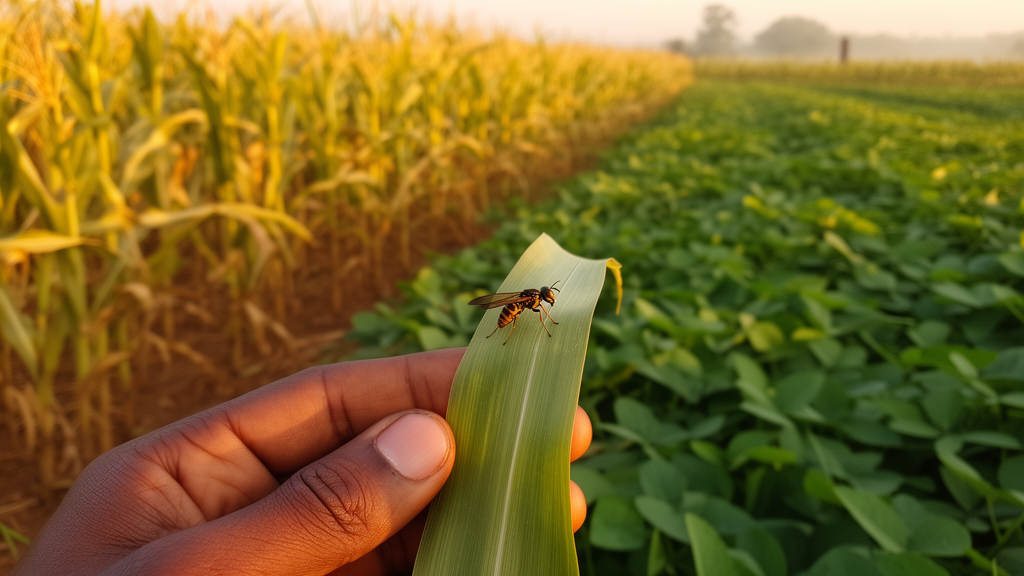
Fall armyworm, the voracious caterpillar that has become one of the most destructive pests of maize worldwide, can be pushed back by combining an egg-parasitizing wasp with a simple change in cropping layout. A new field study from Nigeria reports that releasing the parasitoid wasp Telenomus remus in maize fields intercropped with cowpea cut fall armyworm damage severity nearly in half compared with untreated sole maize, and lifted yield by up to 59 percent relative to untreated controls. The work, published in the Egyptian Journal of Biological Pest Control, was carried out at the University Teaching and Research Farm in the derived savanna agro-ecological zone of Nigeria, at latitude 8.15 degrees N and longitude 6.02 degrees E, an area with bimodal rainfall beginning in April and running through October.
The research team, led by Abiodun Joseph with colleagues including Shakiru Adewale Kazeem, Favour Emoshioke Jonathan, Favour Fadipe-Joseph and Adebukola Adewumi Elizabeth, set out to address a persistent gap. Although the efficacy of Telenomus remus against fall armyworm had previously been evaluated under laboratory conditions in Nigeria, the authors note there has been a dearth of knowledge on the use of this parasitoid in the field. Their experiment therefore tested the wasp not in isolation but in combination with two cropping systems: maize grown alone and maize intercropped with one of two cowpea varieties, Sweet beans and Sokoto white.
Fall armyworm, Spodoptera frugiperda, is difficult to control for well-documented reasons: it has high reproductive capacity, a wide host range, high migratory ability and adaptability to a wide range of temperatures. Its larval stage is the most destructive, feeding on young leaves, leaf whorls, tassels and cobs. The larvae feed voraciously on leaves at night and hide in the joints between leaves, stem and whorl during the day. Damage results in stunted growth, reduced stem diameter and decreased cob number and grain weight, and infestations have been estimated to reduce maize yields by 50 to 80 percent. Chemical control with synthetic insecticides has not proven fully effective, owing to the development of resistance and the broader problems associated with chemical pesticides, which is why the authors argue for effective and environmentally friendly alternatives.
Telenomus remus, a tiny scelionid wasp, attacks fall armyworm at its most vulnerable stage. The female lays her eggs inside the eggs of the moth; the wasp larvae then hatch inside the host egg and consume the developing fall armyworm embryo. The species has been reported to reduce fall armyworm populations by 49 to 100 percent, and the authors describe it as the primary parasitoid for control of the pest. Because biocontrol agents are cost effective and generally harmless to human health, the environment and non-target organisms, the authors consider them a preferred approach to managing the caterpillar.
The field experiment was laid out in a split-plot randomized complete block design with three replications on a 400 square meter area that had a previous history of fall armyworm. The cropping system served as the main plot factor and the fall armyworm control measure as the sub-plot factor, generating nine treatments: sole maize or maize intercropped with either cowpea variety, each combined with Telenomus remus release, with the synthetic insecticide cypermethrin, or with a water control. Maize of the Sammaz 52 variety was sown at an intra- and inter-row spacing of 25 and 75 centimeters, while cowpea was sown at 20 by 75 centimeters. Poultry manure, cured and mineralized for three weeks, was incorporated at 20 tonnes per hectare. Perimeter plantings of FUAMPEA 1 beans, established six weeks before sowing, ringed each plot to prevent inter-plot spread of insects.
The parasitoid was delivered in a practical augmentation format. Four cards, each measuring 12 by 6 centimeters and containing approximately 50 egg masses of roughly 200 eggs, were obtained from the Entomology Laboratory of the Nigerian Agricultural Quarantine Service in Ibadan. The cards were released at 2, 4 and 6 weeks after sowing by hanging the envelopes on maize plants at the center of each plot, installed at mid-height of the maize stem, with releases done early in the morning. Cypermethrin, by contrast, was sprayed manually at weekly intervals at the recommended rate of 24 milliliters per 12 liters of water.
Data collection focused on eight tagged plants in each row of every plot, with fall armyworm incidence and severity assessed at 3, 5 and 7 weeks after planting. Incidence was estimated by counting visibly infested plants as a percentage of all plants observed. Severity was scored on the standard nine-point scale of Prasanna and colleagues, which runs from no visible leaf-feeding damage at score 1, through pinholes and shot-hole injuries on increasing numbers of leaves, to elongated lesions longer than 2.5 centimeters and, at the extreme score 9, whorl and furl leaves almost totally destroyed and the plant dying from extensive foliar damage. Yield parameters included the number of cobs per plot, cob weight, grain weight expressed on a per-hectare basis, and percentage yield increase calculated relative to the control plot. All data were subjected to analysis of variance, with treatment means separated using the Duncan multiple range test at the 5 percent probability level.
The results were consistent across the season. At 3 weeks after planting, untreated sole maize plots recorded the highest fall armyworm severity at 57.48 percent, while the lowest severity occurred in the intercropped, wasp-released plots: 28.99 percent with the Sweet beans cowpea variety and 31.26 percent with Sokoto white. The pattern held at 5 weeks, when severity reached 60.58 percent in untreated sole maize against 15.86 and 20.56 percent in the two wasp-released intercrops, and again at 7 weeks, when untreated sole maize hit 66.05 percent while the intercropped release plots fell to 11.48 and 14.15 percent. Incidence followed the same trajectory, rising from 72.28 percent in untreated sole maize at 3 weeks to 81.03 percent at 7 weeks, while the intercropped release plots dropped from 35.29 and 41.37 percent at 3 weeks to 15.90 and 19.41 percent at 7 weeks. Notably, the interaction between cropping system and control measure was not statistically significant for incidence and severity, although both main effects were significant across all three assessment dates.
The yield data told a parallel story. The highest number of cobs was recorded in the wasp-released intercrops, with 15.33 cobs per plot in the Sokoto white combination and 17.00 in the Sweet beans combination, against lows of 8.33 in untreated sole maize and 9.00 in insecticide-treated sole maize. Cob weight peaked at 2.56 kilograms in the Sweet beans intercrop with wasp release and 2.44 kilograms with Sokoto white, compared with 1.27 kilograms in untreated sole maize. Grain weight was highest in the wasp-released intercrops at 1.97 and 1.73 kilograms, versus 1.13 kilograms in untreated sole maize. Yield increase reached 59 percent in the Sokoto white intercrop with wasp release and 54 percent with Sweet beans, figures not significantly different from the 42 percent achieved with Sokoto white intercropping plus cypermethrin. The lowest yield increase, 9 percent, occurred in insecticide-treated sole maize, which was not significantly different from the control plots at 0 percent, the Sweet beans intercrop with insecticide at 26 percent, or wasp-released sole maize at 25 percent. Statistically, the cropping system main effect was significant for cob number, cob weight and grain weight but not for yield increase; the control measure main effect was significant for cob number, grain weight and yield increase but not cob weight; and the interaction was significant only for grain weight.
The authors attribute the pattern to two complementary mechanisms. In the wasp-released plots, high parasitization of fall armyworm eggs suppresses the pest before larvae emerge to cause damage, lowering both incidence and severity and preserving cobs, cob weight and grain filling. The intercrop adds its own contribution: cowpea retains the parasitoid in the field and provides nectar and shelter, enhancing the survival, longevity and retention of adult wasps, while the physical presence of the legume creates a barrier that impairs larval spread, disrupts the flight of adult moths and restricts oviposition and feeding on maize. The findings are consistent with earlier work the authors cite, including reports of higher fall armyworm incidence and severity in sole maize than in maize-cowpea intercrops, and of significant yield gains from parasitoid releases. The team concludes that integrating Telenomus remus releases with maize-cowpea intercropping is an effective and sustainable strategy for fall armyworm management and improved maize productivity, while noting a limitation: because the study focused on cowpea, similar trials with other legumes such as soybean, groundnut, mungbean, peanut and Bambara groundnut are needed.
Subject of Research: A field trial in Nigeria testing Telenomus remus wasp releases and maize-cowpea intercropping against fall armyworm damage and maize yield
Article Title: Severity of the fall armyworm, Spodoptera frugiperda (J. E. Smith) (Lepidoptera: Noctuidae) damage and maize yield as influenced by Telenomus remus (Nixon) (Hymenoptera: Scelionidae) under sole maize and maize-cowpea intercrop in Southern Guinea Savanna, Nigeria
Article References: Joseph, A., Kazeem, S. A., Jonathan, F. E., Fadipe-Joseph, F., & Adewumi Elizabeth, A. (2026). Severity of the fall armyworm, Spodoptera frugiperda (J. E. Smith) (Lepidoptera: Noctuidae) damage and maize yield as influenced by Telenomus remus (Nixon) (Hymenoptera: Scelionidae) under sole maize and maize-cowpea intercrop in Southern Guinea Savanna, Nigeria. Egyptian Journal of Biological Pest Control, 36(1), Article 34. https://doi.org/10.1186/s41938-026-00912-4
Image Credits: AI Generated
DOI: 10.1186/s41938-026-00912-4
Keywords: fall armyworm, Spodoptera frugiperda, Telenomus remus, biological control, maize, cowpea, intercropping, Nigeria, egg parasitoid, crop yield, pest management, agriculture
News Source: Alan Morgan. (October 27, 2026). Parasitoid wasp plus cowpea intercropping curbs fall armyworm in Nigerian maize. Scienmag.