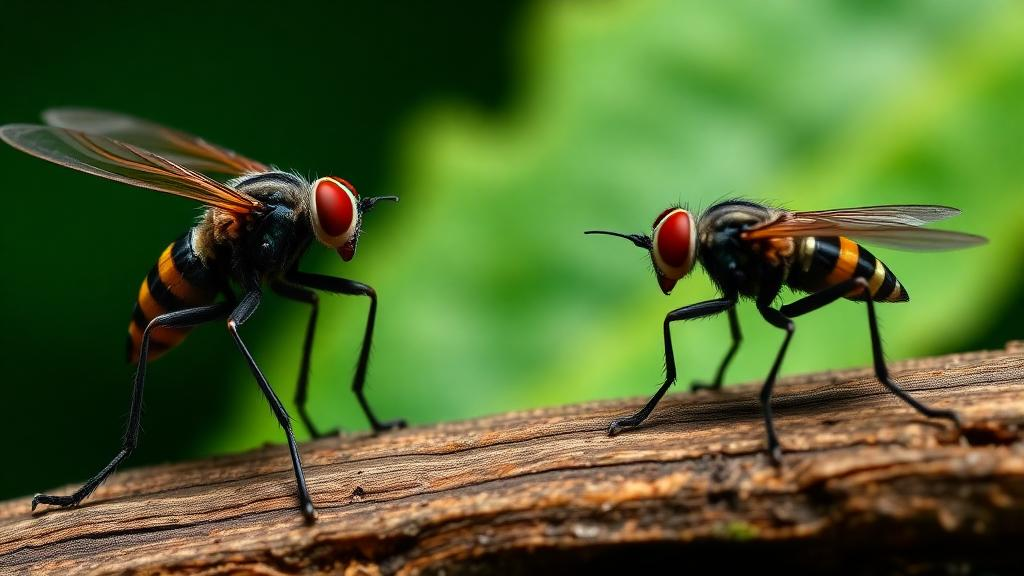
In the fading light of dusk, a pregnant female Ormia ochracea fly faces one of the most consequential decisions of her short life. She must listen for the mating call of a male cricket, navigate toward it in near darkness, and deposit her larvae on or near him so that her offspring can develop using him as a host. But before she commits to a flight path, she has to decide whether the song drifting through the air is actually worth chasing. New research from St. Olaf College, published in the Journal of Experimental Biology, shows that this decision is far more sophisticated than scientists had assumed, revealing that a fly with one of the smallest auditory systems ever studied evaluates cricket songs in a strikingly multidimensional way.
For decades, researchers studying acoustic communication have often worked from a deceptively simple assumption: that animals tuned to a particular sound recognize it primarily by its pulse rate, the number of discrete sound pulses arriving each second. Cricket songs, after all, sound like rhythmic chirps, and pulse rate has frequently been treated as the defining signature of a species’ call. The new study, led by Lauren Bitner, a postbaccalaureate research associate in the Lee Lab of Neural Systems and Behavior at St. Olaf College, upends that assumption for Ormia ochracea. The flies, the research found, do not simply recognize attractive cricket songs based on their beat. Instead, they evaluate multiple aspects of a song’s temporal features, and two songs with exactly the same pulse rate can produce dramatically different responses.
“Two songs can have exactly the same pulse rate but mean very different things to the fly,” Bitner explained. “What matters isn’t just how quickly the sound pulses repeat, but how the fly pays attention to the way the rhythm is constructed.” That distinction may sound subtle, but it carries profound implications for how scientists think about sensory recognition, not only in insects but in nervous systems of every size. If a fly with a brain containing a relatively small number of neurons can integrate several features of a signal simultaneously, then the neural machinery for complex acoustic decisions may be more accessible to study than anyone imagined.
The key insight behind the experimental design lies in the structure of cricket song itself. A cricket’s call may sound simple, but its rhythm can be composed in many different ways. Every song consists of sound pulses separated by periods of silence, and a given pulse rate can therefore be produced in more than one manner: by short pulses separated by longer silences, or by longer pulses separated by shorter silences. The total number of pulses per second is identical in both cases, yet the internal architecture of the rhythm, the specific balance of sound and silence, differs completely. This ambiguity is precisely what allowed the researchers to test whether pulse rate alone governs the fly’s preferences.
Bitner and her colleagues took advantage of this distinction by constructing artificial cricket songs in which they could independently vary the duration of the sound pulses and the duration of the silences between them. This decoupling is the methodological heart of the study. By holding pulse rate constant while manipulating pulse duration and inter-pulse interval, the team could ask whether the flies responded to the beat alone or to something richer in the song’s temporal construction. They then presented these carefully engineered songs to pregnant female Ormia ochracea and measured how strongly the flies responded, using their attraction as a readout of recognition.
The results revealed a striking pattern. Pulse rate did predict some of the flies’ behavior, but it could not fully explain which songs they preferred. Songs sharing the same pulse rate sometimes elicited very different responses depending on the specific combination of sound and silence they contained. The female flies were most attracted to cricket songs presenting a particular combination of sound pulses and pauses, a configuration that evidently matched the template they use to identify a suitable host. Rather than listening for a single magic number of pulses per second, the flies appear to recognize relevant cricket songs based on combinations of temporal features, weighing the rhythm’s construction as a whole rather than reducing it to one number.
The stakes of getting this decision right could hardly be higher for the fly. Ormia ochracea has evolved a remarkably sensitive auditory system that allows it to eavesdrop on the communication signals of crickets and locate a suitable host for its larval young. But not every sound in the environment leads to an appropriate host cricket. A wrong choice means wasted reproductive effort, or worse, larvae deposited where they cannot develop. Correctly identifying the right song therefore has direct consequences for reproduction, and natural selection has presumably shaped the fly’s recognition rules with considerable precision. The new findings suggest that these flies solve the recognition problem by considering several features of a signal at once, and that even their small, relatively simple nervous system can process this information in a combined way.
“It’s tempting to imagine that a tiny fly with a tiny nervous system must use a very simple rule,” said senior author Norman Lee, an associate professor of biology and director of the Neuroscience Program at St. Olaf College. “What we’re finding is that these flies may be integrating multiple pieces of information when deciding which sounds to pursue.” Lee’s laboratory studies how animals sense, process, and respond to the world around them, with a particular focus on acoustic communication, and he leads an undergraduate research team that collaborates with biologists across the United States and Canada. The work was supported by a National Science Foundation CAREER grant, an award that recognizes early-career scientists pursuing ambitious research programs with strong educational integration.
The discovery also opens a series of compelling questions for future research. One concerns neurobiology: where in the fly’s nervous system does this song selectivity or recognition actually arise? Ormia ochracea is famous among neuroscientists for its ears, which sit on the front of its body and are mechanically coupled in a way that allows the fly to localize sound with extraordinary accuracy despite its tiny size, making it a model system for studying directional hearing. Understanding where multidimensional song recognition emerges in its compact nervous system could illuminate how small circuits perform computations that were once assumed to require far more neural hardware. Another question concerns geography and evolution. Ormia ochracea is found in several places in the continental United States and in Hawaii, and in each of these populations the flies may parasitize different host cricket species whose calling songs have drastically different temporal structures. What temporal features might these other populations be assessing to recognize their own hosts? Comparing populations could reveal how recognition templates evolve when the acoustic landscape shifts.
Ultimately, the research addresses a problem much broader than how one fly recognizes one cricket. Animals are constantly bombarded with sights, sounds, and smells, and they must continuously decide which of those signals matter enough to act upon. Those signals are rarely defined by a single feature; more often, meaning is distributed across combinations of attributes that must be detected together. Understanding how Ormia ochracea combines information across a cricket song therefore provides a window into a fundamental problem faced by nervous systems of all sizes, from a fly weighing milligrams to a human being: how the brain turns complex sensory information into a decision about what to do next. For a pregnant fly listening in the dark, that decision determines whether her offspring survive. For scientists, the same computation, performed by one of nature’s smallest listeners, offers a powerful and experimentally tractable model for one of neuroscience’s deepest questions.
Subject of Research: Multidimensional temporal song recognition in the parasitoid fly Ormia ochracea
Article Title: To find a host cricket, this parasitic fly listens to more than the beat
Article References: To find a host cricket, this parasitic fly listens to more than the beat. (n.d.). Original publication
Image Credits: AI Generated
DOI: Not provided
Keywords: Ormia ochracea, parasitic fly, cricket song, acoustic communication, pulse rate, temporal features, auditory system, song recognition, Journal of Experimental Biology, neuroscience, host localization, sensory decision-making
News Source: Gavin Prescott. (October 12, 2026). Parasitic fly judges cricket songs by rhythm structure, not just pulse rate. Scienmag.