Credit: Jorge Aleman_STRI
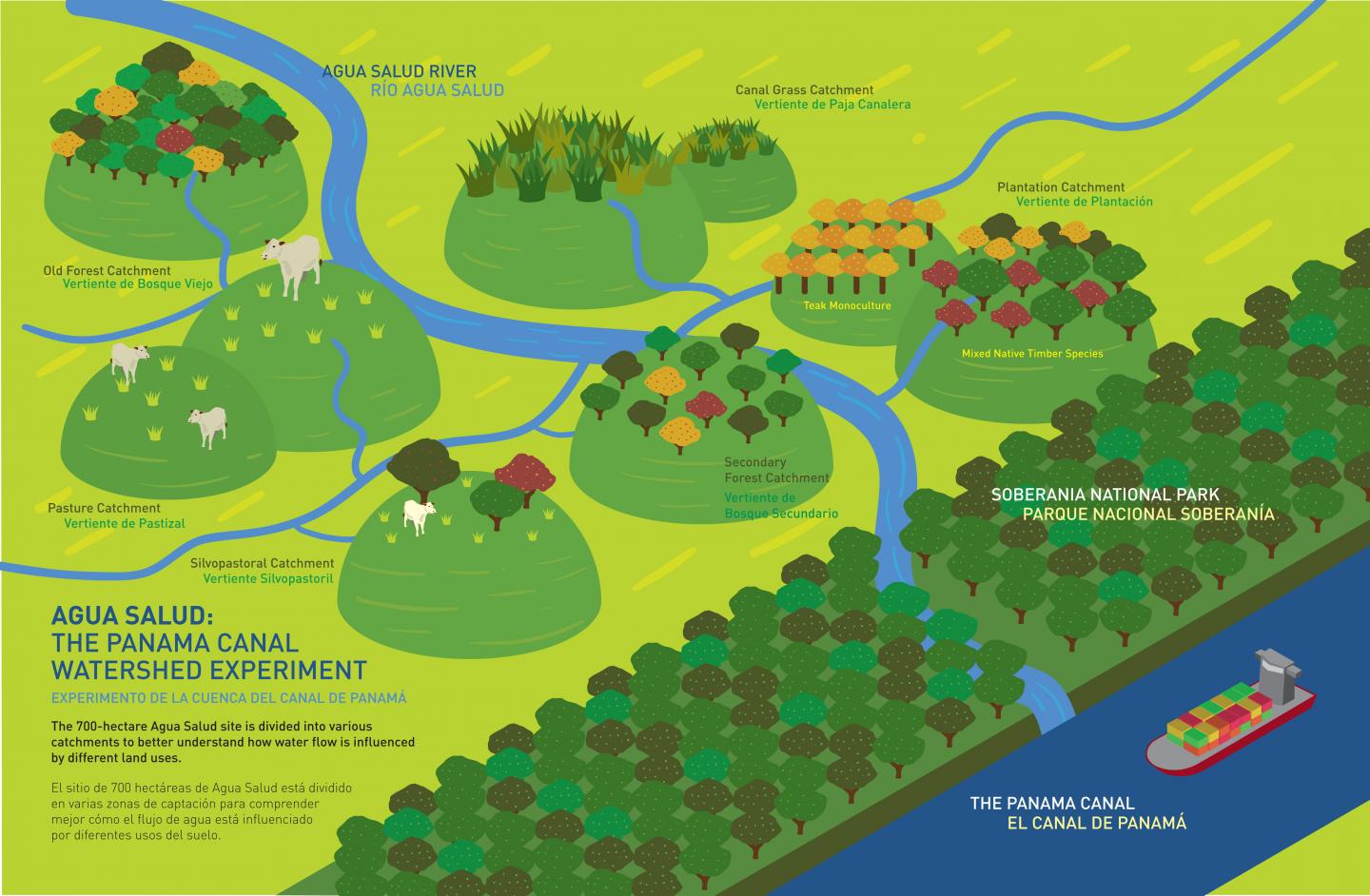
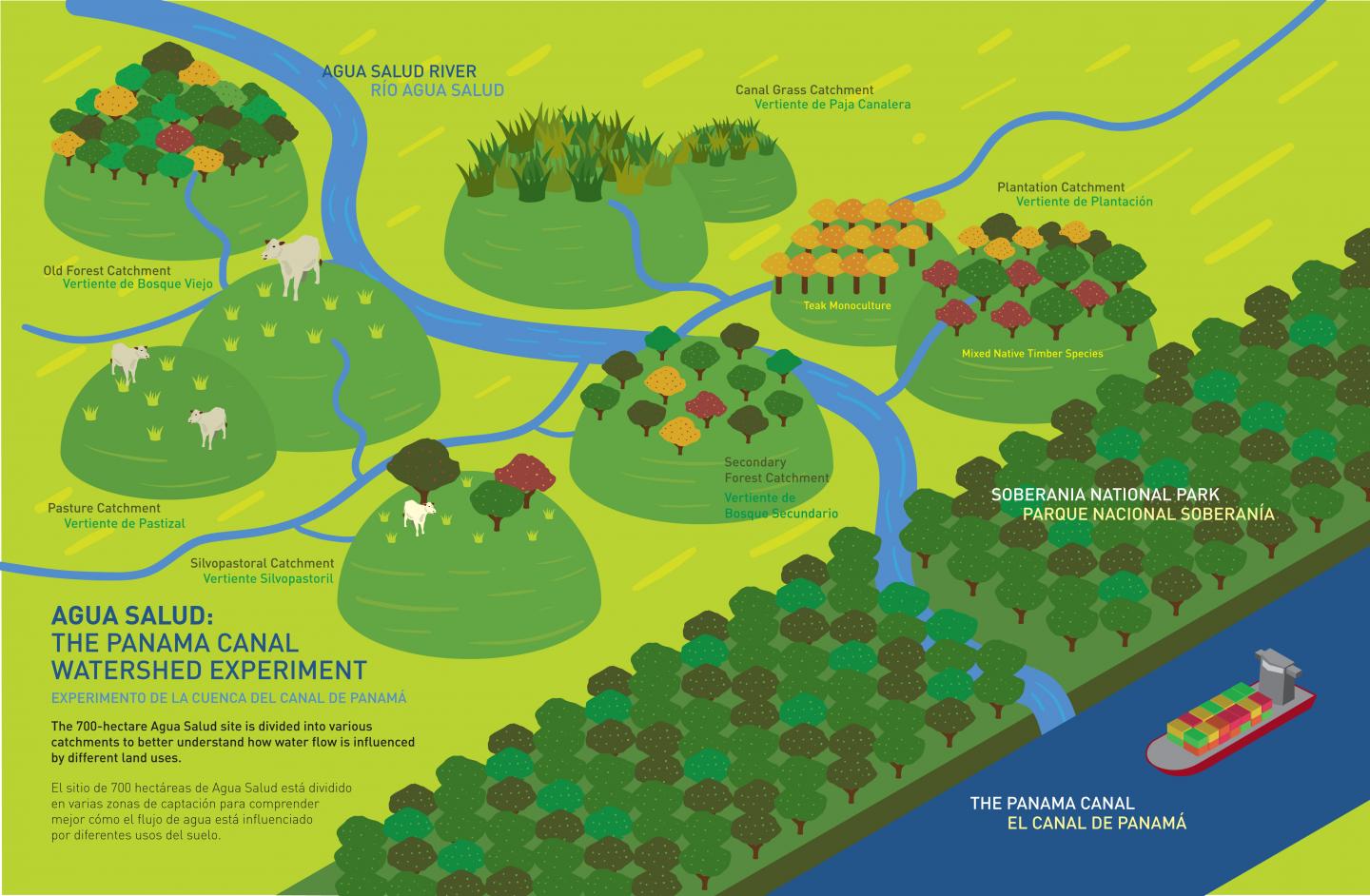
Teak, the most valuable species for tropical reforestation, often performs poorly in the acid soils of steeply sloping land in the tropics. As human population skyrockets and land becomes a scarce resource, balancing tradeoffs between reforestation, conservation, water availability and carbon storage becomes paramount. In a recent publication from the Smart Reforestation Program, Smithsonian scientists and collaborators including the Panama Canal Authority confirm that native tree species performed very well in field trials and would be preferable to teak in this situation.
"The take-home message of this experiment is that if you want to reforest to maximize timber harvest on poor, acidic soils in the Panama Canal watershed, plant Amarillo (Terminalia amazonia)," said Carolina Mayoral, post-doctoral fellow at the Smithsonian Tropical Research Institute (STRI) in Panama and first author of the paper. "It's spectacular. It grows amazingly fast and the trunks are straight and have excellent timber value. It accumulates biomass much faster than teak in these soils."
In 2008, scientists planted five native species, Anacardium excelsum, Dalbergia retusa, Pachira quinata, Tabebuia rosea and T. amazonia, in single-species plots and also in mixtures with each other and with companion species. In all, they tested 21 different land-use options. For the next seven years, they measured the height and basal diameter of more than 22,000 trees each year and calculated the biomass of the trees in each of the treatments.
The companion species, Erythrina fusca, Glircidia sepium, Inga punctate, Luehea speciose and Ochroma pyrimidale, were chosen because they contribute nutrients, provide shade or otherwise improve growth in combination with timber species. By planting a fast-growing timber species with a species that provides nitrogen that it captures from the air (a nitrogen-fixing species), for example, this natural fertilization effect may result in greater growth.
"The first major result of this experiment was that the trees survived: on average, about 95 percent of the seedlings we planted were still there seven years later," Mayoral said.
Amarillo outperformed all of the other species in growth trials. After only seven years, Amarillo trees were more than 9 meters tall and 14 centimeters in diameter at the base and had a biomass of 47.1 tons per hectare when grown in monoculture, compared to 14.9 tons for Dalbergia, 14.2 tons for Anacardium (Espave) and 4.4 tons for Pachira and 3.6 tons for Tabebuia (Roble). From a scientific point of view, it was also interesting that Dalbergia, which fixes nitrogen, and Pachira grown together performed much better than either when grown alone.
Currently, the area planted in teak, Tectona grandis, in Central America is estimated to be almost 133,000 hectares of which 55,000 are planted in Panama. Teak represents 76 percent of the plantations established in Panama between 1992 and 2000, according to the Food and Agriculture Organization (FAO). It does not perform well in infertile, acidic soils.
"We're very pleased to see that native species are a viable alternative to teak for reforestation in these poor soils," said Jefferson Hall, STRI scientist and director of the Agua Salud project. "The unknown is still the pricing structure for these native hardwoods."
"Amarillo has excellent timber quality," Hall said. "It may not be quite as pretty as teak, but it can be painted and it very long-lasting. Cocobolo [D. retusa] is perhaps even more beautiful than teak and is traditionally used for decorative woodwork and rosewood sculptures. High demand has caused the price to double, and there are reports that Dalbergia can be sold for more than $5,000 per cubic meter, almost 10 times the market price of the highest quality teak."
###
The Agua Salud project is part of a global network of 65 forest monitoring sites coordinated by the Smithsonian ForestGEO. Project collaborators include the Panama Canal Authority and Panama's Ministry of the Environment (MiAmbiente). The Agua Salud project receives support from the Panama Canal Authority, Stanley Motta, the Silicon Valley Foundation, the Smithsonian's Competitive Grants for Science, the Smithsonian Institution's Grand Challenge grant to BiodiveriTREE, the Heising-Simons Foundation and the U.S. National Science Foundation.
The Smithsonian Tropical Research Institute, headquartered in Panama City, Panama, is a unit of the Smithsonian Institution. The Institute furthers the understanding of tropical nature and its importance to human welfare, trains students to conduct research in the tropics and promotes conservation by increasing public awareness of the beauty and importance of tropical ecosystems. Website: http://www.stri.si.edu/. Promo video: https://www.youtube.com/watch?v=M9JDSIwBegk.
Agua Salud Project Video: https://www.youtube.com/watch?v=7A-b2SuzJcc&t=33s
Mayoral, C., Van Breugel, M., Cerezo, A. and Hall, J.S. 2017. Survival and growth of five Neotropical timber species in monocultures and mixtures. Forest Ecology and Management 403, 1-11. http://dx.doi.org/10.1016/j.foreco.2017.08.002
Media Contact
Beth King
[email protected]
202-633-4700 x28216
@stri_panama
http://www.stri.org
Related Journal Article
http://dx.doi.org/10.1016/j.foreco.2017.08.002