• HOME
  • NEWS
  • EXPLORE
    • CAREER
      • Companies
      • Jobs
    • EVENTS
    • iGEM
      • News
      • Team
    • PHOTOS
    • VIDEO
    • WIKI
  • BLOG
  • COMMUNITY
    • FACEBOOK
    • INSTAGRAM
    • TWITTER
Friday, September 4, 2026
BIOENGINEER.ORG
No Result
View All Result
  • Login
  • HOME
  • NEWS
  • EXPLORE
    • CAREER
      • Companies
      • Jobs
        • Lecturer
        • PhD Studentship
        • Postdoc
        • Research Assistant
    • EVENTS
    • iGEM
      • News
      • Team
    • PHOTOS
    • VIDEO
    • WIKI
  • BLOG
  • COMMUNITY
    • FACEBOOK
    • INSTAGRAM
    • TWITTER
  • HOME
  • NEWS
  • EXPLORE
    • CAREER
      • Companies
      • Jobs
        • Lecturer
        • PhD Studentship
        • Postdoc
        • Research Assistant
    • EVENTS
    • iGEM
      • News
      • Team
    • PHOTOS
    • VIDEO
    • WIKI
  • BLOG
  • COMMUNITY
    • FACEBOOK
    • INSTAGRAM
    • TWITTER
No Result
View All Result
Bioengineer.org
No Result
View All Result
Home NEWS Science News

Ozone layer recovery delayed, surface UV radiation continues to rise

Bioengineer by Bioengineer
June 1, 2023
in Science News
Reading Time: 2 mins read
0
Ozone
Share on FacebookShare on TwitterShare on LinkedinShare on RedditShare on Telegram

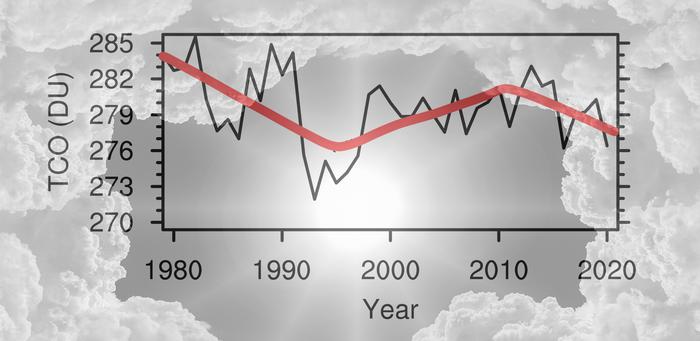
According to a new study published in Advances in Atmospheric Sciences, the ozone isn’t healing as quickly as expected, leading to higher levels of surface ultraviolet (UV) radiation in recent years.
Ozone

Credit: Yan Xia

According to a new study published in Advances in Atmospheric Sciences, the ozone isn’t healing as quickly as expected, leading to higher levels of surface ultraviolet (UV) radiation in recent years.

Despite projections that the ozone layer would fully recover by mid-century, researchers found rising UV radiation levels in the tropics and northern mid-latitudes after 2010, posing risks to human health and the environment. 

“Our analysis shows disturbed ozone levels and enhanced surface UV radiation for more than a decade after 2010,” said lead author Yan Xia of Beijing Normal University. “The slower recovery of stratospheric ozone is largely unexpected.”

The team analyzed satellite data and model simulations to assess long-term changes in ozone and surface UV levels around the globe. “We observed a decrease in ozone levels and an increase in UV radiation over latitudes between 30°S-60°N after 2010,” Xia said. “Especially in the Northern Hemisphere, the rising magnitude of surface UV radiation from 2011 to 2020 reached 0.5-1.4% per year—this should not be neglected.” 

“Continuous monitoring of ozone and UV radiation levels is important to better understand why ozone recovery is delayed and whether this trend will continue,” Xia warned. “Policymakers and the public should be aware of and prepare for the harmful effects of enhanced surface UV radiation on the environment, agriculture, and public health.” 

The findings are a sobering reminder that ozone layer restoration is a complex process affected by factors like global warming—and full recovery remains uncertain. Continued research and implementation of policies like the Montreal Protocol are critical to reverse this worsening trend, reducing UV exposure, and protecting life on Earth in the coming decades. 


Journal

Advances in Atmospheric Sciences

DOI

10.1007/s00376-023-2354-9

Article Title

Increasing Surface UV Radiation in the Tropics and Northern Mid-Latitudes due to Ozone Depletion after 2010

Article Publication Date

12-May-2023

Share12Tweet8Share2ShareShareShare2

Related Posts

Antimicrobial PVA silver nanoparticle zeolite nanofibers developed for wound dressings

Antimicrobial PVA silver nanoparticle zeolite nanofibers developed for wound dressings

September 4, 2026
AgCl Nanoparticles from Dual Extracts: Bioactivity, Ecotoxicity, Molecular Mechanisms

AgCl Nanoparticles from Dual Extracts: Bioactivity, Ecotoxicity, Molecular Mechanisms

September 4, 2026

New NiO–Cu3Mo2O9 Catalyst Boosts Hydrogen Production from Ammonia Borane

September 4, 2026

Molecular stacking under nanoconfinement creates flexible honeycomb topological structures

September 4, 2026

POPULAR NEWS

  • Antimicrobial PVA silver nanoparticle zeolite nanofibers developed for wound dressings

    29 shares
    Share 12 Tweet 7
  • AgCl Nanoparticles from Dual Extracts: Bioactivity, Ecotoxicity, Molecular Mechanisms

    29 shares
    Share 12 Tweet 7
  • New NiO–Cu3Mo2O9 Catalyst Boosts Hydrogen Production from Ammonia Borane

    29 shares
    Share 12 Tweet 7
  • Molecular stacking under nanoconfinement creates flexible honeycomb topological structures

    29 shares
    Share 12 Tweet 7

About

We bring you the latest biotechnology news from best research centers and universities around the world. Check our website.

Follow us

Recent News

Antimicrobial PVA silver nanoparticle zeolite nanofibers developed for wound dressings

AgCl Nanoparticles from Dual Extracts: Bioactivity, Ecotoxicity, Molecular Mechanisms

New NiO–Cu3Mo2O9 Catalyst Boosts Hydrogen Production from Ammonia Borane

Subscribe to Blog via Email

Enter your email address to subscribe to this blog and receive notifications of new posts by email.

Join 85 other subscribers
  • Contact Us

Bioengineer.org © Copyright 2023 All Rights Reserved.

Welcome Back!

Login to your account below

Forgotten Password?

Retrieve your password

Please enter your username or email address to reset your password.

Log In
No Result
View All Result
  • Homepages
    • Home Page 1
    • Home Page 2
  • News
  • National
  • Business
  • Health
  • Lifestyle
  • Science

Bioengineer.org © Copyright 2023 All Rights Reserved.