• HOME
  • NEWS
  • EXPLORE
    • CAREER
      • Companies
      • Jobs
    • EVENTS
    • iGEM
      • News
      • Team
    • PHOTOS
    • VIDEO
    • WIKI
  • BLOG
  • COMMUNITY
    • FACEBOOK
    • INSTAGRAM
    • TWITTER
Thursday, May 21, 2026
BIOENGINEER.ORG
No Result
View All Result
  • Login
  • HOME
  • NEWS
  • EXPLORE
    • CAREER
      • Companies
      • Jobs
        • Lecturer
        • PhD Studentship
        • Postdoc
        • Research Assistant
    • EVENTS
    • iGEM
      • News
      • Team
    • PHOTOS
    • VIDEO
    • WIKI
  • BLOG
  • COMMUNITY
    • FACEBOOK
    • INSTAGRAM
    • TWITTER
  • HOME
  • NEWS
  • EXPLORE
    • CAREER
      • Companies
      • Jobs
        • Lecturer
        • PhD Studentship
        • Postdoc
        • Research Assistant
    • EVENTS
    • iGEM
      • News
      • Team
    • PHOTOS
    • VIDEO
    • WIKI
  • BLOG
  • COMMUNITY
    • FACEBOOK
    • INSTAGRAM
    • TWITTER
No Result
View All Result
Bioengineer.org
No Result
View All Result
Home NEWS Science News Chemistry

Oxygen-promoted synthesis of armchair graphene nanoribbons on Cu(111)

Bioengineer by Bioengineer
April 2, 2021
in Chemistry
Reading Time: 3 mins read
0
IMAGE
Share on FacebookShare on TwitterShare on LinkedinShare on RedditShare on Telegram

IMAGE

Credit: ©Science China Press

On-surface synthesis has received great attention as a method to create atomically-precise one-dimensional (1D) and two-dimensional (2D) polymers with intriguing properties. In particular, graphene nanoribbons (GNRs), a category of quasi-1D nanomaterials derived from graphene, have been widely studied due to their tunable electronic properties and potential applications in semiconductor devices, such as field-effect transistors and spintronics. A series of top-down approaches have been pursued to produce GNRs, but a lack of control over the ribbon width and edge structure has hindered their further development.

In 2010, Cai et al. firstly reported the fabrication of an atomically-precise armchair GNR (AGNR) on the Au(111) surface using a bottom-up approach. The basic mechanism involves thermally-activated dehalogenation, surface-assisted polymerization and finally cyclodehydrogenation.

In the following decade, this bottom-up approach has been extended to synthesize a wide variety of GNRs, including AGNRs with different widths, zigzag GNRs, GNR heterojunctions, chiral GNRs and chemically- doped GNRs. Based on the periodic similarity of their electronic structures, AGNRs can be classified into three families, 3p, 3p+1 and 3p+2 (representing the number of carbon atoms in the narrow direction).

So far, few studies have focused on GNR synthesis on Cu(111) due to the stronger surface interaction, despite the lower temperature for dehalogenation. It has been shown that chiral GNRs can be synthesized on Cu(111) using the same precursor which yields non-chiral 7-AGNR on Au(111) and that dehalogenation can be reversible on Au(111) but not Cu(111), which implies that the reaction pathway and products achieved could be controlled through the choice of substrate.

A second approach to tailor the reaction pathway in surface-confined synthesis is to introduce different atomic species, which has been considered in only a few recent studies. Exposure to iodine creates a monolayer intercalated between the polymers and the Ag(111) surface that decouples their electronic interactions. In addition, hydrogen was shown to remove halogen by-products and to induce covalent coupling, and sulphur to switch the surface-confined Ullmann reaction on or off.

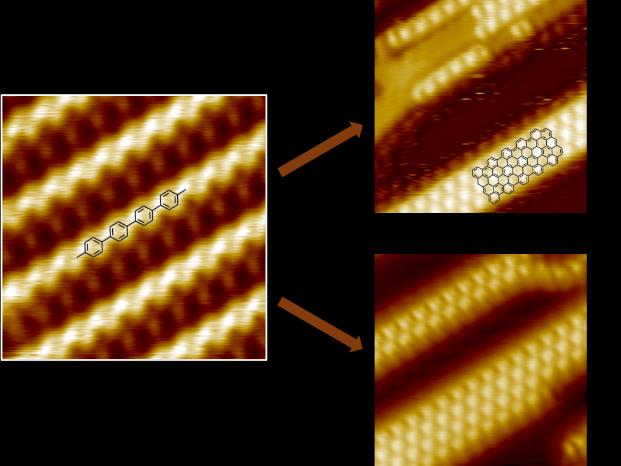
Prof. Lifeng Chi’s research group in Soochow University recently investigated the effect of oxygen on the synthesis of 3-AGNRs by surface-confined Ullmann coupling and determined that it, instead, caused a 1D to 2D transformation of the organometallic (OM) structures.

Here, their objective was to investigate the synthesis of 3p-AGNRs on Cu(111), extending from the previous study on Au(111), and to examine the effect of oxygen on lateral fusion of 3-AGNRs, inspired by their potential to promote C-H activation.

Their investigation demonstrated the successful synthesis of 3p-AGNRs on Cu(111) via lateral fusion of poly(para-phenylene) (i.e. 3-AGNR). Introduction of co-adsorbed atomic oxygen substantially reduced the temperature required to induce the lateral fusion reaction. The identification of this catalytic effect could benefit on-surface synthesis that applies dehydrogenation reactions, not restricting to GNRs, and highlights the potential of additional atomic adsorbates to steer surface reactions.

###

See the article: Ji P, Maclean O, Galeotti G, Dettmann D, Berti G, Sun K, Zhang H, Rosei F, Chi L. Oxygen-promoted synthesis of armchair graphene nanoribbons on Cu(111). Sci China Chem, 2021, 64, https://doi.org/10.1007/s11426-021-9966-x

http://engine.scichina.com/doi/10.1007/s11426-021-9966-x

Media Contact
Lifeng Chi
[email protected]

Related Journal Article

http://dx.doi.org/10.1007/s11426-021-9966-x

Tags: Chemistry/Physics/Materials Sciences
Share12Tweet8Share2ShareShareShare2

Related Posts

Scientists Achieve Breakthrough in Molecular ‘Sandwich’ Assembly — Chemistry

Scientists Achieve Breakthrough in Molecular ‘Sandwich’ Assembly

May 21, 2026
Advancing In Vivo and In Situ Monitoring: Science Bulletin Highlights Host-Based Antifouling Gold Nanotube Sensor for Selective Detection of Mechanically Sensitive Serotonin Release in Intestinal Mucosa — Chemistry

Advancing In Vivo and In Situ Monitoring: Science Bulletin Highlights Host-Based Antifouling Gold Nanotube Sensor for Selective Detection of Mechanically Sensitive Serotonin Release in Intestinal Mucosa

May 20, 2026

How Magnetic Orientation Could Influence the Building Blocks of Life

May 20, 2026

Breaking a 200-Year-Old Belief: Novel Surface Design Achieves Two Distinct Wetting States on One Substrate

May 20, 2026
Please login to join discussion

POPULAR NEWS

  • blank

    New Study Reveals Plants Can Detect the Sound of Rain

    733 shares
    Share 292 Tweet 183
  • ESMO 2025: mRNA COVID Vaccines Enhance Efficacy of Cancer Immunotherapy

    304 shares
    Share 122 Tweet 76
  • Research Indicates Potential Connection Between Prenatal Medication Exposure and Elevated Autism Risk

    846 shares
    Share 338 Tweet 212
  • Breastmilk Balances E. coli and Beneficial Bacteria in Infant Gut Microbiomes

    58 shares
    Share 23 Tweet 15

About

We bring you the latest biotechnology news from best research centers and universities around the world. Check our website.

Follow us

Recent News

Innovative Reusable Brick Walls Revolutionize Construction Industry

Nonlinear Atomic Tunneling Enhanced by Bright Squeezed Vacuum

Label-Free Super-Resolution Imaging of Live Cells

Subscribe to Blog via Email

Enter your email address to subscribe to this blog and receive notifications of new posts by email.

Join 82 other subscribers
  • Contact Us

Bioengineer.org © Copyright 2023 All Rights Reserved.

Welcome Back!

Login to your account below

Forgotten Password?

Retrieve your password

Please enter your username or email address to reset your password.

Log In
No Result
View All Result
  • Homepages
    • Home Page 1
    • Home Page 2
  • News
  • National
  • Business
  • Health
  • Lifestyle
  • Science

Bioengineer.org © Copyright 2023 All Rights Reserved.