


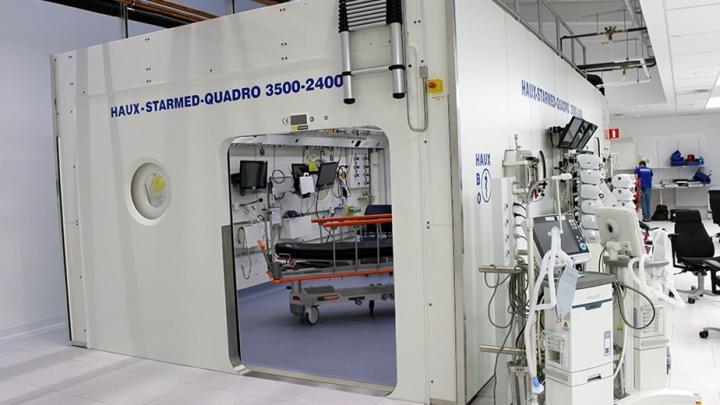
Credit: Photo by Anders Kjellberg
Hyperbaric oxygen therapy (HBOT) can relieve self-reported symptoms and side-effects of radiotherapy against cancer in the pelvic region, a study shows. After 30-40 sessions in a hyperbaric chamber, many patients experienced reductions in bleeding, urinary incontinence, and pain alike.
“This treatment is highly effective for the majority of the patients” states Nicklas Oscarsson, first author of the article, a doctoral student in anesthesiology and intensive care at Sahlgrenska Academy, University of Gothenburg, and senior consultant at Angered Hospital.
Radiotherapy is part of many treatment protocols of cancer in organs such as the prostate, cervix, ovaries, and colon. One side-effect of radiotherapy in the lower abdomen is damage of nearby, healthy tissue such as the urinary tract, bladder, vagina, or rectum.
Symptoms such as a frequent urge to urinate, incontinence, bleeding, and severe abdominal pain cause both physical and social difficulties. These may arise several years after radiotherapy and cause chronic and often increasing discomfort. Often, all these patients can be offered is temporary relief of symptoms or mutilating surgery.
In the current study, the first randomized controlled study to compare hyperbaric oxygen with standard care, published in The Lancet Oncology, 223 patients were screened, and 79 were included in the analysis. Patients reported relatively severe symptoms and lifestyle limitations, mainly due to reduced urinary bladder capacity, bleeding, incontinence, and pain.
The patients were treated at university hospitals in five Nordic cities: Bergen in Norway, Gothenburg and Stockholm in Sweden, Copenhagen in Denmark and Turku in Finland. 38 patients, the control group, were given standard care, which normally includes medication and physical therapy, while the other 41 were treated with hyperbaric oxygen for 90 min daily, 30-40 times.
During their sessions each of the latter patients, wearing a snug-fitting oxygen mask or hood, sat in a hyperbaric chamber for one or more persons. The pressure of the oxygen, 240 kilopascals (kPa), corresponded to water pressure at a depth of 14 meters.
In the hyperbaric chamber group, two out of three patients felt that they got better, and in some cases, all symptoms vanished. The others, including the control group, experienced no major changes. The specific focus of the study is self-reported qualitative and quantitative symptoms, and the important issue of the quality of life for cancer survivors.
The study is also linked to the discoveries behind the Nobel Prize in Physiology or Medicine 2019, about how cells sense and adapt to oxygen availability. It was already known that hyperbaric oxygen therapy boosts vascular growth, but there has been little exploration of its specific effects.
In the patients in the study, general health was greatly impaired before treatment, sometimes after long periods of discomfort. Thus, if a patient no longer needed morphine for pain or was able to go to the toilet once a night instead of five times, it was a clear improvement.
“It’s a great pleasure to hear patients tell us how they feel they’re returning to a normal human life. This also applies to those who get better but perhaps aren’t entirely well,” Oscarsson concludes.
###
Title: Radiation-induced cystitis treated with hyperbaric oxygen therapy (RICH-ART): a randomized, controlled, phase 2-3 trial; https://doi.org/10.1016/S1470-2045(19)30494-2
Media Contact
Nicklas Oscarsson
[email protected]
46-070-081-6867
Original Source
https:/
Related Journal Article
http://dx.



