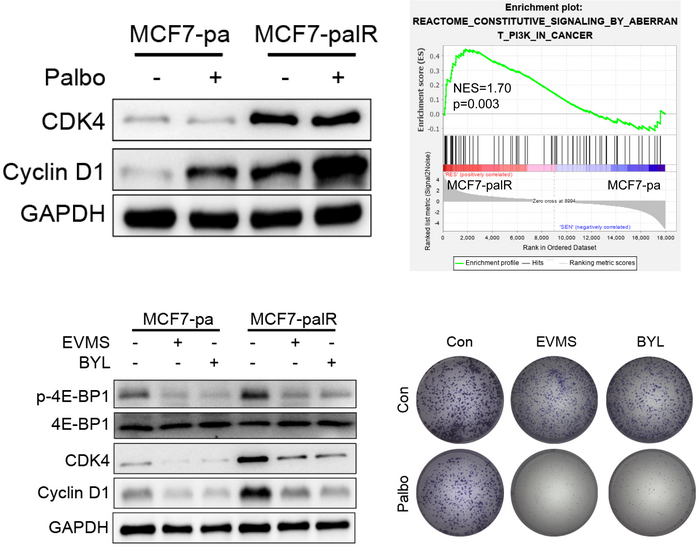
This study is carried out by Prof. Qiang Liu (Breast Tumor Center, Sun Yat-Sen Memorial Hospital, Sun Yat-Sen University). In this study, researchers found that the palbociclib-resistant breast cancer cells are still dependent on Cyclin D1-CDK4 to phosphorylate Rb protein to pass G1-S checkpoint. Moreover, the protein levels of Cyclin D1 and CDK4 are significantly higher in palbociclib-resistant cells than in parental cells, while their mRNAs remain unchanged. Mechanistically, PI3K/mTOR pathway was hyper-activated in palbociclib-resistant cells, leading to more phosphorylated 4E-BP1 and higher levels of Cyclin D1 and CDK4 translation. More importantly, Targeting PI3K/mTOR pathway with a specific PI3Kα inhibitor (BYL719) or a mTOR inhibitor (everolimus) reduced the protein levels of Cyclin D1 and CDK4, and restored the sensitivity to palbociclib in resistant cells both in vitro and in vivo.
Credit: ©Science China Press
This study is carried out by Prof. Qiang Liu (Breast Tumor Center, Sun Yat-Sen Memorial Hospital, Sun Yat-Sen University). In this study, researchers found that the palbociclib-resistant breast cancer cells are still dependent on Cyclin D1-CDK4 to phosphorylate Rb protein to pass G1-S checkpoint. Moreover, the protein levels of Cyclin D1 and CDK4 are significantly higher in palbociclib-resistant cells than in parental cells, while their mRNAs remain unchanged. Mechanistically, PI3K/mTOR pathway was hyper-activated in palbociclib-resistant cells, leading to more phosphorylated 4E-BP1 and higher levels of Cyclin D1 and CDK4 translation. More importantly, Targeting PI3K/mTOR pathway with a specific PI3Kα inhibitor (BYL719) or a mTOR inhibitor (everolimus) reduced the protein levels of Cyclin D1 and CDK4, and restored the sensitivity to palbociclib in resistant cells both in vitro and in vivo.
This study provides the first evidence that excessive Cyclin D1 and CDK4 proteins caused by enhanced protein synthesis are responsible for the resistance to CDK4/6 inhibitors, highlighting the necessity to re-biopsy the tumors after developing resistance and use immunohistochemistry to examine protein levels, but not just mRNA or DNA levels, to determine the mechanism of resistance. This is also the first study that report the regulation of 4E-BP1 on CDK4 translation. More importantly, targeting PI3K/mTOR pathway reduced the protein levels of Cyclin D1/CDK4 and restored the sensitivity to palbociclib in its resistant cells, suggesting the feasibility and therapeutic value of BYL719 or everolimus with continued use of CDK4/6 inhibitors in post-CDK4/6 inhibitors setting. The overexpression of phosphorylated 4E-BP1, as well as overexpressed Cyclin D1 and CDK4 proteins, could be potential biomarkers to indicate the continued use of CDK4/6 inhibitors even after acquired resistance to CDK4/6 inhibitors.
This study shows that the overexpressed Cyclin D1 and CDK4 proteins maintain cell cycle progression after CDK4/6 inhibitors resistance and PI3K/mTOR inhibitors restore the sensitivity to CDK4/6 inhibitors by reducing CDK4 and cyclin D1 protein synthesis. The protein expression of p-4E-BP1/ Cyclin D1/ CDK4 may be the biomarker to select advanced breast cancer patients who will benefit from the combination of PI3K/mTOR inhibitors and CDK4/6 inhibitor after developing the resistance to CDK4/6 inhibitors.
See the article:
Overexpressed Cyclin D1 and CDK4 proteins are responsible for the resistance to CDK4/6 inhibitor in breast cancer that can be reversed by PI3K/mTOR Inhibitors
https://doi.org/10.1007/s11427-021-2140-8
Journal
Science China Life Sciences
DOI
10.1007/s11427-021-2140-8