• HOME
  • NEWS
  • EXPLORE
    • CAREER
      • Companies
      • Jobs
    • EVENTS
    • iGEM
      • News
      • Team
    • PHOTOS
    • VIDEO
    • WIKI
  • BLOG
  • COMMUNITY
    • FACEBOOK
    • INSTAGRAM
    • TWITTER
Thursday, July 9, 2026
BIOENGINEER.ORG
No Result
View All Result
  • Login
  • HOME
  • NEWS
  • EXPLORE
    • CAREER
      • Companies
      • Jobs
        • Lecturer
        • PhD Studentship
        • Postdoc
        • Research Assistant
    • EVENTS
    • iGEM
      • News
      • Team
    • PHOTOS
    • VIDEO
    • WIKI
  • BLOG
  • COMMUNITY
    • FACEBOOK
    • INSTAGRAM
    • TWITTER
  • HOME
  • NEWS
  • EXPLORE
    • CAREER
      • Companies
      • Jobs
        • Lecturer
        • PhD Studentship
        • Postdoc
        • Research Assistant
    • EVENTS
    • iGEM
      • News
      • Team
    • PHOTOS
    • VIDEO
    • WIKI
  • BLOG
  • COMMUNITY
    • FACEBOOK
    • INSTAGRAM
    • TWITTER
No Result
View All Result
Bioengineer.org
No Result
View All Result
Home NEWS Science News Chemistry

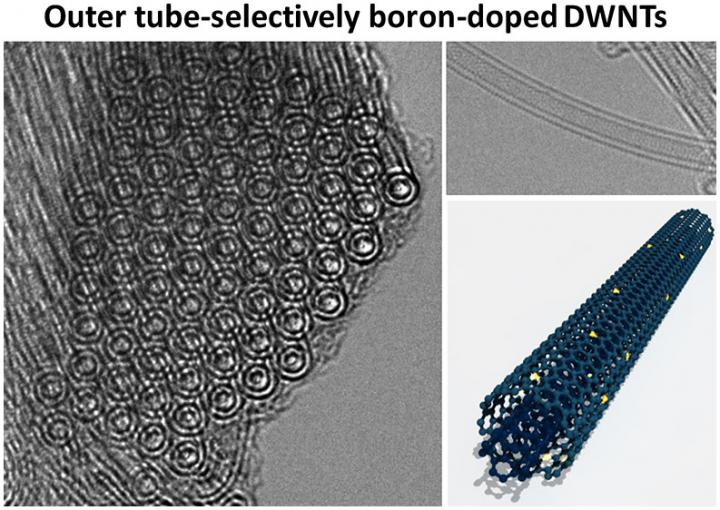
Outer tube-selectively boron-doped double-walled carbon nanotubes for thermoelectric applications

Bioengineer by Bioengineer
May 4, 2020
in Chemistry
Reading Time: 2 mins read
0
IMAGE
Share on FacebookShare on TwitterShare on LinkedinShare on RedditShare on Telegram

IMAGE

Credit: Copyright © 2020, American Chemical Society 

Carbon nanotubes, the tiny hollow tube of hexagonal carbon lattices has been touted as one of the most promising materials for building items with fascinating electrical, thermal and mechanical properties. Selective functionality is realized by adding elements to the carbon nanotubes to make transistors, composite additives, field emitters and transparent conductive films. Carbon nanotubes doped with boron makes the structure of the tubes more functional while increasing the ability to modulate the electrical properties. Boron-doping into coaxially aligned two single-walled carbon nanotubes (double-walled carbon nanotubes :DWNTs) show promise for use in electronic devices, composite materials, energy storage and power generation materials.

A research group led by Hiroyuki Muramatsu of Shinshu University succeeded in selectively doping the outer nanotube of the DWNTs with boron. Previously, there was no method to control the incorporation of boron atoms to carbon nanotubes. The tubes would fuse together or the structure would drastically change through treatments of boron-doping, frustrating researchers. In this study, Muramatsu and his team were able to selectively add boron to the outer tubes of DWNTs. This significantly increased the electrical conductivity and the Seebeck coefficient which resulted in a highly enhanced thermoelectric performance of the DWNTs.

This advancement in technique allows for an extremely effective method to add functionality such as high electrical conductivity, chemical activation and improvement of thermoelectric properties while maintaining the function of the inner CNT. Muramatsu and his team succeeded in discovering the conditions for intricately doping boron on a single outermost layer of CNT without changing the coaxial structure of DWNTs. Only then were they able to actually demonstrate and confirm the characteristics of the synthesized DWNTs.

In the future boron-doped DWNTs could be used in thermoelectric applications to harvest waste heat for electricity generation and other advanced applications. However, DWNTs are still not very well understood. Muramatsu believes that through fundamental research and understanding the basic properties of outer tube-selectively boron-doped DWNTs, more applications can be found while enhancing performance relevant to various applications. The ultimate goal is to strategically use the characteristics of the structure and physical properties of DWNTs to add unique functions and characteristics. New principles and methods must be investigated in detail to establish a more selective high-concentration doping method and study its effect on the structure and function.

###

Media Contact
Hitomi Thompson
[email protected]

Related Journal Article

http://dx.doi.org/10.1021/acsanm.0c00075

Tags: Chemistry/Physics/Materials SciencesMaterials
Share12Tweet8Share2ShareShareShare2

Related Posts

New Approach Advances Eco-Friendly Negative Thermal Expansion Materials

New Approach Advances Eco-Friendly Negative Thermal Expansion Materials

July 8, 2026
Over 90% of Mar Menor nutrient pollution stems from underground water flows

Over 90% of Mar Menor nutrient pollution stems from underground water flows

July 8, 2026

Weakening Atlantic current drives stronger California storms

July 8, 2026

New approach simplifies black hole mergers, universe’s most violent events.

July 8, 2026
Please login to join discussion

POPULAR NEWS

  • Detection of EDCs in Breast Milk and Infant Urine Up to Six Months Highlights Early Exposure Risks

    77 shares
    Share 31 Tweet 19
  • New Drug Candidate Developed at McMaster Shows Potential for Treating Brain Cancer

    58 shares
    Share 23 Tweet 15
  • KTU Researchers Explore Ultrasound’s Role in Enhancing Blood Flow Beyond Diagnostics

    53 shares
    Share 21 Tweet 13
  • 高齢者の骨粗鬆症治療の持続性比較

    51 shares
    Share 20 Tweet 13

About

We bring you the latest biotechnology news from best research centers and universities around the world. Check our website.

Follow us

Recent News

ORNL Wins Five DOE Transportation Technologies Office Awards

New Treatment Targets Weight Issues Following Brain Tumors

New Approach Advances Eco-Friendly Negative Thermal Expansion Materials

Subscribe to Blog via Email

Enter your email address to subscribe to this blog and receive notifications of new posts by email.

Join 83 other subscribers
  • Contact Us

Bioengineer.org © Copyright 2023 All Rights Reserved.

Welcome Back!

Login to your account below

Forgotten Password?

Retrieve your password

Please enter your username or email address to reset your password.

Log In
No Result
View All Result
  • Homepages
    • Home Page 1
    • Home Page 2
  • News
  • National
  • Business
  • Health
  • Lifestyle
  • Science

Bioengineer.org © Copyright 2023 All Rights Reserved.