• HOME
  • NEWS
  • EXPLORE
    • CAREER
      • Companies
      • Jobs
    • EVENTS
    • iGEM
      • News
      • Team
    • PHOTOS
    • VIDEO
    • WIKI
  • BLOG
  • COMMUNITY
    • FACEBOOK
    • INSTAGRAM
    • TWITTER
Saturday, August 22, 2026
BIOENGINEER.ORG
No Result
View All Result
  • Login
  • HOME
  • NEWS
  • EXPLORE
    • CAREER
      • Companies
      • Jobs
        • Lecturer
        • PhD Studentship
        • Postdoc
        • Research Assistant
    • EVENTS
    • iGEM
      • News
      • Team
    • PHOTOS
    • VIDEO
    • WIKI
  • BLOG
  • COMMUNITY
    • FACEBOOK
    • INSTAGRAM
    • TWITTER
  • HOME
  • NEWS
  • EXPLORE
    • CAREER
      • Companies
      • Jobs
        • Lecturer
        • PhD Studentship
        • Postdoc
        • Research Assistant
    • EVENTS
    • iGEM
      • News
      • Team
    • PHOTOS
    • VIDEO
    • WIKI
  • BLOG
  • COMMUNITY
    • FACEBOOK
    • INSTAGRAM
    • TWITTER
No Result
View All Result
Bioengineer.org
No Result
View All Result
Home NEWS Science News Biology

OU neuroscientists find brain pathway supporting an intersection of taste and pain

Bioengineer by Bioengineer
March 12, 2019
in Biology
Reading Time: 2 mins read
0
IMAGE
Share on FacebookShare on TwitterShare on LinkedinShare on RedditShare on Telegram

IMAGE

Credit: University of Oklahoma

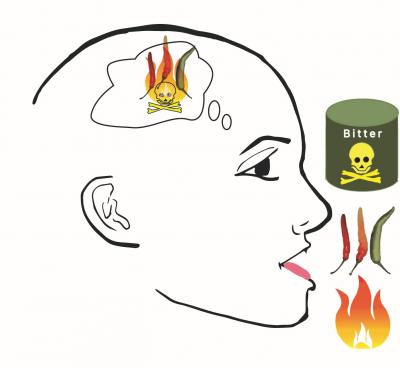
University of Oklahoma neuroscientists have found a pathway in the brain where taste and pain intersect in a new study that originally was designed to look at the intersection of taste and food temperature. This study was the first time researchers have shown that taste and pain signals come together in the brain and use the same circuitry. OU neuroscientists received a five-year, $1.6 million National Institutes of Health grant to study this concept.

“We originally aimed to look at how sense of taste works with thermal sensation in this study to better understand how taste is connected to food preferences, health and well-being. Taste is also closely tied to emotion and understanding how the brain processes different tastes is significant on several levels,” said Christian Lemon, principal investigator on the grant and associate professor in the OU Department of Biology, OU College of Arts and Sciences. “What we found was a surprise because temperature signals were converging with taste near the mid-brain, but so were neural messages for taste and pain.”

Lemon and Jinrong Li, OU research associate, used a molecular biology and physiology technique to understand how taste and thermal pathways might be converging with pain. What OU researchers learned from this study is that the neural circuitry carrying signals for aversive tastes also carries a response to pain. This intersection may support a protective function and opens the possibility that taste messages could change how pain signals are transmitted in the brain, but more research is needed.

The sense of taste is a complicated sensory and nutrient detector that has many implications for how the nervous system guides food preference behaviors and, potentially, response to pain. Now that the circuitry has been identified, OU researchers will explore manipulation of the circuitry to test its influence on behaviors associated with taste and pain. Ultimately, understanding taste is critical to defining its role in human disorders associated with eating behaviors, such as obesity, diabetes, and other conditions and diseases.

###

Lemon and Li recently published the first paper on this study in the Journal of Neuroscience at http://www.jneurosci.org/content/39/9/1631. For more information about this research, contact [email protected].

Media Contact
Jana Smith
[email protected]

Original Source

https://bit.ly/2EUrAJE

Tags: BiologyMolecular BiologyPhysiology
Share13Tweet8Share2ShareShareShare2

Related Posts

Delayed antiviral response in alveolar type 2 cells heightens influenza susceptibility

Delayed antiviral response in alveolar type 2 cells heightens influenza susceptibility

August 22, 2026
Genetic evidence links sleep disruption to hemorrhoidal disease, revealing a hidden connection

Genetic evidence links sleep disruption to hemorrhoidal disease, revealing a hidden connection

August 22, 2026

LASIK Versus Contact Lenses for Correcting Myopia

August 22, 2026

New Advances in Minimally Invasive Laryngeal Surgery

August 22, 2026
Please login to join discussion

POPULAR NEWS

  • How Phages Target Hidden Intracellular Bacteria Behind Persistent Urinary Tract Infections

    29 shares
    Share 12 Tweet 7
  • Genomic Study Reveals Betacoronavirus Evolution in Wild Mice and Small Mammals

    29 shares
    Share 12 Tweet 7
  • Zanidatamab Shows Promise in Early-Stage HER2-Positive Breast Cancer Trial

    29 shares
    Share 12 Tweet 7
  • Early-Onset Inflammatory Bowel Disease Advances, Yet Health Inequities Persist

    29 shares
    Share 12 Tweet 7

About

We bring you the latest biotechnology news from best research centers and universities around the world. Check our website.

Follow us

Recent News

How Phages Target Hidden Intracellular Bacteria Behind Persistent Urinary Tract Infections

Genomic Study Reveals Betacoronavirus Evolution in Wild Mice and Small Mammals

Zanidatamab Shows Promise in Early-Stage HER2-Positive Breast Cancer Trial

Subscribe to Blog via Email

Enter your email address to subscribe to this blog and receive notifications of new posts by email.

Join 85 other subscribers
  • Contact Us

Bioengineer.org © Copyright 2023 All Rights Reserved.

Welcome Back!

Login to your account below

Forgotten Password?

Retrieve your password

Please enter your username or email address to reset your password.

Log In
No Result
View All Result
  • Homepages
    • Home Page 1
    • Home Page 2
  • News
  • National
  • Business
  • Health
  • Lifestyle
  • Science

Bioengineer.org © Copyright 2023 All Rights Reserved.