• HOME
  • NEWS
  • EXPLORE
    • CAREER
      • Companies
      • Jobs
    • EVENTS
    • iGEM
      • News
      • Team
    • PHOTOS
    • VIDEO
    • WIKI
  • BLOG
  • COMMUNITY
    • FACEBOOK
    • INSTAGRAM
    • TWITTER
Saturday, May 16, 2026
BIOENGINEER.ORG
No Result
View All Result
  • Login
  • HOME
  • NEWS
  • EXPLORE
    • CAREER
      • Companies
      • Jobs
        • Lecturer
        • PhD Studentship
        • Postdoc
        • Research Assistant
    • EVENTS
    • iGEM
      • News
      • Team
    • PHOTOS
    • VIDEO
    • WIKI
  • BLOG
  • COMMUNITY
    • FACEBOOK
    • INSTAGRAM
    • TWITTER
  • HOME
  • NEWS
  • EXPLORE
    • CAREER
      • Companies
      • Jobs
        • Lecturer
        • PhD Studentship
        • Postdoc
        • Research Assistant
    • EVENTS
    • iGEM
      • News
      • Team
    • PHOTOS
    • VIDEO
    • WIKI
  • BLOG
  • COMMUNITY
    • FACEBOOK
    • INSTAGRAM
    • TWITTER
No Result
View All Result
Bioengineer.org
No Result
View All Result
Home NEWS Science News Biology

Oregon State University research wins Marcus Wallenberg Prize

Bioengineer by Bioengineer
April 28, 2020
in Biology
Reading Time: 3 mins read
0
IMAGE
Share on FacebookShare on TwitterShare on LinkedinShare on RedditShare on Telegram

IMAGE

Credit: Oregon State University

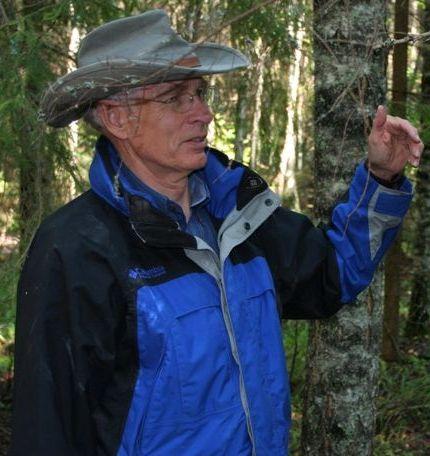
CORVALLIS, Ore. – Richard Waring, professor emeritus in the Oregon State University College of Forestry, is one of three researchers sharing this year’s international Marcus Wallenberg Prize for developing a revolutionary computer model to predict forest growth in a changing climate.

The annual prize, one of the highest honors in the field of forestry, was announced today in Falun, Sweden, and is named for the late Marcus Wallenberg Jr., a banker, industrialist and member of Sweden’s long-influential Wallenberg family.

Waring and co-honorees Joe Landsberg and Nicholas Coops, both of Australia, will each receive 2 million kronor, about $200,000, when they are presented with the prize in October by Swedish King Carl Gustav XVI.

“Dick Waring’s impact on forest science is clear,” said Anthony S. Davis, interim dean of the OSU College of Forestry. “He and his colleagues are well-deserved recipients of this incredible honor. Perhaps the only thing to eclipse his scientific contribution has been his commitment to the students, researchers and colleagues who have worked with him throughout his career. His dedication to their advancement has a cascading, positive impact that continues to grow in scientific accomplishment.”

Waring joined the OSU College of Forestry faculty in 1963 and remained active in forest science teaching and research until 2018. The model created by Waring and his colleagues includes use of satellite imagery to show how different environmental conditions affect the world’s forests.

Established in 1980, the Marcus Wallenberg Prize goes to an individual researcher or a small group of researchers for “a groundbreaking discovery or development in an area of importance to the forest industry,” according to the Marcus Wallenberg Foundation.

The prize’s purpose is to “encourage and stimulate path-breaking scientific achievements which contribute significantly to broadening knowledge and to technical development within the fields of importance to forestry and forest industries.”

Waring and Landsberg are pioneers in forest growth modeling under changing environmental conditions. They first presented their 3PG model – Physiological Principles Predicting Growth – in 1997. In 1998, Coops added satellite imagery to the model, enabling large areas of forest to be surveyed and forest growth and carbon storage to be predicted on a greater scale.

“We recognize that apples and oranges both grow on trees that incorporate similar processes,” Waring said. “Their leaves photosynthesize and transpire, and their roots take up nutrients and water. Exactly the same processes operate in Douglas-fir and eucalyptus trees, although the products of photosynthesis may be distributed somewhat differently.

“By the late 1990s, enough was published that we thought a simplified model could be built that could help foresters as well as ecologists predict how stands of a given composition of tree species might respond to changing environments.”

Waring, Landsberg and Coops have allowed researchers and landowners open access to the model, leading to its rapid and widespread adoption, use and improvement.

“That’s exactly how science is supposed to work,” said Waring, noting the model can be applied to a range of tree species around the world, in mixed-species stands, and in monocultures.

###

Media Contact
Dick Waring
[email protected]

Original Source

https://beav.es/4es

Tags: AgricultureAtmospheric ScienceBiologyClimate ChangeEarth ScienceEcology/EnvironmentForestry
Share12Tweet8Share2ShareShareShare2

Related Posts

Single mother must adapt swiftly — the survival of her colony depends on it — Biology

Single mother must adapt swiftly — the survival of her colony depends on it

May 15, 2026
Why Are Nearly Everyone Right-Handed? It Might Be Linked to How We Learned to Walk — Biology

Why Are Nearly Everyone Right-Handed? It Might Be Linked to How We Learned to Walk

May 15, 2026

Excessive Neuronal Activity Initiates Severe Autoimmune Brain Disorder

May 15, 2026

Precision Anti-Aging Strategies Focus on Eliminating Harmful Senescent Cells While Preserving Beneficial Ones

May 15, 2026
Please login to join discussion

POPULAR NEWS

  • Research Indicates Potential Connection Between Prenatal Medication Exposure and Elevated Autism Risk

    843 shares
    Share 337 Tweet 211
  • New Study Reveals Plants Can Detect the Sound of Rain

    730 shares
    Share 291 Tweet 182
  • Salmonella Haem Blocks Macrophages, Boosts Infection

    62 shares
    Share 25 Tweet 16
  • Breastmilk Balances E. coli and Beneficial Bacteria in Infant Gut Microbiomes

    58 shares
    Share 23 Tweet 15

About

We bring you the latest biotechnology news from best research centers and universities around the world. Check our website.

Follow us

Recent News

New Actinomycin Derivatives Target Malaria More Selectively

Mobile App Enhances Exercise for Older Adults’ Cognition

Botulinum Toxin Reduces Urinary Retention Post-Hemorrhoidopexy

Subscribe to Blog via Email

Enter your email address to subscribe to this blog and receive notifications of new posts by email.

Join 82 other subscribers
  • Contact Us

Bioengineer.org © Copyright 2023 All Rights Reserved.

Welcome Back!

Login to your account below

Forgotten Password?

Retrieve your password

Please enter your username or email address to reset your password.

Log In
No Result
View All Result
  • Homepages
    • Home Page 1
    • Home Page 2
  • News
  • National
  • Business
  • Health
  • Lifestyle
  • Science

Bioengineer.org © Copyright 2023 All Rights Reserved.