• HOME
  • NEWS
  • EXPLORE
    • CAREER
      • Companies
      • Jobs
    • EVENTS
    • iGEM
      • News
      • Team
    • PHOTOS
    • VIDEO
    • WIKI
  • BLOG
  • COMMUNITY
    • FACEBOOK
    • INSTAGRAM
    • TWITTER
Wednesday, May 6, 2026
BIOENGINEER.ORG
No Result
View All Result
  • Login
  • HOME
  • NEWS
  • EXPLORE
    • CAREER
      • Companies
      • Jobs
        • Lecturer
        • PhD Studentship
        • Postdoc
        • Research Assistant
    • EVENTS
    • iGEM
      • News
      • Team
    • PHOTOS
    • VIDEO
    • WIKI
  • BLOG
  • COMMUNITY
    • FACEBOOK
    • INSTAGRAM
    • TWITTER
  • HOME
  • NEWS
  • EXPLORE
    • CAREER
      • Companies
      • Jobs
        • Lecturer
        • PhD Studentship
        • Postdoc
        • Research Assistant
    • EVENTS
    • iGEM
      • News
      • Team
    • PHOTOS
    • VIDEO
    • WIKI
  • BLOG
  • COMMUNITY
    • FACEBOOK
    • INSTAGRAM
    • TWITTER
No Result
View All Result
Bioengineer.org
No Result
View All Result
Home NEWS Science News Biology

Oregon State researchers develop computer model to predict whether a pesticide will harm bees

Bioengineer by Bioengineer
July 13, 2022
in Biology
Reading Time: 3 mins read
0
pesticide toxicity
Share on FacebookShare on TwitterShare on LinkedinShare on RedditShare on Telegram

CORVALLIS, Ore. – Researchers in the Oregon State University College of Engineering have harnessed the power of artificial intelligence to help protect bees from pesticides.
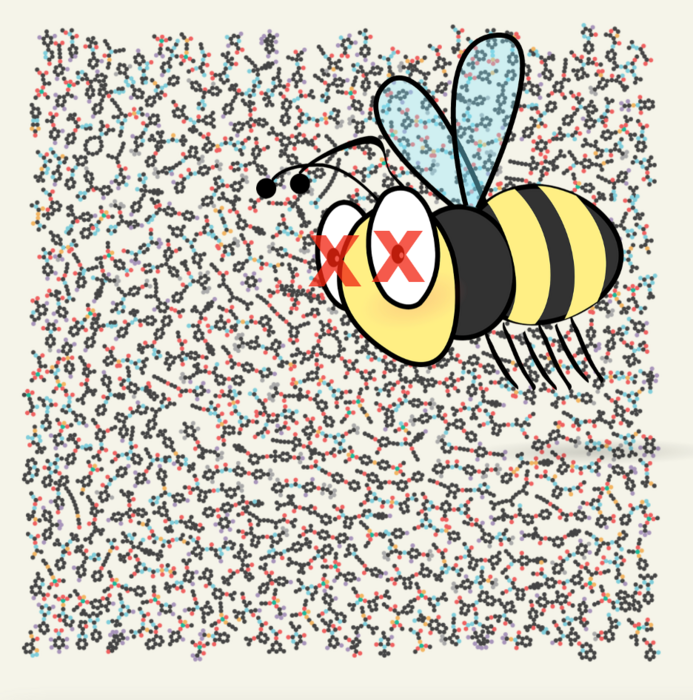
pesticide toxicity

Credit: Provided by Cory Simon, Oregon State University

CORVALLIS, Ore. – Researchers in the Oregon State University College of Engineering have harnessed the power of artificial intelligence to help protect bees from pesticides.

Cory Simon, assistant professor of chemical engineering, and Xiaoli Fern, associate professor of computer science, led the project, which involved training a machine learning model to predict whether any proposed new herbicide, fungicide or insecticide would be toxic to honey bees based on the compound’s molecular structure.

The findings, featured on the cover of The Journal of Chemical Physics in a special issue, “Chemical Design by Artificial Intelligence,” are important because many fruit, nut, vegetable and seed crops rely on bee pollination. 

Without bees to transfer the pollen needed for reproduction, almost 100 commercial crops in the United States would vanish. Bees’ global economic impact is annually estimated to exceed $100 billion.

“Pesticides are widely used in agriculture, which increase crop yield and provide food security, but pesticides can harm off-target species like bees,” Simon said. “And since insects, weeds, etc. eventually evolve resistance, new pesticides must continually be developed, ones that don’t harm bees.”

Graduate students Ping Yang and Adrian Henle used honey bee toxicity data from pesticide exposure experiments, involving nearly 400 different pesticide molecules, to train an algorithm to predict if a new pesticide molecule would be toxic to honey bees. 

“The model represents pesticide molecules by the set of random walks on their molecular graphs,” Yang said.

A random walk is a mathematical concept that describes any meandering path, such as on the complicated chemical structure of a pesticide, where each step along the path is decided by chance, as if by coin tosses.

Imagine, Yang explains, that you’re out for an aimless stroll along a pesticide’s chemical structure, making your way from atom to atom via the bonds that hold the compound together. You travel in random directions but keep track of your route, the sequence of atoms and bonds that you visit. Then you go out on a different molecule, comparing the series of twists and turns to what you’ve done before.

“The algorithm declares two molecules similar if they share many walks with the same sequence of atoms and bonds,” Yang said. “Our model serves as a surrogate for a bee toxicity experiment and can be used to quickly screen proposed pesticide molecules for their toxicity.”

The National Science Foundation supported this research.


Journal

The Journal of Chemical Physics

DOI

10.1063/5.0090573

Method of Research

Computational simulation/modeling

Subject of Research

Not applicable

Article Title

Classifying the toxicity of pesticides to honey bees via support vector machines with random walk graph kernels

Article Publication Date

6-Jun-2022

Share12Tweet8Share2ShareShareShare2

Related Posts

How Do Extreme Climate Events Impact Animal Societies? — Biology

How Do Extreme Climate Events Impact Animal Societies?

May 6, 2026
Scientists Discover Promising New Pathway for Antimalarial Drug Development — Biology

Scientists Discover Promising New Pathway for Antimalarial Drug Development

May 6, 2026

Scientists Harness Large DNA Fragment Assembly to Engineer Microbes for Producing Diverse Complex Compounds

May 6, 2026

Unveiling Evolution: How Fish Brains Reveal Surprising Secrets Inside Their Skulls

May 6, 2026

POPULAR NEWS

  • Research Indicates Potential Connection Between Prenatal Medication Exposure and Elevated Autism Risk

    836 shares
    Share 334 Tweet 209
  • New Study Reveals Plants Can Detect the Sound of Rain

    722 shares
    Share 288 Tweet 180
  • Scientists Investigate Possible Connection Between COVID-19 and Increased Lung Cancer Risk

    68 shares
    Share 27 Tweet 17
  • Salmonella Haem Blocks Macrophages, Boosts Infection

    61 shares
    Share 24 Tweet 15

About

We bring you the latest biotechnology news from best research centers and universities around the world. Check our website.

Follow us

Recent News

miR-205a Suppresses CDH11, Halting Chondrocyte Growth

Single-cell Stereo-seq uncovers kidney repair mechanisms

Community Fact-Checking Curbs Misinformation on X

Subscribe to Blog via Email

Enter your email address to subscribe to this blog and receive notifications of new posts by email.

Join 82 other subscribers
  • Contact Us

Bioengineer.org © Copyright 2023 All Rights Reserved.

Welcome Back!

Login to your account below

Forgotten Password?

Retrieve your password

Please enter your username or email address to reset your password.

Log In
No Result
View All Result
  • Homepages
    • Home Page 1
    • Home Page 2
  • News
  • National
  • Business
  • Health
  • Lifestyle
  • Science

Bioengineer.org © Copyright 2023 All Rights Reserved.