

• HOME
  • NEWS
  • EXPLORE
    • CAREER
      • Companies
      • Jobs
    • EVENTS
    • iGEM
      • News
      • Team
    • PHOTOS
    • VIDEO
    • WIKI
  • BLOG
  • COMMUNITY
    • FACEBOOK
    • INSTAGRAM
    • TWITTER
Monday, November 2, 2026
BIOENGINEER.ORG
No Result
View All Result
  • Login
  • HOME
  • NEWS
  • EXPLORE
    • CAREER
      • Companies
      • Jobs
        • Lecturer
        • PhD Studentship
        • Postdoc
        • Research Assistant
    • EVENTS
    • iGEM
      • News
      • Team
    • PHOTOS
    • VIDEO
    • WIKI
  • BLOG
  • COMMUNITY
    • FACEBOOK
    • INSTAGRAM
    • TWITTER
No Result
View All Result
Bioengineer.org
No Result
View All Result
Home NEWS Science News Biology

Orchid Species Identity, Not Life Form, Shapes Root Bacterial Communities

by
October 29, 2026
in Biology
Reading Time: 2 mins read
0
Orchid Species Identity, Not Life Form, Shapes Root Bacterial Communities

Orchid Species Identity, Not Life Form, Shapes Root Bacterial Communities

Share on FacebookShare on TwitterShare on LinkedinShare on RedditShare on Telegram

The bacteria living inside orchid roots appear to be selected far more by the species of the host plant than by whether that plant grows in soil or on tree branches. A new study of ten Cymbidium orchid species, all grown side by side in the same greenhouse, found that host species identity explained nearly 60 percent of the variation in root endophytic bacterial communities, while the distinction between epiphytic and terrestrial life forms accounted for less than 7 percent.

Root bacterial communities were profiled by 16S rRNA gene amplicon sequencing. After rarefying each sample to 29,628 sequences, the team recovered 129,922 amplicon sequence variants, or ASVs, distributed across 33 phyla and 779 genera. The most abundant genera included Pseudomonas, Sphingomonas, the Burkholderia–Caballeronia–Paraburkholderia complex, Bradyrhizobium and Reyranella.

One of the most striking results was how little the bacterial communities overlapped between orchid species. This points to an extremely small interspecific core microbiome, suggesting that each Cymbidium species hosts a largely distinct set of root bacteria even when grown under identical conditions. Alpha-diversity measures told a similar story from a different angle: no diversity index differed between epiphytic and terrestrial orchids, yet the Shannon, Simpson and Pielou evenness indices all differed significantly among host species.

Statistical modeling reinforced the hierarchy of host effects. Single-factor permutational multivariate analysis showed that life form explained only 6.9 percent of community variation, infrageneric section 35.6 percent, and host species 59.9 percent. Even closely related species within the same section were significantly differentiated, with an effect size of roughly 0.51. The authors caution, however, that life form, section and species are partially confounded in this design, so these figures describe associations rather than fully independent effects. A random forest classifier independently corroborated the pattern: community composition correctly assigned all 60 samples to their host species, but life-form prediction did not generalize across species, and under leave-one-species-out cross-validation its accuracy fell to 50.0 percent, below the 60 percent majority-class baseline.

Subject of Research: Root endophytic bacterial communities of Cymbidium orchids and the relative influence of host species identity versus life form

Article Title: Host species identity outweighs life form in shaping the root endophytic bacterial communities of 10 Cymbidium species grown under uniform conditions

Article References: Chen, X., Fang, R., Zhang, T., Zhao, G., & Wang, F. (2026). Host species identity outweighs life form in shaping the root endophytic bacterial communities of 10 Cymbidium species grown under uniform conditions. Frontiers in Microbiology, 17, 1996961. https://doi.org/10.3389/fmicb.2026.1996961

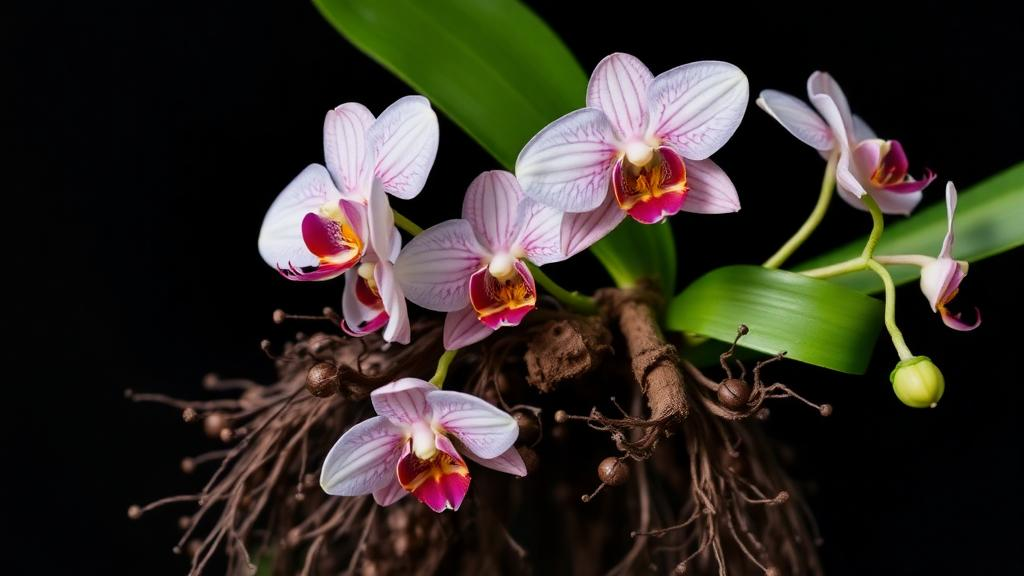
Image Credits: AI Generated

DOI: 10.3389/fmicb.2026.1996961

Keywords: Cymbidium, orchid microbiome, root endophytic bacteria, 16S rRNA sequencing, host species identity, life form, community assembly, Proteobacteria, core microbiome, random forest classification, Host, species

News Source: Morgan Morrow. (October 29, 2026). Orchid Species Identity, Not Life Form, Shapes Root Bacterial Communities. Scienmag.


Tags: 16S rRNA sequencingcommunity assemblycore microbiomeCymbidiumhosthost species identitylife formorchid microbiomeProteobacteriarandom forest classificationroot endophytic bacteriaspecies
Share12Tweet7Share2ShareShareShare1

Related Posts

Microbial Sources and Stress Shape the Hidden Endophytes of an Invasive Plant

Microbial Sources and Stress Shape the Hidden Endophytes of an Invasive Plant

October 30, 2026
Firebreaks Leave Lasting Scars in Grasslands While Wildfire Heals Fast

Firebreaks Leave Lasting Scars in Grasslands While Wildfire Heals Fast

October 30, 2026

Hidden Peptides in Non-Coding RNAs Reshape Cardiovascular Biology

October 30, 2026

Phage K Holin’s C-Terminal Region Shapes Antibacterial Activity, Study Finds

October 30, 2026

POPULAR NEWS

  • Microbial Sources and Stress Shape the Hidden Endophytes of an Invasive Plant

    Microbial Sources and Stress Shape the Hidden Endophytes of an Invasive Plant

    29 shares
    Share 12 Tweet 7
  • Firebreaks Leave Lasting Scars in Grasslands While Wildfire Heals Fast

    29 shares
    Share 12 Tweet 7
  • ZNF207 shields glutamine transporter ASCT2 from degradation to fuel liver cancer growth

    29 shares
    Share 12 Tweet 7
  • Systematic review maps sustainability tensions in offshore wind development

    29 shares
    Share 12 Tweet 7

About

We bring you the latest biotechnology news from best research centers and universities around the world. Check our website.

Follow us

Recent News

Microbial Sources and Stress Shape the Hidden Endophytes of an Invasive Plant

Firebreaks Leave Lasting Scars in Grasslands While Wildfire Heals Fast

ZNF207 shields glutamine transporter ASCT2 from degradation to fuel liver cancer growth

Subscribe to Blog via Email

Enter your email address to subscribe to this blog and receive notifications of new posts by email.

Join 86 other subscribers
  • Contact Us

Bioengineer.org © Copyright 2023 All Rights Reserved.

Welcome Back!

Login to your account below

Forgotten Password?

Retrieve your password

Please enter your username or email address to reset your password.

Log In
No Result
View All Result
  • Homepages
    • Home Page 1
    • Home Page 2
  • News
  • National
  • Business
  • Health
  • Lifestyle
  • Science

Bioengineer.org © Copyright 2023 All Rights Reserved.
