


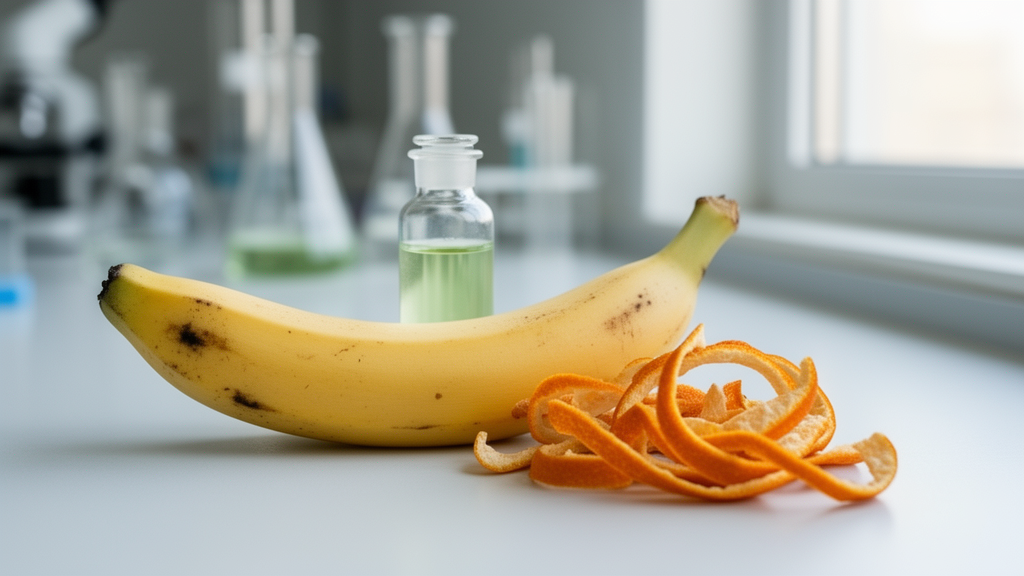
Copper oxide nanoparticles made from an unlikely raw material—orange peel waste—have shown promise on two fronts: fighting drug-resistant bacteria and slowing the spoilage of bananas. In a study published in BMC Biotechnology, researchers biosynthesized copper oxide nanoparticles (CuO NPs) using extracts of Citrus sinensis, the sweet orange, and then characterized the particles and tested their performance in the laboratory and on fruit.
The team prepared the nanoparticles using different ratios of copper precursor to peel extract—1:1, 1:2, and 2:1—and examined each batch with a suite of analytical techniques. X-ray diffraction profiling revealed average crystallite sizes of 28.34, 28.36, and 19.94 nanometers for the 1:1, 1:2, and 2:1 preparations respectively, confirming the formation of crystalline CuO. Fourier-transform infrared spectroscopy indicated that phytochemicals naturally present in the peel extract mediated the reduction of the copper precursor and stabilized the resulting particles, which is the defining feature of a green synthesis route: no harsh synthetic reagents are required because the plant chemistry does the work.
Optical measurements added further support. UV-Vis spectrophotometry of the biosynthesized nanoparticles showed a prominent absorption peak in the 450–480 nanometer region, a signature the authors identify as characteristic of intrinsic band-edge absorption in monoclinic CuO nanoparticles. Electron microscopy completed the structural picture: transmission electron microscopy and high-resolution TEM, combined with selected area electron diffraction, showed spherical particles with homogeneous morphology, while scanning electron microscopy results were consistent with pure, crystalline CuO.
The antibacterial evaluation focused on drug-resistant bacterial strains, a category of pathogens that has become a global concern as conventional antibiotics lose effectiveness. Among the three nanoparticle formulations, the CuO nanoparticles produced at the 1:2 precursor-to-extract ratio performed best, with activity that the authors report as closely approaching that of ampicillin, a standard antibiotic tested at 100 micrograms per milliliter. The researchers suggest that this antimicrobial efficacy points to a potential role for the nanoparticles as a biocidal agent in controlling bacterial contamination associated with food spoilage.
The second application targeted one of the most familiar problems in the fruit supply chain: bananas ripen rapidly and spoil quickly, driven by ethylene gas production, physical damage, and fungal infections. To test whether the nanoparticles could help, the team ran a 14-day preservation experiment in which banana samples were coated with CuO nanoparticle suspensions at different concentrations and ratios, alongside a water-treated control group.
The outcome was measured primarily by weight loss, a standard indicator of deterioration in stored fruit. Bananas coated with a 75 percent concentration of CuO nanoparticles prepared at the 1:1 ratio fared best, losing only 21.1 percent of their weight over the two-week period. The water-treated control bananas lost the most weight, 53.0 percent—a difference of nearly 32 percentage points between the best coating and the untreated control.
The study’s framing places these results against a backdrop of two converging challenges. Antibacterial-caused diseases are increasingly difficult to treat because of drug resistance, while post-harvest losses in perishable fruit impose economic and food-security costs worldwide. The authors position green nanoparticle synthesis as a promising response to both, turning agricultural waste—peels that would otherwise be discarded—into functional material.
Several caveats temper the findings. The antibacterial tests were laboratory assays against bacterial strains, and the nanoparticle activity, while approaching that of ampicillin in this assay, did not surpass the standard antibiotic. The banana experiment tracked weight loss over 14 days under the study’s specific conditions; broader claims about commercial shelf-life extension, effects on other spoilage organisms, food-safety evaluation of nanoparticle coatings on edible fruit, and performance at scale would require further research beyond what this study reports. The article was also shared early as a peer-reviewed accepted manuscript, a citable version subject to further edits before the final Version of Record.
Even with those limits, the work illustrates a growing trend in materials science: using plant extracts as biological factories for nanoparticles with tailored size and morphology. By tuning the precursor-to-extract ratio, the researchers obtained crystallites ranging from roughly 20 to 28 nanometers and identified the formulation that balanced antibacterial potency and coating performance. If subsequent studies confirm safety and efficacy, orange peel—today largely a waste stream from juice production—could become a low-cost feedstock for antimicrobial coatings that keep fruit fresher for longer.
Subject of Research: Green synthesis of copper oxide nanoparticles from orange peel extract for antibacterial testing and banana preservation
Article Title: Facile green synthesis of CuO NPs using Citrus sinensis peel extract for potential antibacterial applications and banana shelf-life extension
Article References: Molla, A., Bekele, E. T., Adimasu, Y., Ayalew, G., Alemu, Y., Dagne, H., Dagnaw, T., Meseret, G., Leja, D., & Tadesse, M. (2026). Facile green synthesis of CuO NPs using Citrus sinensis peel extract for potential antibacterial applications and banana shelf-life extension. BMC Biotechnology. https://doi.org/10.1186/s12896-026-01222-1
Image Credits: AI Generated
DOI: 10.1186/s12896-026-01222-1
Keywords: copper oxide nanoparticles, green synthesis, Citrus sinensis, orange peel extract, antibacterial, drug-resistant bacteria, banana preservation, food spoilage, XRD, FTIR, shelf life, nanotechnology
News Source: Gregory Coleman. (October 30, 2026). Orange Peel Extract Yields Copper Oxide Nanoparticles That Curb Banana Spoilage. Scienmag.



