• HOME
  • NEWS
  • EXPLORE
    • CAREER
      • Companies
      • Jobs
    • EVENTS
    • iGEM
      • News
      • Team
    • PHOTOS
    • VIDEO
    • WIKI
  • BLOG
  • COMMUNITY
    • FACEBOOK
    • INSTAGRAM
    • TWITTER
Friday, April 17, 2026
BIOENGINEER.ORG
No Result
View All Result
  • Login
  • HOME
  • NEWS
  • EXPLORE
    • CAREER
      • Companies
      • Jobs
        • Lecturer
        • PhD Studentship
        • Postdoc
        • Research Assistant
    • EVENTS
    • iGEM
      • News
      • Team
    • PHOTOS
    • VIDEO
    • WIKI
  • BLOG
  • COMMUNITY
    • FACEBOOK
    • INSTAGRAM
    • TWITTER
  • HOME
  • NEWS
  • EXPLORE
    • CAREER
      • Companies
      • Jobs
        • Lecturer
        • PhD Studentship
        • Postdoc
        • Research Assistant
    • EVENTS
    • iGEM
      • News
      • Team
    • PHOTOS
    • VIDEO
    • WIKI
  • BLOG
  • COMMUNITY
    • FACEBOOK
    • INSTAGRAM
    • TWITTER
No Result
View All Result
Bioengineer.org
No Result
View All Result
Home NEWS Science News Biology

Optoelectronic interface for stimulating neural networks in the brain

Bioengineer by Bioengineer
October 22, 2018
in Biology
Reading Time: 2 mins read
0
Share on FacebookShare on TwitterShare on LinkedinShare on RedditShare on Telegram
IMAGE

Credit: Lobachevsky University

In the past few decades, research aimed at finding approaches to restoring brain function has increased exponentially. An interdisciplinary approach to the task of brain function restoration combines complementary approaches and methods of regenerative medicine, on the one hand, and those proposed by neuroengineering, on the other. Biological approaches are based on activating the regenerative capacity of the brain and on cell transplantation, whereas engineering strategies include methods of neuromodulation, creating replacement or bridge neuroprostheses or developing brain-machine interfaces. The engineering approach is to create a biohybrid architecture that somehow connects the artificial control device with the brain: it hinders neuronal activity or, on the contrary, initiates this activity.

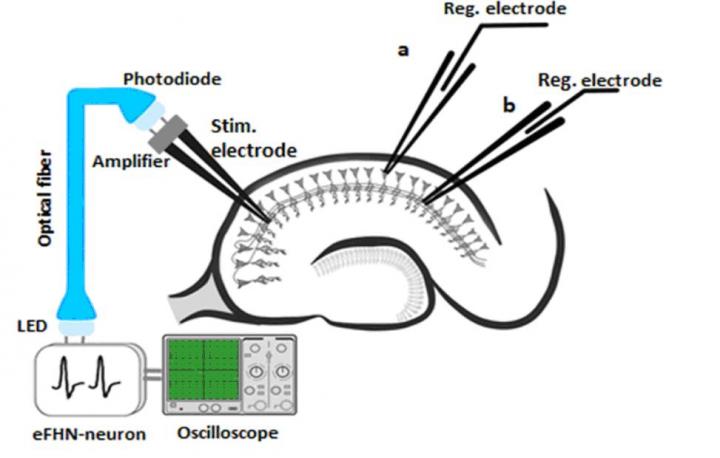
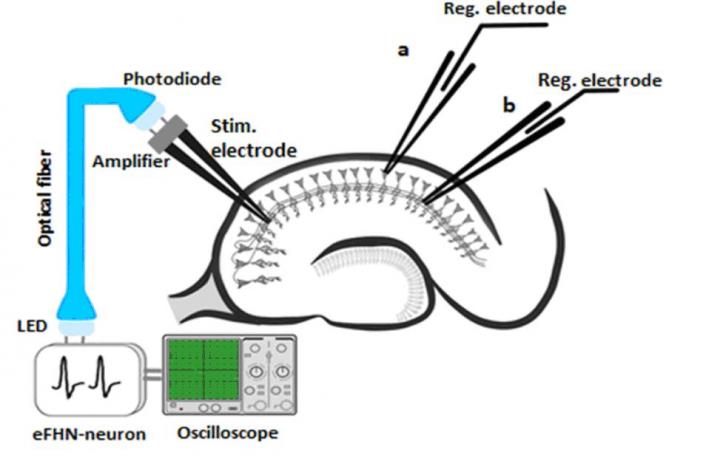
According to Svetlana Gerasimova, junior researcher at the Physics and Technology Research Institute and at the Neurotechnology Department of Lobachevsky University (Nizhny Novgorod, Russia), Russian scientists together with their colleagues from the Technical University of Madrid (Spain) have first proposed and developed an optoelectronic interface for the interaction of electronic neuron-like generators and living neurons of the brain (Fig.1).

"The designed interface differs from the existing methods of acting on brain neurons: it uses a fiber-optic channel to transmit signals from an artificial electronic neuron to a live one (Fig. 2). At the same time, unlike in the known optogenetics methods, there is no need to perform technically difficult and expensive genetic modifications of neurons for stimulation. Stimulation of living neurons is carried out with the help of an electrical signal obtained using photoelectric conversion at the output of the optical fiber," Svetlana Gerasimova says.

Mikhail Mishchenko, researcher at the Department of Oscillation Theory and Automatic Control of the UNN Faculty of Radiophysics, notes that the main advantage of using optical fiber instead of traditional metal wires is galvanic isolation, which rules out the possibility of electrical damage to brain tissue due to breakdown or electromagnetic effects.

"Besides, optical fiber provides another important advantage: the effectiveness of the interface in terms of affecting brain neurons can be increased by using an active optical fiber instead of a passive one. Thus, adaptive stimulation will be possible and its effectiveness will depend on the current state of the fiber optic channel, which reproduces the effects of synaptic plasticity," concludes Mikhail Mishchenko.

The effectiveness of the proposed system in stimulating the electrophysiological activity of neurons in a surviving section of the hippocampus has been demonstrated. It can be used to develop adaptive systems for restoring brain activity or replacing individual parts of the brain affected by an injury or a neurodegenerative disease.

###

Media Contact

Nikita Avralev
[email protected]

http://www.unn.ru/eng/

Share12Tweet8Share2ShareShareShare2

Related Posts

MIT Study Uncovers Novel Function of Cell Membranes

MIT Study Uncovers Novel Function of Cell Membranes

April 16, 2026
Long-Term HIV Remission via CCR5Δ32 Stem Cell Transplant

Long-Term HIV Remission via CCR5Δ32 Stem Cell Transplant

April 16, 2026

Renowned Cell Biologist Dr. Peter Walter Joins Faculty at The Buck Institute

April 16, 2026

Freshwater Fish Found to Accumulate Opioids and Other Pharmaceuticals

April 16, 2026
Please login to join discussion

POPULAR NEWS

  • Scientists Investigate Possible Connection Between COVID-19 and Increased Lung Cancer Risk

    62 shares
    Share 25 Tweet 16
  • NSF funds machine-learning research at UNO and UNL to study energy requirements of walking in older adults

    100 shares
    Share 40 Tweet 25
  • Boosting Breast Cancer Risk Prediction with Genetics

    47 shares
    Share 19 Tweet 12
  • Popular Anti-Aging Compound Linked to Damage in Corpus Callosum, Study Finds

    46 shares
    Share 18 Tweet 12

About

We bring you the latest biotechnology news from best research centers and universities around the world. Check our website.

Follow us

Recent News

Lipid-Anchored Melanotransferrin Enables Iron Uptake

Stroke Risk After TBI: Effects of Smoking, Alcohol

Greater Glymphatic Activity May Extend REM Disorder Onset

Subscribe to Blog via Email

Enter your email address to subscribe to this blog and receive notifications of new posts by email.

Join 79 other subscribers
  • Contact Us

Bioengineer.org © Copyright 2023 All Rights Reserved.

Welcome Back!

Login to your account below

Forgotten Password?

Retrieve your password

Please enter your username or email address to reset your password.

Log In
No Result
View All Result
  • Homepages
    • Home Page 1
    • Home Page 2
  • News
  • National
  • Business
  • Health
  • Lifestyle
  • Science

Bioengineer.org © Copyright 2023 All Rights Reserved.