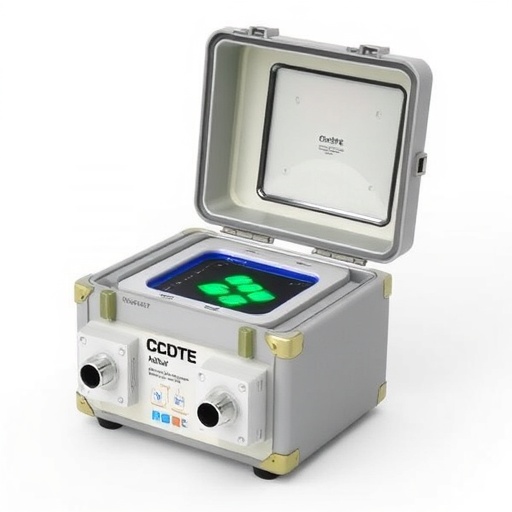
In the realm of environmental safety and public health, accurate detection of radon—a naturally occurring radioactive gas linked to lung cancer risk—remains a pressing challenge. Recent advancements have been made with the development of a novel portable alpha particle detector engineered to enhance radon monitoring capabilities. Leveraging the synergy of advanced simulation and circuit optimization tools, this device promises unprecedented portability without sacrificing sensitivity or accuracy, thereby signaling a paradigm shift in environmental radiation surveillance.
At the heart of this technological breakthrough lies a clever integration of the Geant4 toolkit and SPICE simulation environments, two powerhouse platforms often used independently in particle physics and electronic design, respectively. Their coupling facilitates an end-to-end optimization approach in the design process of a cadmium telluride (CdTe)-based semiconductor detector, tailored specifically for alpha particle detection attributed to radon decay. This integration allows engineers to simulate particle interactions with detector materials while concurrently refining its electronic response, thereby bridging the gap between theoretical physics and practical measurement systems.
Geant4, a Monte Carlo-based software toolkit, historically serves the scientific community by meticulously modeling the passage of particles through matter. In this project, its application was critical for understanding how alpha particles emanating from radon and its progeny interact within the semiconductor layers of the detector. These interactions define the energy deposition profiles which directly correlate with the device’s sensitivity and resolution. By simulating these microscopic events with high fidelity, the researchers gained invaluable insights into how detector geometry and material properties influence performance.
Meanwhile, SPICE (Simulation Program with Integrated Circuit Emphasis) simulation provided vital support by modeling the electronic circuitry responsible for signal processing. The compactness and portability goals necessitated a highly efficient amplifier and filtering system to discern the faint alpha signals amid inevitable electronic noise. Through iterative simulations in SPICE, the team was able to optimize the front-end electronics to maximize signal-to-noise ratio while minimizing power consumption, an essential factor for field-deployable instruments reliant on battery operation.
This dual simulation strategy enabled a holistic optimization framework. Rather than separately tuning the detector’s physical and electronic systems, the researchers simultaneously refined them, attuning material parameters, detector architecture, and circuit elements in unison. Such a methodology ensures that design alterations in one domain do not inadvertently degrade performance in the other. This integration exemplifies a growing trend in instrumentation engineering where multi-physics and multi-domain simulations converge to push technological boundaries.
The choice of cadmium telluride as the semiconductor material is particularly noteworthy. CdTe boasts a high atomic number and density, enhancing its interaction probability with alpha particles—a critical feature since alpha particles are highly ionizing but have limited penetration depth in matter. Its direct bandgap properties also contribute to efficient charge carrier generation and collection, essential for producing clear electrical signals correlating to radiation events. Such material characteristics position CdTe as an ideal candidate for miniaturized, high-performance radiation detectors.
Portability was a central design criterion, considering the growing need for radon detection in a variety of environments—from residential buildings and workplaces to outdoor public spaces. Traditional radon detectors often require bulky instrumentation or prolonged measurement times, limiting their practical deployment. By reducing the detector into a compact, battery-powered device without compromising sensitivity, this work paves the way for widespread, on-the-go radon monitoring. This democratization of environmental measurement could profoundly impact public health policies and individual decision-making regarding radon exposure.
Importantly, radon gas is invisible, odorless, and tasteless, making detection reliant on indirect measurement of its radioactive decay products. Alpha particles emitted during this decay are indicative of radon presence and concentration. However, their short range challenges effective detection, demanding precise instrumentation close to the emission source. The optimized detector’s heightened sensitivity to these alpha particles addresses this fundamental challenge, offering rapid and accurate readings that can inform risk assessments and mitigation strategies.
This research also highlights a trend towards interdisciplinary collaboration, merging expertise from nuclear physics, materials science, and electrical engineering to solve complex environmental monitoring issues. By utilizing sophisticated computational tools traditionally reserved for high-energy physics and microelectronics, the team demonstrated how cross-pollination of scientific domains can yield practical innovations with societal benefits.
The implications of such an optimized detector extend beyond radon monitoring. The methodologies established for coupled Geant4-SPICE optimization could be adapted to develop portable detectors for other types of ionizing radiation, such as beta or gamma rays, broadening the utility of this technology in environmental science, homeland security, and health physics. This flexibility underscores the potential for rapid development cycles and customized detector solutions tailored to diverse applications.
Moreover, sensitivity improvements made possible through this design approach may enable the detection of radon at lower concentrations than currently feasible, facilitating earlier intervention and risk reduction. Quick feedback loops enabled by portable detectors could drive behavioral changes in occupants regarding ventilation and building use, thereby mitigating radon exposure on a community-wide scale.
In terms of instrumentation advancement, the work underscored trade-offs between device miniaturization and electronic noise management. Smaller physical volumes inherently limit charge collection, but coupling simulations allowed fine-tuning of amplifier parameters to compensate for these constraints. The success of this balancing act sets a compelling precedent for future handheld detectors operating in noisy or challenging environments.
The incorporation of realistic environmental conditions into simulation models further strengthens confidence in device reliability. Factors such as temperature fluctuations and background radiation were considered in the SPICE electronic behavioral models, ensuring the detector’s robustness under real-world operating scenarios. This foresight enhances the technology’s readiness for commercialization and large-scale deployment.
In conclusion, the integration of Geant4 and SPICE simulations in the development of a portable CdTe-based alpha detector represents a remarkable stride forward in environmental radiation monitoring technology. By capturing the nuances of particle-matter interactions alongside sophisticated electronics optimization, the resulting device offers a compelling solution for accurate, real-time radon detection. This technological leap holds promise not only for advancing scientific instrumentation but also for fostering healthier living environments worldwide.
Such advancements highlight the transformative power that computational tools bring to applied physics and engineering, affirming that innovative detector designs no longer require time-consuming, trial-and-error experimentation alone. Instead, the fusion of physics-based simulations with electronic circuit emulations delivers high-performance, user-friendly instruments capable of addressing critical global health challenges.
The emphasis on portability and precision showcases a modern approach to environmental monitoring—one where accessibility and technological rigor converge to empower individuals and communities alike. As these devices become more widespread, they could catalyze a shift toward proactive radon exposure management, reducing the incidence of related diseases and improving public health outcomes.
Looking ahead, further refinements inspired by this methodology could unlock new frontiers in radiation detection, including real-time data integration with wireless networks and AI-driven analytics for predictive modeling of radon levels. The foundation established by this coupled Geant4-SPICE optimization approach offers a versatile platform upon which next-generation environmental sensors can be built.
This work exemplifies how meticulous simulation-driven design can overcome longstanding obstacles in sensor miniaturization and performance optimization. It signals a bright future for portable radiation detection, one that combines scientific insight with engineering ingenuity to protect and inform societies facing invisible environmental threats.
Subject of Research: Development and optimization of a portable cadmium telluride (CdTe)-based alpha particle detector for environmental radon monitoring.
Article Title: Coupled Geant4–SPICE optimization of a portable CdTe-based alpha detector for environmental radon monitoring
Article References:
Hosseinnezhad, A., Sabri, H. Coupled Geant4–SPICE optimization of a portable CdTe-based alpha detector for environmental radon monitoring. Sci Rep (2026). https://doi.org/10.1038/s41598-026-56485-7
Image Credits: AI Generated
Tags: advanced radon monitoring systemsalpha particle detection optimizationcadmium telluride semiconductor detectorenvironmental radiation monitoringGeant4 simulation in radiation detectionintegrated simulation for detector designlung cancer risk from radonportable CdTe alpha detectorportable radiation safety devicesradon decay alpha particle measurementradon gas detection technologySPICE circuit simulation for detectors