• HOME
  • NEWS
  • EXPLORE
    • CAREER
      • Companies
      • Jobs
    • EVENTS
    • iGEM
      • News
      • Team
    • PHOTOS
    • VIDEO
    • WIKI
  • BLOG
  • COMMUNITY
    • FACEBOOK
    • INSTAGRAM
    • TWITTER
Friday, August 14, 2026
BIOENGINEER.ORG
No Result
View All Result
  • Login
  • HOME
  • NEWS
  • EXPLORE
    • CAREER
      • Companies
      • Jobs
        • Lecturer
        • PhD Studentship
        • Postdoc
        • Research Assistant
    • EVENTS
    • iGEM
      • News
      • Team
    • PHOTOS
    • VIDEO
    • WIKI
  • BLOG
  • COMMUNITY
    • FACEBOOK
    • INSTAGRAM
    • TWITTER
  • HOME
  • NEWS
  • EXPLORE
    • CAREER
      • Companies
      • Jobs
        • Lecturer
        • PhD Studentship
        • Postdoc
        • Research Assistant
    • EVENTS
    • iGEM
      • News
      • Team
    • PHOTOS
    • VIDEO
    • WIKI
  • BLOG
  • COMMUNITY
    • FACEBOOK
    • INSTAGRAM
    • TWITTER
No Result
View All Result
Bioengineer.org
No Result
View All Result
Home NEWS Science News Health

Optimizing device implantation in patients with atrial fibrillation and risk of stroke

Bioengineer by Bioengineer
May 15, 2019
in Health
Reading Time: 3 mins read
0
IMAGE
Share on FacebookShare on TwitterShare on LinkedinShare on RedditShare on Telegram

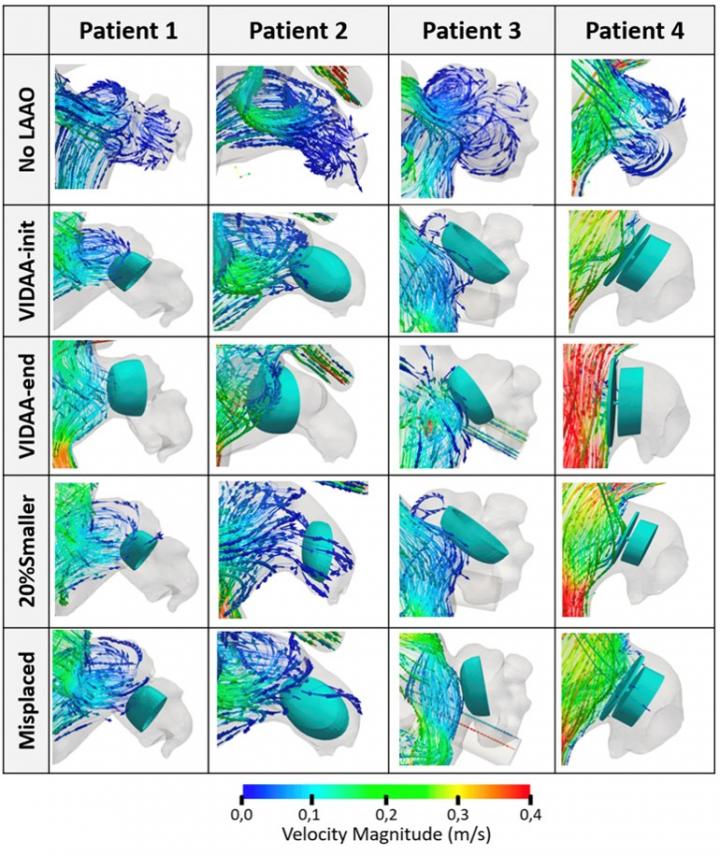
The study is based on the bachelor’s degree final project in Biomedical Engineering by Ainhoa M. Aguado, first author of the article, who worked under the leadership of Òscar Camara of the Physense group
IMAGE

Credit: UPF

According to clinical studies, about a third of patients with atrial fibrillation will suffer a stroke during their lifetime. Between 70 and 90% of these strokes are caused by a thrombus formed in the left atrial appendage.

In patients with contraindications to oral anticoagulants, a left atrial appendage occluder (LAAO) is often implanted to prevent blood flow entering in the LAA. But this strategy is not without problems and often the success of the device depends on the clinician’s experience. Implementation can even lead to blood clots outside the device, eventually leading to stroke if not treated.

The aim of a study, published in March in Frontiers in Physiology, was to develop tools based on biophysical models and interactive interfaces to optimize LAAO device therapies. The study was led by Òscar Camara, a researcher with the Physense Research Group, which is a part of the BCN MedTech Unit at the UPF Department of Information and Communication Technologies (DTIC). “A study that summarizes the good work of our research team over the past three years and is part of the bachelor’s degree final project in Biomedical Engineering by Ainhoa M. Aguado, first author of the study”, explains Camara.

VIDAA, a web-based 3D interactive virtual implantation platform

To obtain the most appropriate LAAO configurations for a given patient-specific LAA morphology, the researchers created a web-based 3D interactive virtual implantation platform called VIDAA. Then, based on the features of the shape of the patient’s appendage, the researchers calculated the most promising LAAO device.

Using the geometric and anatomic data of the patient’s left atrial appendage, together with the most suitable ad hoc device, volumetric meshes were built to run computational fluid dynamics simulations. Thus the researchers were able to assess estimated blood flow patterns after device implantation.

Thus, by combining the VIDAA platform with computational simulations it has been possible to identify the LAAO configurations associated to a lower risk of thrombus formation and also to reveal that the positioning of the device is a key element in the creation of regions with turbulent blood flows after implantation.

###

This work was led by Oscar Camara with the participation of his team, researchers of the Physense Research Group, at the UPF Department of Information and Communication Technologies, together with researchers from the Interventional Cardiology Division at Hospital de la Santa Creu i Sant Pau of the Autonomous University of Barcelona and the Cardiology Department at Hospital Clínic, of the University of Barcelona. There has also been international participation via the Arrhythmia Unit of the Cardiology Department at the Aalst Cardiovascular Centre in Belgium.

The research was supported by the Spanish Ministry of Economy and Competitiveness in the framework of the María de Maeztu Units of Excellence (MDM-2015-0502) and the Retos R&D Programme (DPI2015-71640-R).

Media Contact
Nuria Pérez
[email protected]

Original Source

https://www.upf.edu/web/e-noticies/home/-/asset_publisher/wEpPxsVRD6Vt/content/id/224330755/maximized#.XNu-Jo4zYdU

Related Journal Article

http://dx.doi.org/10.3389/fphys.2019.00237

Tags: CardiologyClinical TrialsMedicine/Healthneurobiology
Share13Tweet8Share2ShareShareShare2

Related Posts

Cell Membrane Protein Quality Control Begins at the Ribosome

August 14, 2026

Levidex RCT Shows Clinically Significant Quality-of-Life Improvements in Multiple Sclerosis

August 14, 2026

Study links coffee consumption with metabolic health and sex hormone levels

August 14, 2026

Alzheimer’s Protein Patterns Differ Across Populations

August 14, 2026
Please login to join discussion

POPULAR NEWS

  • London-held mystery leads scientists to discover a new Ecuadorian frog

    29 shares
    Share 12 Tweet 7
  • Acbd7 Essential for Maintaining Hair Cell-Mediated Hearing and Balance

    29 shares
    Share 12 Tweet 7
  • Active particles offer new ways to control brittle failure

    29 shares
    Share 12 Tweet 7
  • Independent Validation Emerges as Challenge for Industry-Led AI in Surgical Scene Understanding

    29 shares
    Share 12 Tweet 7

About

We bring you the latest biotechnology news from best research centers and universities around the world. Check our website.

Follow us

Recent News

London-held mystery leads scientists to discover a new Ecuadorian frog

Acbd7 Essential for Maintaining Hair Cell-Mediated Hearing and Balance

Active particles offer new ways to control brittle failure

Subscribe to Blog via Email

Enter your email address to subscribe to this blog and receive notifications of new posts by email.

Join 85 other subscribers
  • Contact Us

Bioengineer.org © Copyright 2023 All Rights Reserved.

Welcome Back!

Login to your account below

Forgotten Password?

Retrieve your password

Please enter your username or email address to reset your password.

Log In
No Result
View All Result
  • Homepages
    • Home Page 1
    • Home Page 2
  • News
  • National
  • Business
  • Health
  • Lifestyle
  • Science

Bioengineer.org © Copyright 2023 All Rights Reserved.