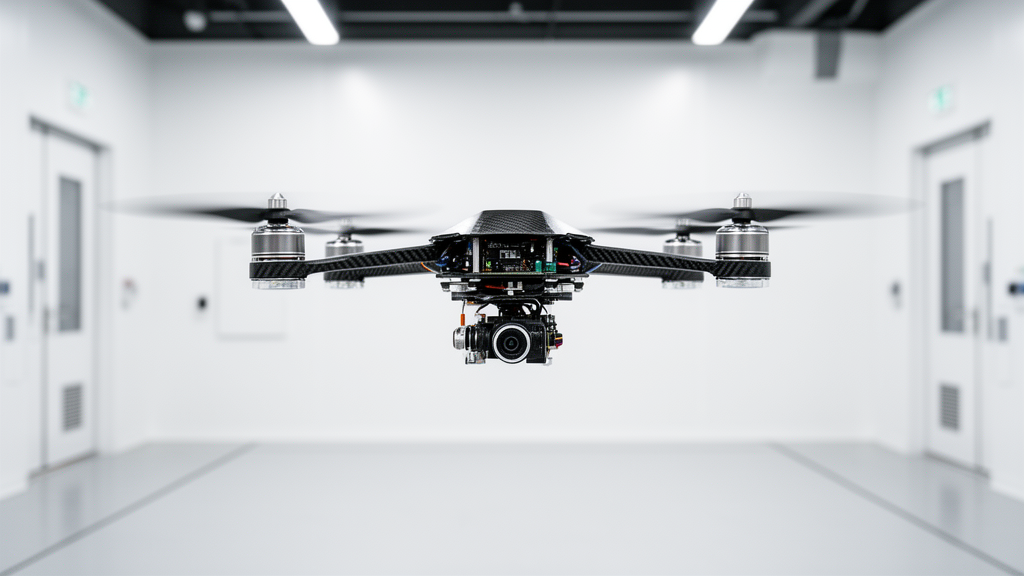
A newly developed dual-loop control architecture offers robust three-dimensional position tracking for quadrotors operating under environmental disturbances and model uncertainties. Published in the Journal of Intelligent & Robotic Systems, the engineering study introduces a hybrid framework combining an inner adaptive fuzzy feedback linearization controller with an outer sliding mode controller. The integrated control methodology is optimized using late acceptance hill climbing to maintain high-precision position and path tracking during dynamic aerial operations.
The research focuses on the complex technical problem of maintaining reliable quadrotor position control under demanding physical and aerodynamic constraints. Quadrotor flight dynamics involve strong nonlinear couplings across system states, physical actuator constraints, and inherent modeling errors.
To address these interrelated control challenges, the authors proposed a dual-loop architecture that divides stabilization and trajectory duties between two cooperative stages. The inner loop relies on a Fuzzy Adaptive Feedback Linearization Controller, designated as AFFLC, which is specifically tasked with cancelling structural nonlinearities and estimating system uncertainties online. Meanwhile, the outer loop utilizes a Sliding Mode Controller, or SMC, to enforce precise path following and robust position tracking across the desired flight trajectory.
To refine tracking performance, the framework incorporates a specialized asymmetric fuzzy adaptation mapping. This adaptive mechanism is formulated so that the adaptive gain scales nonlinearly with the magnitude of the tracking error while remaining small when the system is near the origin.
The dual-loop system incorporates Late Acceptance Hill Climbing, or LAHC, optimization to adjust the control parameters. Applying the LAHC optimization algorithm enhances the convergence speed of the tracking response, reduces unwanted oscillations within the generated control signals, and significantly improves system adaptability under varying payloads and changing dynamic operating conditions. Furthermore, the researchers verified the theoretical stability of the entire hybrid closed-loop structure using Lyapunov stability analysis.
Overall evaluation results indicate that the hybrid framework achieves more accurate three-dimensional trajectory tracking and demonstrates greater robustness against both external disturbances and internal uncertainties. Compared with computationally intensive deep learning approaches or heavy meta-heuristic optimization techniques, the proposed architecture generates smoother, low-cost control signals. Consequently, the authors conclude that the system provides a practical and implementable control solution for real-world quadrotor platforms.
Subject of Research: Robust quadrotor position control using dual-loop adaptive hybrid architectures
Article Title: Robust Quadrotor Position Tracking Using an LAHC-Optimized Dual-Loop Adaptive Fuzzy Feedback Linearization and Sliding Mode Control Framework
Article References: Spanogianopoulos, S., & Jalalnezhad, M. (2026). Robust Quadrotor Position Tracking Using an LAHC-Optimized Dual-Loop Adaptive Fuzzy Feedback Linearization and Sliding Mode Control Framework. Journal of Intelligent & Robotic Systems. https://doi.org/10.1007/s10846-026-02478-7
Image Credits: AI Generated
DOI: 10.1007/s10846-026-02478-7
Keywords: quadrotors, position tracking, dual-loop control, sliding mode control, feedback linearization, fuzzy adaptive control, Late Acceptance Hill Climbing, Lyapunov stability, actuator constraints, payload variations, wind disturbances, chattering reduction, nonlinear couplings, control signal optimization, three-dimensional tracking, aerial robotics
News Source: Denise Maddox. (November 18, 2026). Optimized Dual-Loop Control Framework Improves Robust Quadrotor Position Tracking. Scienmag.