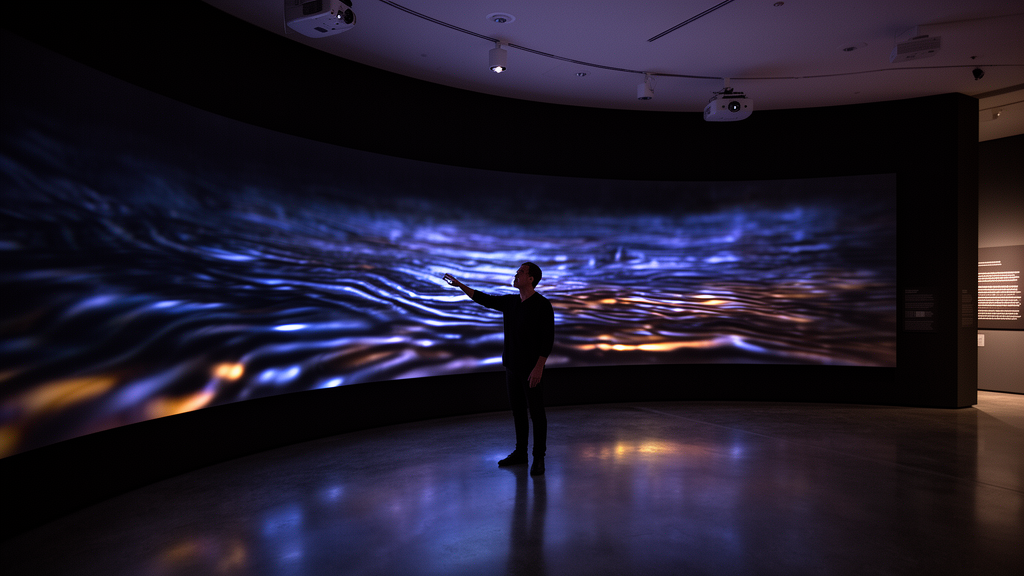
A computational framework combining cross-attention memory networks with a nature-inspired metaheuristic algorithm can predict audience immersion in digital twin art environments with a response time of 115 milliseconds, according to research conducted by Fang Qiao and published in Discover Artificial Intelligence. The system, designated as the dhole optimized cross-attention memory network, or DOCAMN, addresses long-standing computational bottlenecks in responsive cultural installations by unifying multimodal feature extraction, cross-modal attention mechanisms, and temporal modeling. Evaluated on a structured digital twin benchmark, the model maintained an operational memory footprint of 690 megabytes and a stability index of 0.91, while securing user-centric interaction, engagement, and adaptability ratings of 88.9, 90.5, and 89.7, respectively.
Interactive cultural spaces and contemporary media art installations increasingly rely on digital twin platforms that bridge physical gallery architectures with responsive virtual representations through continuous sensor monitoring and real-time visualization. However, conventional technical implementations frequently suffer from notable operational constraints, including static system architectures, dependence on isolated single-modal streams, and inadequate cross-modal fusion mechanisms that fail to register complex behavioral dependencies over extended exhibition visits. Existing installations utilizing rule-based routines or standard deep learning pipelines struggle with latency delays, computational scaling issues, and software-hardware integration friction when managing concurrent streams of environmental, physical, and participant tracking inputs. Furthermore, previous digital twin frameworks have primarily operated as descriptive simulation tools rather than active, predictive control systems, restricting their capacity to anticipate fluctuating participant attention or adapt spatial elements synchronously to changing user engagement levels within dynamic exhibition galleries.
To rigorously evaluate the predictive capabilities of the proposed architecture, the investigation utilized the publicly accessible Digital Twin Interactive Art Experience Dataset, an empirical repository comprising 10,350 multimodal interaction records gathered from 27 participants engaging across distinct gallery zones, including virtual reality, holographic, art, and acoustic environments. Each participant contributed multiple time-stamped interaction instances across varying observation intervals, providing continuous longitudinal tracking of user actions. The dataset captures structured multimodal metrics spanning physical movement velocity, spatial coordinates along horizontal and vertical axes, directional vectors, gesture intensity metrics, visual gaze durations, facial expression indicators, categorical attention states, and ambient environmental attributes such as ambient temperature and crowd density. Experimental validation adhered to an established protocol wherein 70 percent of the corpus, accounting for 7,245 records, served for model parameter estimation, while the remaining 30 percent, encompassing 3,105 records, was reserved strictly for out-of-sample performance evaluation.
Data preprocessing addressed substantial variations across measurement scales and experimental noise inherent to multi-sensor gallery telemetry. The raw input attributes exhibited notable scale disparities, with raw numerical values ranging from 4.82 to 498, skewness coefficients between 0.05 and 0.28, missing entry rates reaching up to 0.12 in gesture channels, and outlier rates reaching 0.18 in crowd density records. The author implemented linear Min-Max normalization to project all heterogeneous attributes onto a standardized zero-to-one interval, preventing individual high-magnitude dimensions from exerting undue numerical dominance during network parameter updates. Missing values across spatial, sensory, and interaction channels were resolved through local neighborhood value imputation, preserving local behavioral continuity while removing noisy structural artifacts. Notably, statistical outliers were intentionally preserved rather than trimmed, as abrupt deviations in motor activity, such as rapid hand gestures or rapid head rotations, frequently denote spontaneous peaks in audience engagement rather than instrumental transmission errors.
Multimodal signal conditioning further incorporated one-dimensional median filtering to suppress impulse spikes without degrading meaningful behavioral state transitions. In empirical filter evaluations across time windows spanning zero to ten seconds, sliding filtering windows with a kernel size of five to seven samples eliminated sharp transient anomalies caused by environmental interference or hardware recording latency. Specifically, testing confirmed signal-to-noise ratio enhancements of 19.2 decibels for movement speed, 24.1 decibels for gesture intensity, 18.4 decibels for environmental sensor logs, and 18.2 decibels for gaze tracking durations, while achieving an overall signal recovery rate exceeding 94 percent. Complementary time-frequency spectrogram analyses verified distinct modal dynamics: visual tracking signals concentrated spectral energy primarily below 7 hertz, spatial tracking trajectories exhibited broadband activity up to 10 hertz dominated by low-frequency drift, environmental sensors maintained narrow mid-frequency stability around 12 hertz, and physical interaction streams generated structured harmonic features centering near 8 hertz.
Following signal conditioning, the normalized tabular feature vectors were reshaped into structured one-dimensional representations and fed into a specialized one-dimensional convolutional neural network. Rather than processing raw video matrices or high-resolution graphic renderings, the convolutional layers extract localized cross-attribute correlations and latent representations directly from the behavioral and spatial sensor vectors. Mid-network convolutional layers progressively compressed feature dimensions through pooling operations while retaining critical interaction patterns and managing peak floating-point operations.
The deep feature representations generated by the convolutional module are subsequently directed into the Cross-Attention Memory Network, or CAMN, which orchestrates cross-modal alignment, dynamic feature fusion, and temporal sequence learning. The architecture incorporates an initial feature alignment layer that linearly projects heterogeneous visual-spatial features and interaction-sensor attributes into a shared latent space. A multi-head cross-attention mechanism then calculates interdependencies between the aligned channels, treating visual-spatial projections as query matrices while mapping interaction-sensor vectors into key and value representations. Scaled dot-product attention across multiple attention heads dynamically weights critical cross-modal patterns, which are concatenated, projected, and stabilized through residual connections and layer normalization. To model evolving temporal behaviors over extended gallery visits without suffering from the gradient vanishing limitations of recurrent cells, a dedicated memory network module replaces conventional long short-term memory units, forwarding memory-enhanced temporal representations to a dense regression head that outputs real-time immersion predictions.
To maximize predictive fidelity and prevent convergence toward suboptimal architectural states, the author introduced the Dhole Optimization algorithm to automate hyperparameter tuning across the multi-layered CAMN structure. Inspired by collective searching, encircling, and predatory convergence dynamics, the metaheuristic systematically navigates multidimensional parameter spaces to calibrate learning rates, attention head counts, memory depth parameters, feature projection weights, and regression coefficients. The algorithm balances exploration and exploitation phases through a decaying exploration factor, an encircling formulation based on population neighborhood vectors, and a sine-cosine attacking mechanism that dynamically adjusts candidate positions relative to weakened prey estimates. Across a population diversity ribbon that steadily contracted from 4.2 to 1.0 over 120 iterations, the optimization framework converged toward an optimal global configuration featuring an attention head count of 12 and an initial learning rate of 0.001, effectively avoiding secondary local attraction peaks.
In empirical benchmarking against established immersive modeling frameworks, DOCAMN demonstrated superior operational efficiency and stability when tested under identical hardware configurations and dataset splits. The proposed model attained an average response latency of 115 milliseconds, providing approximately 8.7 continuous inference cycles per second to support closed-loop exhibition synchronization. In contrast, existing baseline architectures, including a deep deterministic policy gradient framework with attention-based reinforcement learning and a hybrid recurrent neural network with genetic optimization, logged slower average response latencies of 132 milliseconds and 145 milliseconds, alongside higher 95th-percentile tail latencies of 275 milliseconds and 320 milliseconds compared to 222 milliseconds for DOCAMN. Furthermore, DOCAMN reduced physical-digital state divergence to values between 0.068 and 0.080, down from conventional baseline ranges of 0.208 to 0.287, achieving a 70.7 percent reduction in cumulative synchronization error across continuous 20-second tracking windows.
User-centric experiential evaluations were conducted with 27 domain evaluators possessing prior interaction experience in immersive digital media art environments to assess qualitative system responsiveness. Within this testing cohort, DOCAMN secured an interaction score of 88.9, an engagement score of 90.5, and an adaptability score of 89.7, outperforming baseline models across all user experience categories. Model predictions consistently traced measured ground-truth immersion trajectories within an absolute error boundary of plus or minus three points across a 60-to-100 evaluation scale, accurately capturing progressive transitions through initial exploration, active engagement, and peak immersion phases. The statistical validity and generalizability of these performance gains were corroborated through five-fold stratified cross-validation on the experimental dataset, which yielded low standard deviations, narrow 95 percent confidence intervals, and statistically significant p-values confirming structural stability across independent data folds.
Despite these documented technical advantages, the author highlighted several operational boundaries and developmental constraints that govern the present implementation. The predictive framework was constructed and validated entirely using offline interaction records extracted from a static Kaggle dataset rather than deployed within an active physical exhibition linked to a live digital twin network with bidirectional sensor telemetry.
Subject of Research: Multimodal audience immersion prediction in digital twin interactive art spaces using optimized neural networks
Article Title: AI and digital twin driven multimodal immersive experience prediction for art space audiences
Article References: Qiao, F. (2026). AI and digital twin driven multimodal immersive experience prediction for art space audiences. Discover Artificial Intelligence, 6(1), Article 1765. https://doi.org/10.1007/s44163-026-02115-0
Image Credits: AI Generated
DOI: 10.1007/s44163-026-02115-0
Keywords: digital twin, interactive art, multimodal fusion, cross-attention memory network, dhole optimization, immersion prediction, audience engagement, one-dimensional CNN, response time, median filtering, feature alignment, hyperparameter tuning, sensor telemetry, latent space, temporal dependencies, system stability
News Source: Denise Maddox. (November 12, 2026). Optimized Cross-Attention Memory Network Accurately Predicts Audience Immersion in Interactive Art. Scienmag.