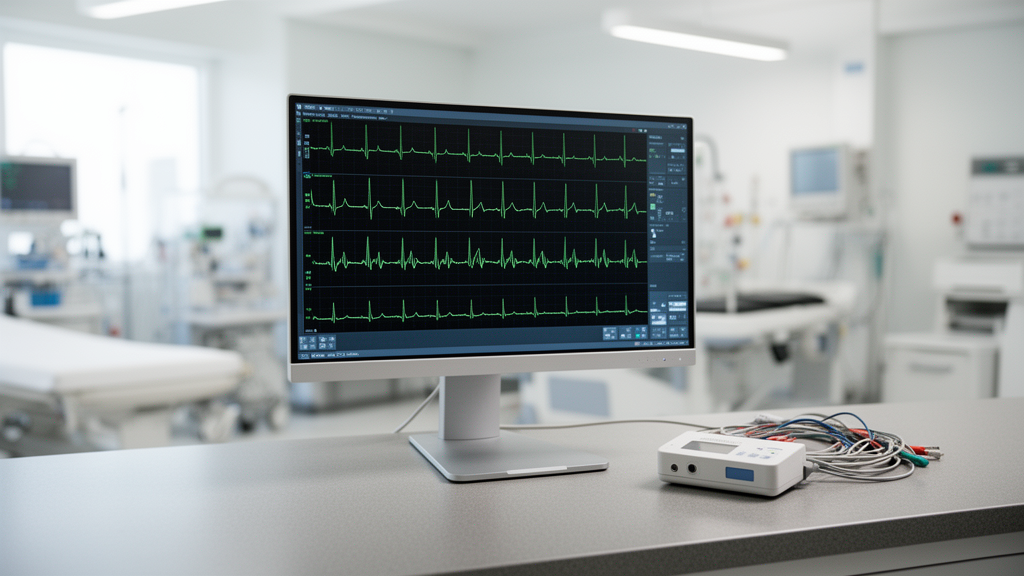
A computational framework that pairs sequential recurrent processing with graph neural representations has demonstrated improved precision and reduced false alarms in automated electrocardiogram screening. Developed by researcher Mohamed Mostafa Abdulali and reported in Discover Artificial Intelligence, the lightweight architecture combines long short-term memory networks with explicit message-passing graph structures to evaluate heart rhythms from standard biosignal recordings. Automated analysis of cardiac signals has become increasingly central to the Internet of Medical Things, where continuous physiological monitoring systems must balance temporal dynamics, complex relational features, and restricted computational resources. Rather than deploying oversized neural networks that demand extensive hardware infrastructure, the investigation introduced a streamlined framework engineered to process short segments of cardiac activity while adhering to strict methodological constraints. By examining cardiac waveforms through a hybrid model that evaluates both sequential beat order and relational signal representations, the research establishes a reproducible benchmark for preliminary screening without depending on post-hoc parameter adjustments or unverified assumptions about algorithmic adaptability.
Continuous physiological monitoring in out-of-hospital environments has expanded rapidly alongside the proliferation of wearable electronic sensors and connected healthcare ecosystems. Although deep neural networks are increasingly applied to detect anomalous biosignals, many existing models function as opaque predictive classifiers that fail to provide transparent operating procedures. Standard electrocardiogram analysis demands an architecture capable of processing both the instantaneous morphological features of individual heartbeats and the sequential relationships that unfold across consecutive cardiac cycles. Graph neural networks offer an effective mathematical mechanism for modeling relational dependencies among distinct signal features, yet a graph abstraction by itself does not naturally capture the temporal progression of physiological rhythms over time. Conversely, recurrent networks excel at tracking sequential patterns but can overlook structural relationships among heterogeneous descriptors derived from the same recording. To bridge this architectural divide, the study proposed a unified hybrid design that structures feature relationships into explicit graph nodes before passing the resulting embeddings into a temporal sequence encoder governed by a fixed decision threshold.
The structural foundation of the model relies on three explicitly defined feature representations extracted from each usable heartbeat window within the official MIT-BIH Arrhythmia Database. From the forty-seven retained patient recordings, complete three-hundred-sample segments centered on annotated beats were standardized using their individual segment means and standard deviations. Each standardized window was interpolated down to sixteen morphology points, forming a compact temporal snapshot of ventricular depolarization and repolarization. Alongside this morphological descriptor, two summary metrics were calculated from the standardized waveform to represent rhythm properties: total signal energy and peak-to-peak amplitude. To prevent data leakage across testing partitions, the scaling parameters for these rhythm descriptors were computed strictly from the training data folds and preserved without modification during validation and testing. Furthermore, each beat was assigned an electrocardiogram-derived proxy-context variable based on estimated heart rate, constructed from consecutive RR intervals using deterministic operational cutoffs to differentiate between lower, intermediate, and elevated cardiac frequencies.
These three distinct components—waveform morphology, normalized rhythm descriptors, and categorical proxy context—were structured into a fully connected three-node graph at each time increment. Each feature representation was aligned to a uniform width of sixteen dimensions through zero-padding, producing a compact node matrix. The graph architecture applied explicit mean-neighbor message passing between distinct nodes without self-loops, ensuring that each node aggregated feature information directly from the other two entities via separate learned linear transformation matrices and rectified linear unit activations. The resulting node vectors were averaged to generate a single sixteen-dimensional summary embedding for each discrete cardiac cycle. In the full hybrid pipeline, an ordered sequence of five consecutive beat embeddings, constructed with a five-beat stride to avoid overlapping cycles within individual patient records, was fed into a unidirectional long short-term memory encoder with a hidden dimension of sixteen. The final hidden state of the recurrent network was then passed through a two-layer classification head that generated a continuous probability denoting the likelihood of an abnormal beat.
To evaluate the system under rigorous methodological conditions, the experimental framework instituted a record-wise partitioning scheme that completely isolated patient recordings between training, validation, and testing partitions. This configuration ensured that the model never encountered cardiac cycles from the test subjects during training, preventing the inflated performance estimates that occur when beats from the same recording are randomly scattered across partitions. The diagnostic objective was formulated as a binary screening task rather than multi-class diagnosis, mapping normal sinus beats to class zero and ventricular ectopic, atrial ectopic, and paced beats to class one, while excluding unharmonized annotations. A single non-optimized decision threshold of 0.50 was applied across all experimental conditions to govern binary classification, directly linking the continuous probability output to a predictable operating rule. By executing all primary comparisons across five distinct random initialization seeds from 42 to 46, the study systematically accounted for optimization variance while maintaining transparent confusion-matrix accountability across thousands of test sequences.
In empirical evaluations on the primary MIT-BIH benchmark, the complete hybrid framework delivered noticeable improvements in screening precision and false-alarm suppression compared to a pure graph neural network baseline. The baseline model, which evaluated identical record-wise splits without recurrent temporal modeling or proxy-context features, attained a mean accuracy of 0.8717 across the five random seeds, coupled with a sensitivity of 0.9468, a precision of 0.6488, and a false-alarm rate of 0.1503. Incorporating the full hybrid configuration elevated mean accuracy to 0.8991 and improved the overall F1-score to 0.8121, while shifting the mean false-alarm rate downward to 0.1129. Precision increased by more than seven percentage points to reach 0.7215, while receiver operating characteristic area under the curve reached 0.9427 in the baseline and 0.9668 in the full hybrid model. Mean sensitivity under the full hybrid condition decreased slightly to 0.9399, highlighting an operational trade-off wherein the architecture substantially suppressed false positive detections at the cost of a marginal reduction in raw anomaly detection rate.
Systematic ablation experiments isolated the functional contributions of each model element by evaluating configurations that disabled specific architectural components under the identical fixed decision protocol. Testing an isolated proxy-context graph model demonstrated that incorporating heart-rate strata yielded modest improvements across accuracy, precision, and discrimination metrics compared to the baseline, confirming that relational integration of rhythm-derived categories contributes measurable predictive utility. Conversely, an ablation condition evaluating the temporal recurrent network without proxy-context features exhibited a slight decline in recall, F1-score, and area under the curve relative to the baseline, despite achieving a minor reduction in false alarms. This outcome revealed that adding sequential processing in isolation does not guarantee uniform performance gains across all metrics. Instead, the performance gains observed in the full hybrid model emerged from the coordinated interaction between structured graph message passing, temporal sequence modeling, and the inclusion of the context node, illustrating the nuanced dependencies underlying multi-component neural designs.
Because the proxy-context node was derived exclusively from consecutive electrocardiogram intervals rather than an independent physical activity sensor, the researchers conducted diagnostic sensitivity analyses to evaluate potential circularity and test the influence of sequential alignment. Evaluated on a representative test partition, the intact context representation increased classification accuracy by 4.03 percentage points and area under the curve by 3.17 points compared to a condition where context values were replaced with zeros, while simultaneously lowering the false-alarm rate by 2.83 points. To determine whether these improvements depended on accurate temporal ordering, the researchers tested a permuted condition in which context values were randomized across the five-beat sequence. This sequence-level permutation caused a modest decline of 0.55 percentage points in area under the curve and 0.69 points in F1-score relative to the properly aligned sequence. These diagnostic checks confirmed that while the proxy node provides meaningful predictive structure within the signal stream, it represents an internal feature transformation rather than an independent multimodal channel.
To establish whether the operating profile identified on the primary benchmark remained stable when applied to external data acquired under different technical specifications, the architecture was subjected to cross-database evaluation on the St Petersburg INCART arrhythmia database. Comprising twelve-lead recordings sampled at 257 hertz from seventy-five individuals, the external dataset was processed by extracting and resampling Lead I to match the 360-hertz configuration of the primary dataset. Applying the established binary label mapping and non-overlapping five-beat sequence construction yielded 34,428 evaluation sequences. Crucially, the external evaluation was conducted without fine-tuning, retraining, or threshold adjustment, directly transferring the model weights and fixed 0.50 threshold learned from the primary database. Across the five random training seeds, the full hybrid model achieved a mean accuracy of 0.8801, an area under the curve of 0.9065, an average precision of 0.6365, and an F1-score of 0.6129, alongside a false-alarm rate of 0.0977 and a recall of 0.7306, demonstrating robust cross-database stability under a locked protocol.
Alongside algorithmic validation, the study examined software-level portability and runtime efficiency to assess whether the lightweight architecture could operate effectively within computationally constrained digital environments. Exporting the trained hybrid network to the open neural network exchange format yielded a compact model file comprising 8,066 parameters with an on-disk footprint of approximately 36.1 kilobytes. Execution profiling conducted in a standard single-thread central processing unit environment via ONNX Runtime recorded a median latency of 0.076 milliseconds per five-beat sequence, representing a substantial reduction from the native PyTorch runtime latency of 0.572 milliseconds and corresponding to an operational throughput exceeding thirteen thousand samples per second. Numerical agreement checks confirmed strict logit consistency between the exported model and the original framework. The author emphasized that these computational metrics confirm software efficiency rather than physical microcontroller deployment, providing a transparent foundation for prospective investigations examining embedded hardware implementations and prospective clinical trials.
Subject of Research: Lightweight hybrid neural architectures for physiological electrocardiogram anomaly screening
Article Title: A lightweight hybrid LSTM–GNN framework with context-aware risk calibration for physiological monitoring
Article References: Abdulali, M. M. (2026). A lightweight hybrid LSTM–GNN framework with context-aware risk calibration for physiological monitoring. Discover Artificial Intelligence, 6(1), Article 1722. https://doi.org/10.1007/s44163-026-02679-x
Image Credits: AI Generated
DOI: 10.1007/s44163-026-02679-x
Keywords: electrocardiogram screening, graph neural networks, long short-term memory, physiological monitoring, machine learning, benchmark evaluation, cross-database testing, biomedical engineering, lightweight, hybrid, LSTM, framework
News Source: Cassandra Pierce. (November 13, 2026). Compact Hybrid Neural Model Enhances Electrocardiogram Anomaly Screening in Benchmark Tests. Scienmag.