WASHINGTON, July 5, 2022 – An optical fiber as thin as a strand of hair holds promise for use in minimally invasive deep-tissue studies of patients’ brains that show the effects Alzheimer’s disease and other brain disorders. The research could set the stage for minimally invasive in vivo brain imaging in lab studies and monitoring neuronal activity over time in patients with neurological disorders.
Credit: CREDIT: Benjamin Lochocki
WASHINGTON, July 5, 2022 – An optical fiber as thin as a strand of hair holds promise for use in minimally invasive deep-tissue studies of patients’ brains that show the effects Alzheimer’s disease and other brain disorders. The research could set the stage for minimally invasive in vivo brain imaging in lab studies and monitoring neuronal activity over time in patients with neurological disorders.
“The ultrathin multimode fiber would easily fit into an acupuncture needle, and we know these needles can be inserted into anyone’s body with almost no pain, potentially enabling deep-tissue imaging in real time,” said co-author Benjamin Lochocki, from Vrije Universiteit Amsterdam.
The challenge is efficiently increasing image resolution at the subcellular level, because loss of information is inevitable from light scrambling. In APL Photonics, published by AIP Publishing, researchers in the Netherlands address this challenge with speckle-based compressive imaging (SBCI) that exploits the light scrambling of multimode fibers to their advantage.
Optical fibers, a well-understood solution to guide light over long distances, have increasingly garnered attention in microendoscopy as a better way to access deep-lying tissue, due to their miniscule dimensions. They also eliminate the need for fluorescent labeling, a complicated and costly step.
Light scrambling is typically addressed via shaping the wavefront of an incident beam to reduce scattering and create a focused beam at the distal end of the fiber. However, this technique has limitations in acquisition speed and producing high-quality deep tissue images.
SBCI alters the laser beam entry position to create multiple and uncorrelated random speckle patterns at the fiber output. A computer algorithm can reconstruct an image of the object based on the pattern and its collected information.
This “compressive imaging” reduces the amount of pixel measurements needed to reconstruct an image of similar or better quality than the gold-standard raster imaging used in conventional endoscopes and microscopes. SBCI can produce high-resolution images up to 11 times faster, for a space three times as big, than the traditional raster-scan approach.
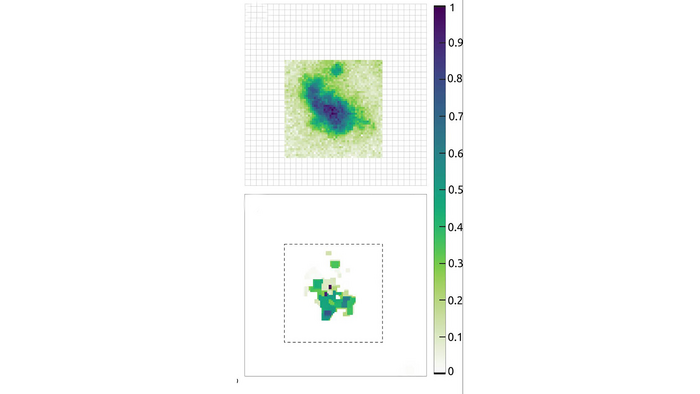
The technique was used to image lipofuscin, age-related fluorescent pigment that accumulates over time as metabolic waste in the soma, the part of neurons that contains the nucleus and is responsible for neurotransmitter production. Abnormal accumulation of lipofuscin might be associated with Alzheimer’s disease progression, although there is little understanding of this process.
The pigment buildup was visualized in a brain tissue sample of an Alzheimer’s patient donor obtained through the Netherlands Brain Bank.
###
The article “Epi-fluorescence imaging of the human brain though a multimode fiber” is authored by Benjamin Lochocki, Max V. Verweg, Jeroen J.M. Hoozemans, Johannes F. de Boer, and Lyubov Amitonova. The article will appear in APL Photonics on July 5, 2022 (DOI: 10.1063/5.0080672). After that date, it can be accessed at https://aip.scitation.org/doi/10.1063/5.0080672.
ABOUT THE JOURNAL
APL Photonics is the dedicated home for open access multidisciplinary research from and for the photonics community. The journal publishes fundamental and applied results that significantly advance the knowledge in photonics across physics, chemistry, biology and materials science. See https://aip.scitation.org/journal/app.
###
Journal
APL Photonics
DOI
10.1063/5.0080672
Article Title
Epi-fluorescence imaging of the human brain though a multimode fiber
Article Publication Date
5-Jul-2022