Credit: L. Brian Stauffer, University of Illinois
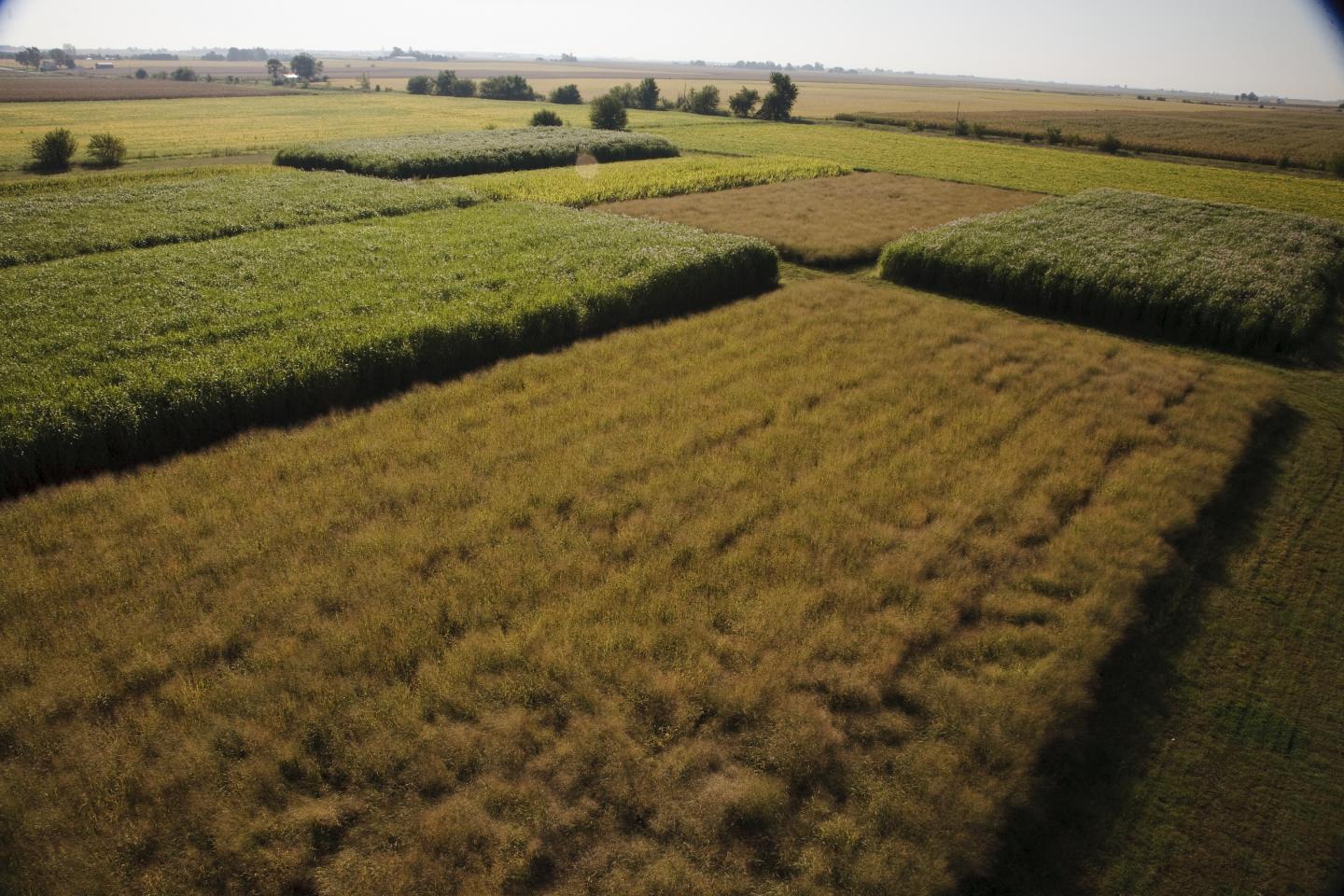
Scientists have confirmed that Miscanthus, long speculated to be the top biofuel producer, yields more than twice as much as switchgrass in the U.S. using an open-source bioenergy crop database gaining traction in plant science, climate change, and ecology research.
"To understand yield trends and variation across the country for our major food crops, extensive databases are available–notably those provided by the USDA Statistical Service," said lead author Stephen Long, Gutgsell Endowed Professor of Plant Biology and Crop Sciences at the University of Illinois. "But there was nowhere to go if you wanted to know about biomass crops, particularly those that have no food value such as Miscanthus, switchgrass, willow trees, etc."
To fill this gap, researchers at the Energy Biosciences Institute at the Carl R. Woese Institute for Genomic Biology created BETYdb, an open-source repository for physiological and yield data that facilitates bioenergy research. The goal of this database is not only to store the data but to make the data widely available and usable.
"In addition to providing an easy-to-use, web-based interface, the database supports automated data collection and big data analysis," said first author David LeBauer, a research scientist at Illinois. "Today the BETYdb database contains more than 40,000 open-access records.By making all of this data open access, we hope that researchers can identify new plants and best practices for biomass production. We've been using these data not only to summarize what has been observed in field trials, but also to identify new crops and predict productivity in new environments."
To demonstrate the database's value, researchers used BETYdb to definitively establish that Miscanthus is 2.4 times more productive than Switchgrass in the U.S. under a wide range of environmental and management conditions (e.g. fertilization rates, stand ages, planting densities), as reported in Global Change Biology Bioenergy.
"More than a decade of studies suggested that regardless of temperature, water or nitrogen Miscanthus, then grown only in Europe, would out yield the North American favorite switchgrass by more than two-fold," Long said. "This was based on limited data and did not take into account the breeding improvements in switchgrass that were occurring. Now that Miscanthus is grown in North America along with many improved cultivars of switchgrass we wondered: does the remarkable two-fold difference in yield still hold? And it does."
###
The Energy Biosciences Institute (EBI) is a public-private collaboration that is helping solve the global energy challenge with support from energy company BP. The partnership includes the University of California, Berkeley; University of Illinois at Urbana-Champaign; Lawrence Berkeley National Laboratory; and BP. Learn more at http://www.energybiosciencesinstitute.org.
The paper "BETYdb: A Yield, Trait and Ecosystem Service Database Applied to Second Generation Bioenergy Feedstock Production" is published by Global Change Biology (DOI: 10.1111/gcbb.12420). Co-authors include: Rob Kooper, University of Illinois; Patrick Mulrooney, University of California at San Diego; Scott Rohde, University of Illinois; Dan Wang, Nanjing University of Information Science and Technology; and Michael Dietze, Boston University. Their work was supported by the EBI and the National Science Foundation.
Media Contact
Claire Benjamin
[email protected]
@IGBIllinois
http://www.igb.uiuc.edu
############
Story Source: Materials provided by Scienmag