Credit: Tobias Fremout (KU Leuven)
A new tool maps the threats to the tropical dry forests in Peru and Ecuador. Bioscience engineers at KU Leuven combined data on possible threats to these forests – including fires and overgrazing – with data on the vulnerability of local tree species to these dangers, which the team estimated on the basis of species traits such as bark thickness and edibility of the leaves. The result is an online tool that local governments and NGOs can use to restore and conserve forests.
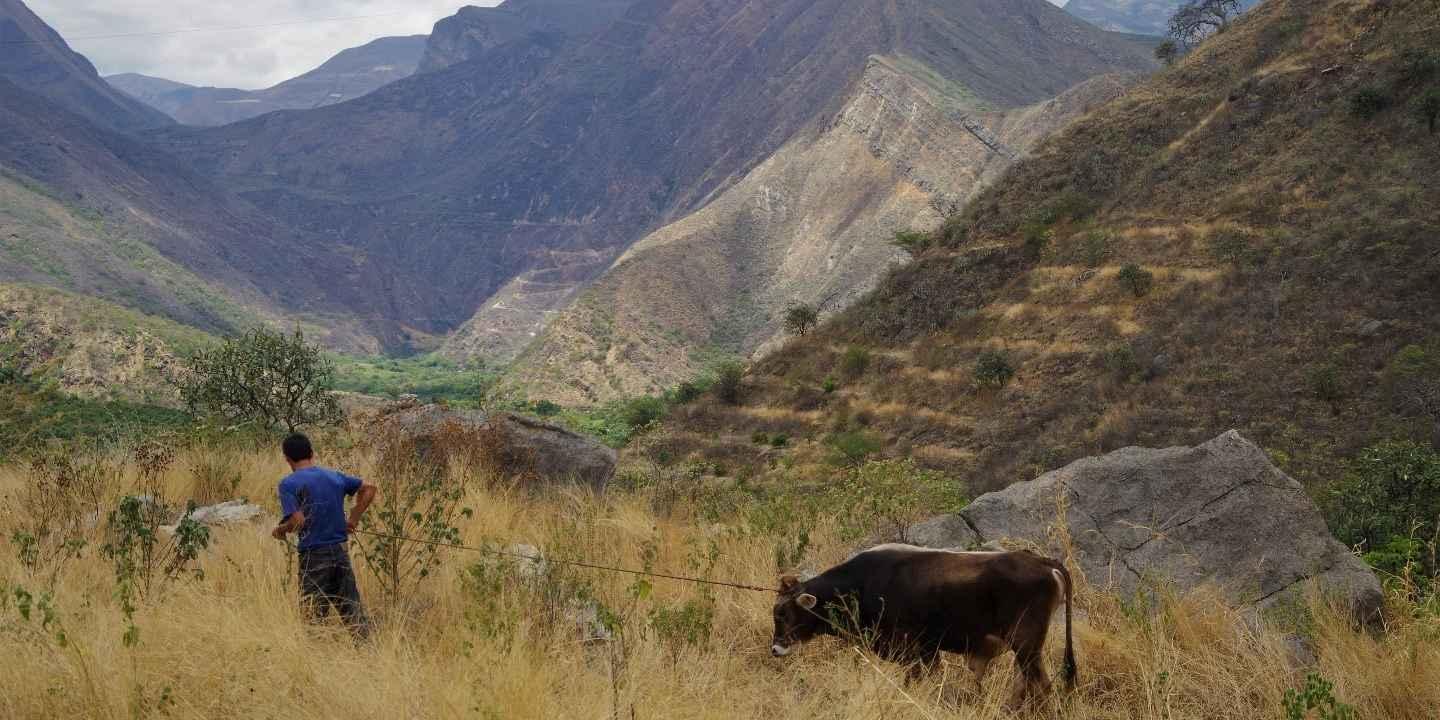
The tropical dry forests in Peru and Ecuador are under considerable strain due to fires, overgrazing, and overexploitation, among other things. And then there’s climate change as well. In collaboration with the international research institution Bioversity International, researchers from the Division of Forest, Nature and Landscape at KU Leuven developed a model that advises local governments and NGOs on how to restore and conserve these forests.
Unique model thanks to tree traits
What makes the KU Leuven model unique is the combination of the threats that a forest is exposed to with the traits of local tree species. “Due to this combination of factors, our model provides an accurate representation of the resilience of a forest and its tree species,” says doctoral student Tobias Fremout (KU Leuven), who is the lead author of this study. “A forest that mostly consists of trees with edible or ‘palatable’ leaves will be much more sensitive to overgrazing, for instance. Trees that are very useful for firewood, by contrast, are much more likely to suffer from overexploitation.”
The possible threats to a forest were divided into five categories: fire, habitat conversion, overexploitation, overgrazing, and climate change. These categories, in turn, were combined with several traits of tree species, including bark thickness, usability as firewood or timber, and growth rates.
Tobias Fremout was able to map more than 40,000 km2 of (former) forest and 50 tree species. He combined all this information in an online vulnerability assessment tool.
Conservation, restoration or a seed bank
It was a very deliberate decision to make the tool available to local governments. “The online tool is freely accessible on the Internet. Local governments can consult it to check for each tree species where it is most at risk due to which specific threat,” Tobias Fremout explains. This allows local governments to engage with the conservation and restoration of their forests in a very deliberate way. “The Peruvian authorities are aware of the enormous strain their forests are under, but their restoration efforts are sometimes still ill-considered. Via our tool, the authorities can see which species they should replant where, but especially also from which risks they should protect that specific area. After all, it’s hardly useful to replant trees with edible leaves without also providing a fence to keep away cows and goats.”
Replanting often seems to be the most logical choice. Due to climate change, however, it may not always be the smartest option. “We have used five climate models to predict whether, in the future, the regions under consideration will still offer the right circumstances for the tree species that are currently found there. If certain species are likely to get difficulties in particular areas, it’s a better idea to replant these species elsewhere or to store seeds in a seed bank,” Tobias Fremout continues.
Also useful in other countries
As the model developed by Tobias Fremout and his colleagues uses existing data on threats to tree species and traits, the model can also be translated to tropical forests in regions such as Africa or Asia. “To map the risk of forest fires, for instance, we used NASA observations. This information is available for the entire world and can, therefore, also be used for Cameroon or Indonesia, for instance. The characteristics of African and Asian trees are known and can be used in our model.”
###
More information
This study is a collaboration between KU Leuven and Bioversity International. The online tool is available here: https:/
Media Contact
Tobias Fremout
[email protected]
Original Source
https:/
Related Journal Article
http://dx.