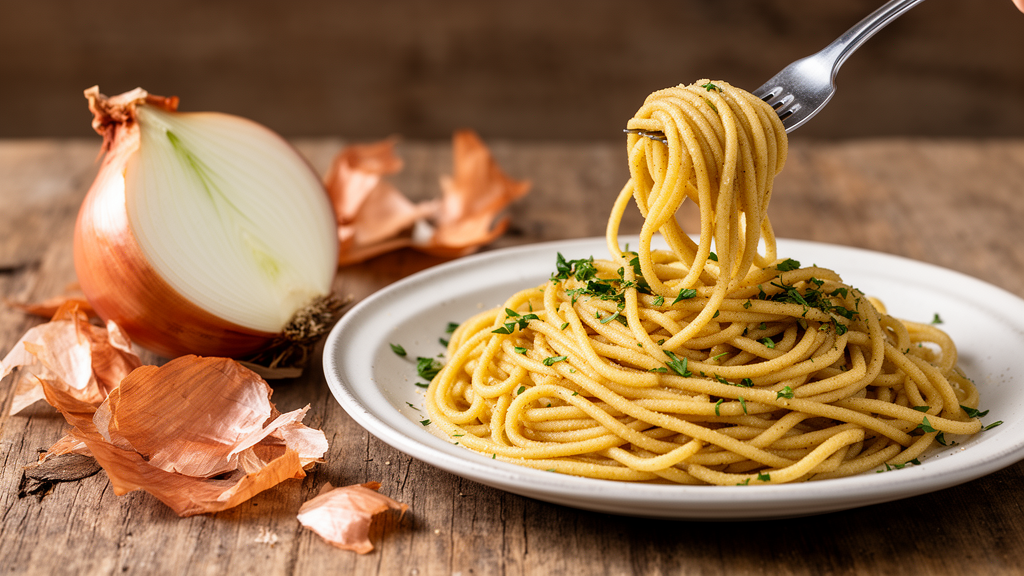
Every year, the global onion industry strips away mountains of papery outer skins, a waste stream that most processors pay to dispose of even though those peels are among the richest plant sources of quercetin and anthocyanins known to food science. A team of Italian researchers has now shown that this overlooked by-product can be transformed into something far more valuable than compost: a functional ingredient for fresh pasta that not only survives boiling but, remarkably, appears to release more of its beneficial compounds after cooking, and still delivers a measurable payload of antioxidants after a full simulated journey through the human digestive tract.
The study, published in the Journal of Agriculture and Food Research, builds on earlier work by the same group at the University of Foggia, who had already demonstrated that fresh pasta fortified with powdered red onion peel retained good technological quality and scored well in consumer taste tests. The new investigation asked a harder question: do the polyphenols actually survive processing and digestion, or do they simply vanish before they can do anything useful in the body? The answer, drawn from detailed chemical profiling at every stage from raw dough to intestinal digesta, is that a substantial fraction persists, and that the food matrix itself appears to play a protective role.
The raw material came from PGI Rossa di Tropea red onions, a prized variety from Calabria, supplied by the agricultural company Azienda Agricola Veltri. Chemical analysis revealed why the peels are so prized. The peel powder contained approximately 3,719 milligrams of total polyphenols per 100 grams of dry weight, roughly 400 times more than the durum wheat semolina used as the pasta base, which registered a mere 8.9 milligrams. Flavonoids dominated the profile at about 81 percent of the total, led by quercetin aglycone at over 2,000 milligrams per 100 grams, followed by the glycoside spiraeoside. Anthocyanins, the pigments that give red onions their color, accounted for about 13 percent, with cyanidin-3-glucoside as the flagship compound.
The researchers produced four pasta formulations: a plain control and three versions enriched with 3, 6, and 9 percent onion peel powder by weight. Each was cooked to its optimal cooking time, and both raw and cooked samples were then dried, milled, and analyzed by high-performance liquid chromatography with diode array detection. The results were striking. Uncooked control pasta contained just 3.9 milligrams of total polyphenols per 100 grams, while the enriched versions climbed from 152 to 330 and finally 534 milligrams as the peel fraction increased. After boiling, the numbers rose still further: the cooked 9 percent pasta reached 608 milligrams, a retention value of nearly 114 percent compared with its uncooked counterpart.
These apparent increases after cooking, the authors caution, do not mean that new polyphenols were being created in the pot. Rather, boiling water hydrates the pasta and partially disrupts the starch-protein network that locks phenolic compounds in place, making them easier to extract with solvents during analysis. The effect was most dramatic for quercetin aglycone, whose extractable concentration jumped from 101 to 166 milligrams per 100 grams in the 3 percent pasta, a retention of over 164 percent. Similar surges appeared for protocatechuic acid and a taxifolin derivative, while several quercetin glycosides and spiraeoside remained essentially stable, with retention values mostly between 80 and 110 percent.
The vulnerable compounds were the anthocyanins. These fragile pigments, which are prized for their potential role in modulating blood glucose and exerting anti-inflammatory effects, showed retention values ranging from about 57 to 97 percent depending on the derivative and the enrichment level. Cyanidin-3-(6-malonylglucoside), for example, dropped by roughly a quarter to a third during cooking. The researchers note that heating time may matter more than temperature for anthocyanin stability, and that some losses may reflect leaching into the cooking water, which was not analyzed in this study. Even so, the fact that most of these compounds remained detectable at all suggests that embedding them in a dense starch matrix offers partial protection against thermal degradation.
The decisive test came next: simulated gastrointestinal digestion. Using a standardized three-stage in vitro model with salivary amylase, gastric pepsin at pH 3, and an intestinal cocktail of pancreatin, lipase, and bile salts, the team tracked what happened to the polyphenols as a meal of the enriched pasta passed through the digestive system. The bioaccessible polyphenol content, meaning the fraction dissolved in the intestinal fluid and therefore potentially available for absorption, reached 55.6, 104, and 134 milligrams per 100 grams in the 3, 6, and 9 percent pastas respectively, compared with a paltry 1.36 milligrams for the control. Protocatechuic acid and spiraeoside led the charge, while anthocyanins contributed a bioaccessible 18 milligrams at the highest fortification level.
Mass balance calculations revealed that roughly 47 to 54 percent of the initial polyphenols could no longer be detected after digestion, a figure consistent with what is widely reported for food polyphenols, which are degraded, transformed into untargeted derivatives, or bound so tightly to matrix components that standard extraction misses them. About a quarter of the total phenolics remained in the insoluble residual fraction, and this is where the story takes a gut-health turn. Polyphenols that escape absorption in the small intestine travel to the colon, where resident microbes can ferment and transform them into smaller metabolites with potential prebiotic-like effects, modulating the composition and activity of the gut microbiome. The enriched pasta therefore delivers compounds with two distinct potential fates: an immediately bioaccessible fraction and a slow-release reservoir for the microbiota.
Antioxidant activity tracked the chemistry closely. Using two complementary assays, ABTS radical scavenging and FRAP ferric reducing power, the researchers found correlation coefficients as high as 0.996 between total polyphenol content and antioxidant capacity across all sample types, uncooked, cooked, soluble, and insoluble alike. The team is careful to point out that these assays measure different chemical properties and that the response reflects the combined contribution of many compounds rather than any single hero molecule. Interestingly, the 9 percent formulation yielded the most bioaccessible polyphenols in absolute terms, but the 6 percent version achieved the highest recovery index, indicating more efficient release per unit of polyphenol, likely because excessive fortification promotes binding to starch, proteins, and fiber while saturating the digestive enzymes.
Taken together with the earlier sensory and technological data, the authors conclude that 6 percent onion peel powder represents the sweet spot: enough to multiply the pasta’s polyphenol content roughly a hundredfold over semolina alone, with strong antioxidant delivery and the best recovery after digestion, all without sacrificing the qualities that make people actually want to eat it. The work also carries a broader message about circular economy food design. Rather than treating agro-industrial side streams as disposal problems, this study shows that a single waste product can be rerouted into a staple food consumed by billions of people worldwide. The researchers stress that in vitro digestion is only a proxy, and that bioavailability studies in humans and investigations of gut microbiota interactions will be needed to confirm any real health benefit, alongside questions of industrial scalability, shelf life, and regulation. But the core demonstration stands: the humble onion skin, once thrown away, can ride through boiling water and digestive enzymes and still arrive with its antioxidant cargo largely intact.
Subject of Research: Polyphenol stability, antioxidant activity, and bioaccessibility in fresh pasta enriched with red onion peel powder during processing and simulated gastrointestinal digestion
Article Title: From Processing to Digestion: Polyphenols Stability, Antioxidant Activity, and Bioaccessibility in Onion Peel–Enriched Fresh Pasta
Article References: Bavaro, A. R., Pagazzo, A., Del Nobile, M. A., Conte, A., D’Antuono, I., Linsalata, V., & Cardinali, A. (2026). From Processing to Digestion: Polyphenols Stability, Antioxidant Activity, and Bioaccessibility in Onion Peel–Enriched Fresh Pasta. Journal of Agriculture and Food Research, Article 103372. https://doi.org/10.1016/j.jafr.2026.103372
Image Credits: AI Generated
DOI: 10.1016/j.jafr.2026.103372
Keywords: onion peel, polyphenols, quercetin, anthocyanins, functional foods, pasta, bioaccessibility, in vitro digestion, antioxidant activity, food waste valorization, circular economy, gut microbiota
News Source: Alan Morgan. (October 15, 2026). Onion Peel Pasta Survives Cooking and Digestion With Its Antioxidants Largely Intact. Scienmag.