• HOME
  • NEWS
  • EXPLORE
    • CAREER
      • Companies
      • Jobs
    • EVENTS
    • iGEM
      • News
      • Team
    • PHOTOS
    • VIDEO
    • WIKI
  • BLOG
  • COMMUNITY
    • FACEBOOK
    • INSTAGRAM
    • TWITTER
Friday, May 15, 2026
BIOENGINEER.ORG
No Result
View All Result
  • Login
  • HOME
  • NEWS
  • EXPLORE
    • CAREER
      • Companies
      • Jobs
        • Lecturer
        • PhD Studentship
        • Postdoc
        • Research Assistant
    • EVENTS
    • iGEM
      • News
      • Team
    • PHOTOS
    • VIDEO
    • WIKI
  • BLOG
  • COMMUNITY
    • FACEBOOK
    • INSTAGRAM
    • TWITTER
  • HOME
  • NEWS
  • EXPLORE
    • CAREER
      • Companies
      • Jobs
        • Lecturer
        • PhD Studentship
        • Postdoc
        • Research Assistant
    • EVENTS
    • iGEM
      • News
      • Team
    • PHOTOS
    • VIDEO
    • WIKI
  • BLOG
  • COMMUNITY
    • FACEBOOK
    • INSTAGRAM
    • TWITTER
No Result
View All Result
Bioengineer.org
No Result
View All Result
Home NEWS Science News Chemistry

One-two-punch catalysts trapping CO2 for cleaner fuels

Bioengineer by Bioengineer
June 7, 2019
in Chemistry
Reading Time: 2 mins read
0
IMAGE
Share on FacebookShare on TwitterShare on LinkedinShare on RedditShare on Telegram

IMAGE

Credit: ©DGIST

Copper and platinum nanoparticles added to the surface of a blue titania photocatalyst significantly improve its ability to recycle atmospheric carbon dioxide into hydrocarbon fuels.

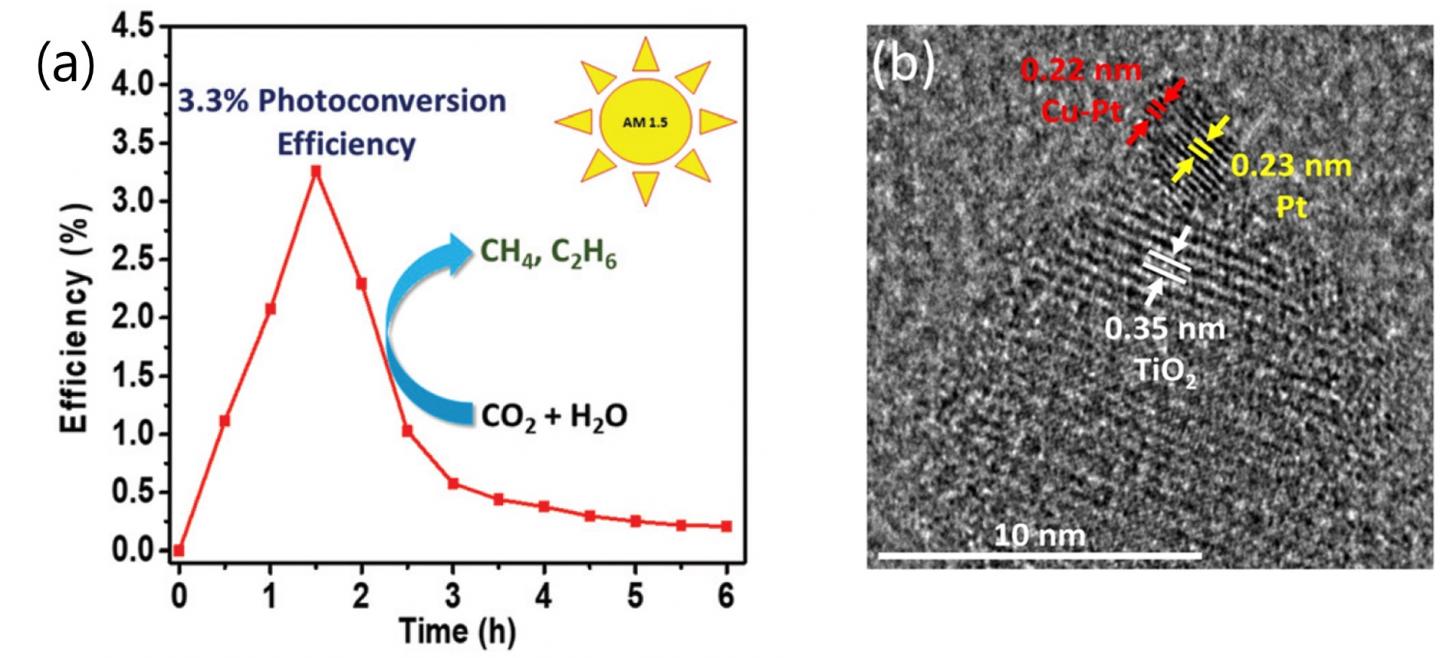
The modified photocatalyst was developed and tested by researchers at the Daegu Gyeongbuk Institute of Science and Technology (DGIST), with colleagues in Korea, Japan, and the US. It converted sunlight to fuel with an efficiency of 3.3% over 30-minute periods. This ‘photoconversion efficiency’ is an important milestone, the researchers report in their study published in the journal Energy and Environmental Science, as it means that large-scale use of this technology is becoming a more realistic prospect.

Photocatalysts are semiconducting materials that can use the energy from sunlight to catalyse a chemical reaction. Scientists are investigating their use to trap harmful carbon dioxide from the atmosphere as one of many means to alleviate global warming. Some photocatalysts are being tested for their ability to recycle carbon dioxide into hydrocarbon fuels like methane, the main component found in natural gas. Methane combustion releases less carbon dioxide into the atmosphere compared to other fossil fuels, making it an attractive alternative. But scientists have been finding it difficult to manufacture photocatalysts that produce a large enough yield of hydrocarbon products for their use to be practical.

Professor Su-Il In of DGIST’s Department of Energy Science and Engineering and his colleagues modified a blue titania photocatalyst by adding copper and platinum nanoparticles to its surface.

Copper has good carbon dioxide adsorption property while platinum is very good at separating the much-needed charges generated by the blue titania from the sun’s energy.

The team developed a unique set-up to accurately measure the catalyst’s photoconversion efficiency. The catalyst was placed in a chamber that received a quantifiable amount of artificial sunlight. Carbon dioxide gas and water vapour moved through the chamber, passing over the catalyst. An analyser measured the gaseous components coming out of the chamber as a result of the photocatalytic reaction.

The blue titania catalyst converts the energy in sunlight into charges that are transferred to the carbon and hydrogen molecules in carbon dioxide and water to convert them into methane and ethane gases. The addition of copper and platinum nanoparticles on the catalyst’s surface was found to significantly improve the efficiency of this process.

“The photocatalyst has a very high conversion efficiency and is relatively easy to manufacture, making it advantageous for commercialization,” says Prof. In. “

The team plans to continue its efforts to further improve the catalyst’s photoconversion efficiency, to make it thick enough to absorb all incident light, and to improve its mechanical integrity to enable easier handling.

###

Media Contact
Su-il In
[email protected]

Original Source

https://www.dgist.ac.kr/bbs/?mode=V&site_dvs_cd=en&menu_dvs_cd=060202&code=060104&no=03491263fa5e177ed963b82c17c0f6f8&GotoPage=1

Related Journal Article

http://dx.doi.org/10.1039/c9ee00734b

Tags: Biomedical/Environmental/Chemical EngineeringChemistry/Physics/Materials SciencesEcology/EnvironmentEnergy SourcesEnergy/Fuel (non-petroleum)Industrial Engineering/Chemistry
Share12Tweet8Share2ShareShareShare2

Related Posts

Smart Hydrogels Revolutionize Information Security with Photo-Patterning and Multi-Stimuli Responsive Structural Colors — Chemistry

Smart Hydrogels Revolutionize Information Security with Photo-Patterning and Multi-Stimuli Responsive Structural Colors

May 15, 2026
Scientists Overcome Longstanding Challenge in Measuring Semiconductor Defects — Chemistry

Scientists Overcome Longstanding Challenge in Measuring Semiconductor Defects

May 14, 2026

Wall Design Highlights Deaf and Hard-of-Hearing Experience at #ASA190

May 14, 2026

New Method Finds More Efficient Route Between Earth and Moon Than Ever Before

May 14, 2026
Please login to join discussion

POPULAR NEWS

  • Research Indicates Potential Connection Between Prenatal Medication Exposure and Elevated Autism Risk

    843 shares
    Share 337 Tweet 211
  • New Study Reveals Plants Can Detect the Sound of Rain

    729 shares
    Share 291 Tweet 182
  • Salmonella Haem Blocks Macrophages, Boosts Infection

    62 shares
    Share 25 Tweet 16
  • Breastmilk Balances E. coli and Beneficial Bacteria in Infant Gut Microbiomes

    58 shares
    Share 23 Tweet 15

About

We bring you the latest biotechnology news from best research centers and universities around the world. Check our website.

Follow us

Recent News

A*STAR Scientists Unveil Novel Technique to Decipher RNA Structure’s Impact on Health and Disease

Smart Hydrogels Revolutionize Information Security with Photo-Patterning and Multi-Stimuli Responsive Structural Colors

Unveiling the Unseen: POSTECH Team Creates AI Framework to Detect Hidden Defects in Metal 3D Printing

Subscribe to Blog via Email

Enter your email address to subscribe to this blog and receive notifications of new posts by email.

Join 82 other subscribers
  • Contact Us

Bioengineer.org © Copyright 2023 All Rights Reserved.

Welcome Back!

Login to your account below

Forgotten Password?

Retrieve your password

Please enter your username or email address to reset your password.

Log In
No Result
View All Result
  • Homepages
    • Home Page 1
    • Home Page 2
  • News
  • National
  • Business
  • Health
  • Lifestyle
  • Science

Bioengineer.org © Copyright 2023 All Rights Reserved.