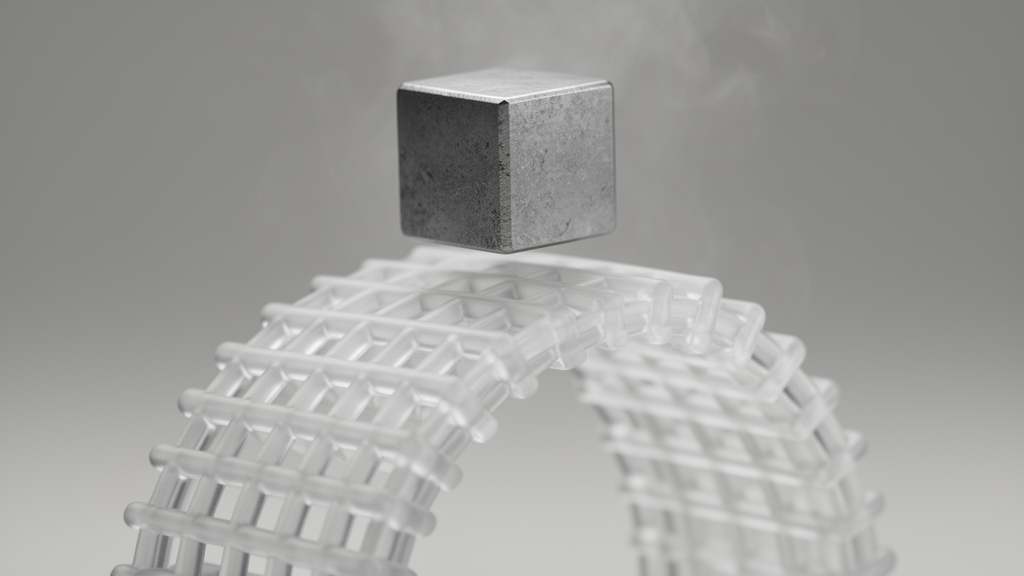
Researchers have fabricated bioinspired microactuators using a one-step meniscus-guided 3D nanoprinting technique that directly produces a freestanding three-dimensional composite architecture. The process integrates a rigid nanoparticle framework with a hygroscopic polymer matrix in a single, assembly-free step, according to the study published in Advanced Composites and Hybrid Materials.
The design draws on the functional integration of rigid and compliant components in the insect exoskeletal joint. In the resulting microscale pillar, these two roles are combined in a single structure: the nanoparticle scaffold provides mechanical support, while the polymeric phase provides volumetric expansion. This pairing yields large reversible elongation under humidity while preserving structural integrity, the authors report.
Comprehensive experiments, including comparative control structures and microscopic analysis, were used to elucidate the actuation mechanism. The resulting AuNP–PVP microactuator shows humidity-responsive actuation at the microscale, with representative demonstrations of repeated humidity cycling and load lifting up to approximately 800 times its estimated own weight under the tested conditions.
Variant geometries extend what the basic pillar can do. Hinged pillars demonstrate how axial swelling can be converted into bending motion, and an optical configuration shows how actuation can modulate reflected light signals. These demonstrations suggest routes toward microscale sensing, optical modulation, and adaptive microdevices, the authors note.
The nanoprinting approach is presented as a simple strategy for constructing bioinspired soft microactuators with humidity-responsive deformation. Because the freestanding composite architecture forms directly in a single process, the technique avoids separate assembly steps, and the reported results are limited to the tested laboratory conditions described in the study.
Subject of Research: Fabrication of bioinspired humidity-responsive microactuators by one-step meniscus-guided 3D nanoprinting
Article Title: Bioinspired microactuators fabricated via one-step meniscus-guided 3D nanoprinting
Article References: Eom, S.-J., Devaraj, V., Kwak, S., Seo, H.-S., Zentgraf, T., Kim, W.-G., & Lee, J.-M. (2026). Bioinspired microactuators fabricated via one-step meniscus-guided 3D nanoprinting. Advanced Composites and Hybrid Materials. https://doi.org/10.1007/s42114-026-02151-5
Image Credits: AI Generated
DOI: 10.1007/s42114-026-02151-5
Keywords: microactuators, 3D nanoprinting, meniscus-guided printing, bioinspired materials, gold nanoparticles, PVP polymer, humidity response, hygroscopic swelling, soft robotics, optical modulation, composite architecture, microscale actuation
News Source: Denise Maddox. (October 29, 2026). One-step 3D nanoprinting creates humidity-driven microactuators that lift 800 times their weight. Scienmag.