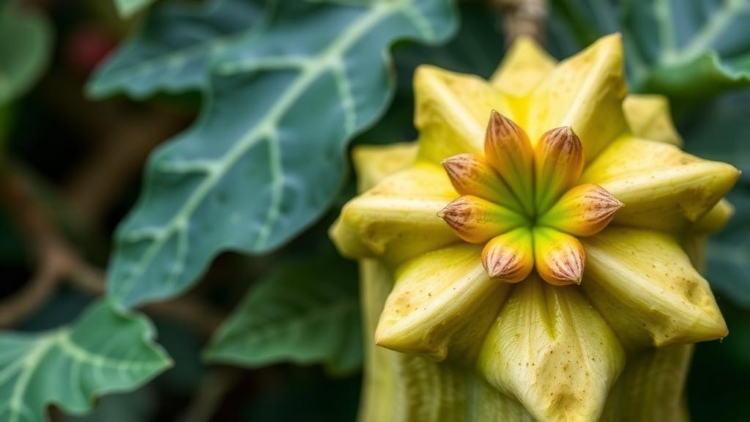
In the quiet world of vegetable genetics, a humble winter melon relative is making unexpected waves. Wax gourd, or Benincasa hispida, is a sprawling cucurbit cultivated across Asia for its enormous waxy fruits, yet the molecular machinery that sculpts those fruits has remained largely a black box. Now a team at the Guangdong Academy of Agricultural Sciences has mapped an entire family of shape-controlling genes in the crop and zeroed in on one member, BhYAB2, that appears to act as a brake on organ elongation. The study, published in BMC Plant Biology, offers the first genome-wide portrait of the YABBY transcription factor family in wax gourd and provides experimental evidence that a single gene from this family can visibly reshape leaves and seed pods when transplanted into another plant species.
The YABBY family is one of botany’s classic shape-regulating gene groups. First characterized in the laboratory weed Arabidopsis thaliana, YABBY transcription factors are DNA-binding proteins that switch other genes on or off, and they are famous for their role in defining the identity and polarity of lateral organs such as leaves, floral organs and fruits. In essence, they help a plant decide how a leaf or a fruit should grow along its length versus its width. Because fruit shape is a major determinant of yield, handling quality and market value in cucurbit crops, understanding which YABBY genes are active during fruit development in wax gourd could eventually give breeders a molecular handle on one of the crop’s most economically visible traits.
The researchers began with a systematic sweep of the wax gourd genome. Using bioinformatic screening against known YABBY sequences from Arabidopsis and other cucurbits, they identified eight BhYAB genes, which fell neatly into the five subfamilies typical of flowering plants: YAB1, YAB2, YAB3, YAB5 and CRC-like. Phylogenetic trees built from the protein sequences showed that each BhYAB gene sat closest to its homologs in Arabidopsis and related cucurbit species, indicating that the family has been conserved through the evolutionary history of these lineages rather than expanded or pruned in wax gourd specifically. That conservation is itself informative, because it suggests the core developmental functions of the family are likely shared across species, making cross-species experiments a reasonable first probe of function.
A closer look at gene architecture reinforced this picture of conservation. The eight genes shared highly similar exon-intron structures, and their proteins carried the same conserved motifs, including the zinc-finger-like N-terminal region and the characteristic YABBY domain that defines the family. When the team examined the promoter regions upstream of each gene, they found a rich assortment of hormone-responsive elements, including binding sites linked to auxin, gibberellin, abscisic acid and methyl jasmonate signaling. This detail matters because plant organ shape is heavily modulated by hormone pathways, and the presence of these regulatory elements hints that BhYAB genes may act as intersection points where developmental identity meets hormonal control.
With the family catalogued, the next challenge was deciding which member to study in depth. The team turned to transcriptome data, measuring gene activity as fragments per kilobase of transcript per million mapped reads across different tissues and fruit developmental stages. One gene stood out: BhYAB2 showed the most pronounced fruit-specific expression during early fruit development, the critical window when a young ovary is expanding rapidly after pollination. Quantitative reverse transcription PCR, a sensitive laboratory technique that amplifies and measures specific RNA transcripts, confirmed the transcriptome pattern, showing that BhYAB2 activity peaked in the days following pollination. This temporal signature made BhYAB2 the natural candidate for functional testing.
Before any functional experiment, the researchers confirmed where the protein operates inside the cell. Transcription factors must physically enter the nucleus to bind DNA, and BhYAB2 passed this test cleanly. Fusion studies with fluorescent reporter proteins showed that BhYAB2 localizes to the nucleus, consistent with its predicted nuclear localization signal and with its presumed role as a direct regulator of gene expression rather than an indirect player in the cytoplasm.
The decisive experiment came from moving BhYAB2 into Arabidopsis, the workhorse of plant genetics. The team created overexpression lines in which BhYAB2 was driven by the strong 35S promoter, forcing the gene to be active throughout the plant. The results were striking and anatomically specific. Overexpression lines produced siliques, the elongated seed pods of Arabidopsis, that were shorter and wider than those of wild-type plants. Rosette leaves showed the opposite dimensional shift, becoming longer relative to their width, with a higher length-to-width ratio. Taken together, the authors interpret these phenotypes as evidence that BhYAB2 may restrain longitudinal elongation while promoting lateral expansion of lateral organs, effectively reprogramming the growth axes of the tissues where it is active. The fact that leaves and fruits responded differently underscores how context-dependent these transcription factors can be, with the same gene producing divergent geometric outcomes depending on the organ and developmental program it enters.
To connect these visible shape changes to underlying biochemistry, the researchers examined gibberellin, the plant hormone class most directly responsible for driving cell elongation. In the siliques of BhYAB2 overexpression lines, three key gibberellin biosynthesis genes, AtGA20ox1, AtGA20ox2 and AtGA3ox1, were down-regulated. These enzymes catalyze essential steps in the production of active gibberellins, so their reduced expression is consistent with a model in which BhYAB2 dampens gibberellin biosynthesis, thereby limiting the hormone-fueled elongation that normally lengthens the organ. The authors are careful with their language here, describing this as a potential repressive effect rather than a proven causal chain, but the correlation between reduced gibberellin pathway activity and the shorter, wider organ phenotype provides a plausible mechanistic thread linking gene to geometry.
The study’s conclusions come with appropriate scientific caution. Because the functional work was performed in Arabidopsis rather than in wax gourd itself, BhYAB2 is best described as a candidate regulator of organ shape whose endogenous role in its native crop remains to be verified. The gold standard confirmation would involve knocking out or editing BhYAB2 in wax gourd and observing whether fruit dimensions change accordingly, an experiment the authors flag as the logical next step. Supplementary data from the paper, including stem measurements and expression profiles across two inbred wax gourd lines, suggest the team is already building the foundation for such validation. Still, even at the candidate stage, the work delivers real value: a complete annotated inventory of the BhYAB family, expression maps that point breeders toward fruit-development genes, and a heterologous functional test that narrows the field from eight genes to one prime suspect.
For the broader agricultural community, the implications extend beyond one melon. Wax gourd is an increasingly important crop in tropical and subtropical agriculture, and fruit shape traits in cucurbits are classic targets for both conventional breeding and gene editing. If BhYAB2 or its relatives prove to control fruit proportions in the crop itself, they could join the growing toolkit of shape genes, alongside known cucurbit fruit-shape loci, that breeders manipulate to tailor produce for market preference, mechanical harvestability and packing efficiency. The study also adds to a growing appreciation that YABBY genes across the plant kingdom act as tunable dials on organ geometry, dialing elongation up or down through hormonal pathways. What began as a systematic gene census in an under-studied gourd has thus surfaced a candidate switch with the potential to reshape, quite literally, one of Asia’s most familiar vegetables.
Subject of Research: YABBY transcription factor family identification in wax gourd and functional analysis of BhYAB2 in fruit and leaf development
Article Title: Genome-wide identification of the YABBY gene family in wax gourd (Benincasa hispida) and functional analysis of BhYAB2 in fruit and leaf development
Article References: Li, D., Wang, B., Sun, P., Zhai, X., Huang, L., Jiang, B., Yan, J., & Liu, W. (2026). Genome-wide identification of the YABBY gene family in wax gourd (Benincasa hispida) and functional analysis of BhYAB2 in fruit and leaf development. BMC Plant Biology. https://doi.org/10.1186/s12870-026-10050-6
Image Credits: AI Generated
DOI: 10.1186/s12870-026-10050-6
Keywords: YABBY transcription factors, wax gourd, Benincasa hispida, BhYAB2, fruit development, leaf development, gibberellin, transcription factors, genome-wide identification, plant hormones, cucurbits, organ shape
Cite Scienmag News
APA
MLA
Chicago
Juliet Wilcox. (October 2, 2026). One Gene Shapes Gourds: BhYAB2 Emerges as a Master Switch for Fruit and Leaf Form. Scienmag. https://scienmag.com/one-gene-shapes-gourds-bhyab2-emerges-as-a-master-switch-for-fruit-and-leaf-form/
Juliet Wilcox. “One Gene Shapes Gourds: BhYAB2 Emerges as a Master Switch for Fruit and Leaf Form.” Scienmag, 2 October 2026, https://scienmag.com/one-gene-shapes-gourds-bhyab2-emerges-as-a-master-switch-for-fruit-and-leaf-form/. Accessed 2 October 2026.
Juliet Wilcox. “One Gene Shapes Gourds: BhYAB2 Emerges as a Master Switch for Fruit and Leaf Form.” Scienmag. October 2, 2026. https://scienmag.com/one-gene-shapes-gourds-bhyab2-emerges-as-a-master-switch-for-fruit-and-leaf-form/
Copy citation
Download RIS
Tags: Benincasa hispidaBhYAB2cucurbitsfruit developmentgene editing for crop shape modificationgenetic control of leaf and fruit morphologygenetic engineering of plant organ shapegenome-wide analysis of YABBY gene familygenome-wide identificationgibberellinleaf developmentmolecular basis of vegetable shape controlmolecular mechanisms of organ elongationorgan shapeplant developmental biologyplant hormonesplant shape regulationrole of BhYAB2 in plant organ formationtranscription factorstranscription factors influencing plant polaritywax gourdwax gourd fruit development geneticsYABBY transcription factorsYABBY transcription factors in cucurbit genetics