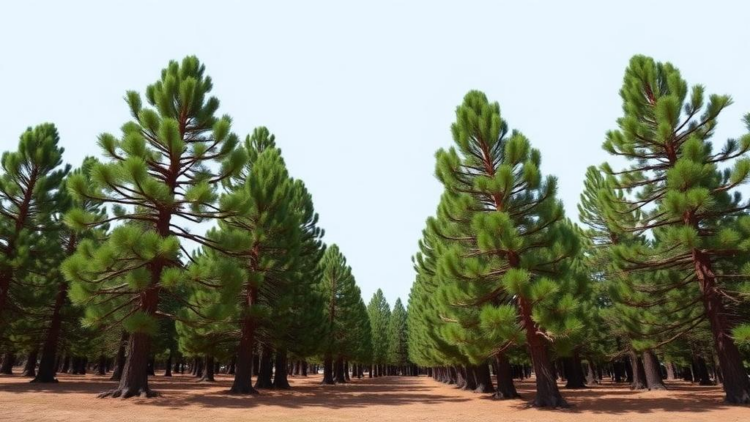
In the misty ridges of the Dabie Mountains in central China grows one of the world’s rarest pines, Pinus dabeshanensis, a species so restricted in range and so scarce in numbers that its future hangs on a narrow thread of successful reproduction. A new study published in Forest Ecosystems has now revealed just how thin that thread may be. After three years of patient fieldwork, researchers discovered that the regeneration of this critically endangered tree depends overwhelmingly on a tiny handful of exceptionally productive mother trees, while the majority of adults in the population contribute nothing at all to the next generation. The finding challenges a long-standing assumption in conservation practice, namely that every individual in a small population matters roughly equally, and it points toward a more precise, individual-focused strategy for rescuing species on the brink.
The research team set out to answer a deceptively simple question: which trees in an endangered population actually produce the seeds that give the species a chance to persist? To find out, they monitored 88 adult Pinus dabeshanensis trees from 2022 to 2024 in the Miaodao Mountains of Anhui Province, home to the largest known natural population of the species. Year after year, they recorded seed production, seed abortion, the number of mature seeds, and the mass of those seeds for every tree in the sample. This kind of long-term, individual-level monitoring is laborious but essential, because population-level averages can hide the enormous differences between trees that the study ultimately uncovered.
The results were striking. Of the 88 adult trees followed across the three-year period, 55 trees, or 62.5 percent of the monitored population, produced no seeds at all during the entire study. Reproduction, it turns out, is the business of a minority. Among the 33 trees that did reproduce, output varied dramatically, ranging from a modest 38 seeds in the least productive individual to an astonishing 11,195 seeds in the most prolific one. That is a nearly 300-fold difference between individual mother trees of the same species growing in the same population, a spread far wider than most conservation models would anticipate.
When the researchers narrowed their focus to mature seeds, the seeds most likely to actually contribute to regeneration, the pattern became even more lopsided. Just six trees, roughly 7 percent of the monitored population, accounted for more than 70 percent of all mature seeds produced. In statistical terms, the distribution of reproductive output was extremely skewed, with a few dominant mothers carrying the reproductive burden for the entire population. Every trait the team measured, including seed production, abortion rate, mature seed number, and mature seed mass, showed significant variation from one individual tree to another, confirming that these differences were consistent and substantial rather than fleeting annual fluctuations.
Seed production alone, however, does not guarantee that a tree’s offspring will make it into the forest. Many pines rely on animals to disperse their seeds, and the fate of a seed after it leaves the cone depends on whether an animal carries it away, caches it in a suitable spot, and fails to eat it. To capture this second stage of the regeneration process, the researchers tagged and tracked 1,500 seeds sourced from five of the most productive mother trees. By following individual seeds, they could measure not just how many seeds each tree made, but how many of those seeds were successfully dispersed into the environment where germination might occur.
The dispersal experiment produced a subtle but important insight. Seeds from each of the five trees had a broadly similar chance of being successfully moved and stored by animals. In other words, the quality of a tree’s seeds, at least in terms of their appeal to dispersers, did not differ dramatically from tree to tree. What mattered instead was sheer quantity. Because dispersal success per seed was roughly comparable across trees, a tree that produced many more mature seeds inevitably contributed far more successfully dispersed offspring to the landscape. The single most productive tree in the tracking experiment contributed 113 successfully dispersed seeds, while two less productive trees managed only 44 and 45 respectively, despite receiving similar per-seed treatment from the animals that moved them.
Taken together, these results reshape the diagnosis of why Pinus dabeshanensis struggles to regenerate. The problem, the study suggests, is not primarily that seeds are being eaten in excessive numbers or failing to spread through the forest. Animals appear willing and able to move the seeds that are produced. Instead, the bottleneck lies upstream, in the extreme inequality of reproductive output among individual mother trees. If most adults produce nothing and a few produce nearly everything, the effective breeding population is far smaller than the census count of adult trees would suggest. This phenomenon, sometimes described in conservation biology as a skewed individual contribution to recruitment, means that genetic diversity and demographic resilience may be concentrated in a very small number of trees, leaving the species vulnerable to the loss of even one or two key individuals.
The practical implications for conservation are direct. Rather than treating all 88 adults as interchangeable members of a protected population, managers can now identify and prioritize the dominant mother trees that actually drive regeneration. For Pinus dabeshanensis, the researchers suggest this could mean collecting seeds specifically from the most productive trees for ex situ storage and replanting programs, giving those key individuals extra protection against damage and disturbance, actively supporting the dispersal of their seeds to suitable sites, and improving the habitat conditions surrounding them so that dispersed seeds have a better chance of establishing. Such a targeted approach concentrates limited conservation resources where they will have the greatest demographic impact, a philosophy increasingly described as precision conservation.
The broader significance of the study extends well beyond a single pine in a single mountain range. Endangered plants around the world are often conserved on the basis of population counts and habitat protection, with little attention paid to how reproduction is distributed among individuals. If the pattern documented here proves common, many recovery plans may be protecting trees that contribute little to the next generation while overlooking the few individuals on which recovery genuinely depends. Identifying dominant mothers, monitoring their output over multiple years, and building conservation actions around them could become a standard step in the toolkit for saving rare plant species. For Pinus dabeshanensis, an ancient pine with a vanishingly small natural range, the message of the study is stark but actionable: the species’ future rests on a handful of trees, and those trees now have names, locations, and a measurable claim on conservation priority.
Subject of Research: Individual variation in seed production and dispersal among mother trees of the critically endangered pine Pinus dabeshanensis
Article Title: Not all trees matter equally: Study identifies key mother trees for endangered species conservation
Article References: Not all trees matter equally: Study identifies key mother trees for endangered species conservation. (n.d.). Original publication
Image Credits: AI Generated
DOI: Not provided
Keywords: Pinus dabeshanensis, mother trees, seed dispersal, endangered species, forest ecosystems, seed production, conservation biology, regeneration, precision conservation, Dabie Mountains, population monitoring, trees
Cite Scienmag News
APA MLA Chicago
Alan Morgan. (October 2, 2026). A Handful of Mother Trees Hold the Survival of a Critically Endangered Pine. Scienmag. https://scienmag.com/a-handful-of-mother-trees-hold-the-survival-of-a-critically-endangered-pine/
Alan Morgan. “A Handful of Mother Trees Hold the Survival of a Critically Endangered Pine.” Scienmag, 2 October 2026, https://scienmag.com/a-handful-of-mother-trees-hold-the-survival-of-a-critically-endangered-pine/. Accessed 2 October 2026.
Alan Morgan. “A Handful of Mother Trees Hold the Survival of a Critically Endangered Pine.” Scienmag. October 2, 2026. https://scienmag.com/a-handful-of-mother-trees-hold-the-survival-of-a-critically-endangered-pine/
Copy citation Download RIS
Tags: conservation biologyconservation challenges for rare conifer speciescritical role of mother trees in forest regenerationDabie MountainsEndangered pine tree conservationendangered speciesforest ecosystem resilience and endangered species survivalForest Ecosystemsgenetic diversity in critically endangered pinesimpact of dominant trees on forest regenerationindividual-based conservation strategiesmother treesPinus dabeshanensisPinus dabeshanensis reproductive ecologypopulation dynamics of endangered pinespopulation monitoringprecision conservationregenerationseed dispersalseed dispersal and recruitment in Dabie Mountainsseed productionselective seed production in rare pine speciestargeted conservation efforts for rare mountain pinestrees