


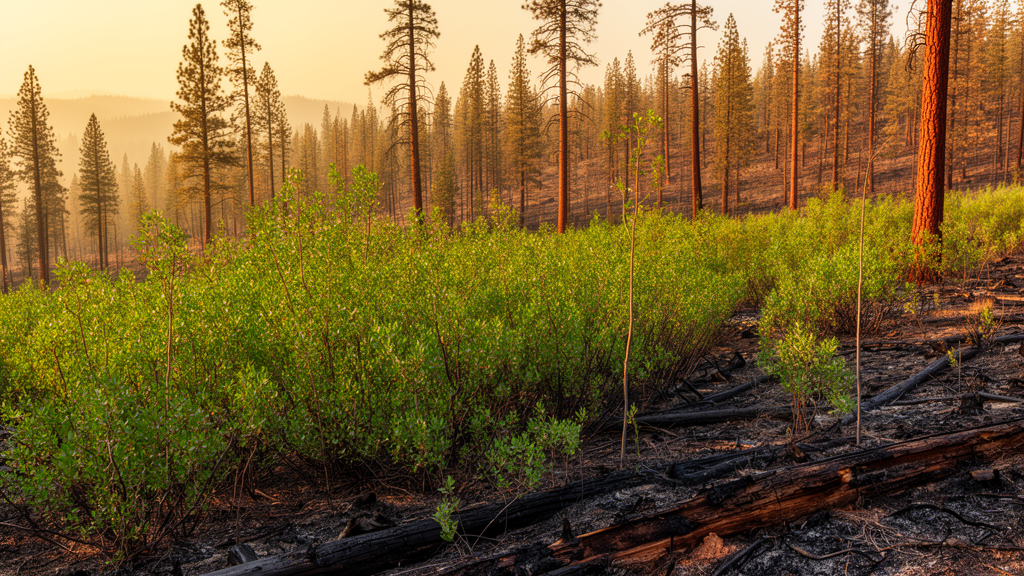
When wildfire returned in 2013 to a Sierra Nevada forest that had been shielded from fire for more than a century, many ecologists expected the blaze to begin restoring a historical balance in which fire-tolerant pines dominated. A new study of that forest, published in Fire Ecology, reports the opposite outcome: ten years after fire re-entered the Yosemite Forest Dynamics Plot, the composition of young trees still reflected the fire-suppression era, with the fire-sensitive white fir regenerating more successfully than the fire-tolerant sugar pine. The culprit, the researchers found, was not the fire itself but the dense shrub growth it triggered, which suppressed pine seedlings more heavily than fir.
The study site, the Yosemite Forest Dynamics Plot, is a 25.6-hectare old-growth white fir–sugar pine forest on the western slope of the Sierra Nevada in Yosemite National Park. Established in 2009 and 2010, the plot carries a fully censused map of every tree at least 1 centimeter in diameter at breast height, along with maps of downed woody fuels and shrub patches. Before the Rim Fire arrived, fire had been successfully excluded from the area from 1900 onward, despite a historical mean fire return interval of roughly 30 years. That long absence allowed fire-sensitive species to accumulate: white fir, Abies concolor, was the most common tree by stem count at 985.5 stems per hectare, while sugar pine, Pinus lambertiana, numbered 193.3 stems per hectare.
The two conifers sit at opposite ends of a fire-resistance spectrum. Sugar pine develops remarkably thick bark and self-prunes its lower branches, especially in larger size classes, earning it one of the highest fire-resistance scores in the region at 0.74. White fir retains thin bark and low crowns throughout its life and scores lowest at 0.43. In forests that historically burned frequently at low to mixed severity, these traits maintained pine dominance; a century of suppression reversed it, and the question the researchers posed was whether a single re-entry fire could reverse it back.
To answer that question, the team sampled the burned plot in the summer of 2024, eleven growing seasons after the fire. Using the pre-fire shrub map, they generated random points within shrub patches and stratified them into three shrub guilds defined by species composition and topography: xeric montane chaparral on convex ridgetops, riparian shrubs in concave drainages, and generalist shrubs on intermediate positions. From these they selected 38 transects—15 xeric, 12 generalist, and 11 riparian—each 10 meters long, with the first 5 meters inside a shrub patch and the second 5 meters outside it. At every meter they placed a 1-square-meter quadrat, recording ground cover, herbaceous and shrub cover, shrub height, and every tree seedling, for a total sampled area of 380 square meters.
The tally yielded 834 tree seedlings, equivalent to 21,947 seedlings per hectare. White fir dominated with 549 individuals, or 14,447 per hectare, while sugar pine contributed 257 individuals, or 6,763 per hectare. Seedling densities were highest in the xeric shrub communities, at 26,933 per hectare, compared with 22,250 per hectare in generalist communities and 14,818 per hectare in riparian ones. Shrub cover averaged 46 percent inside patches and only 10 percent outside, and across all guilds, seedling density was higher outside shrub patches than within them.
To disentangle the direct and indirect effects of fire, the researchers fit mixed-effects structural equation models predicting seedling density per quadrat from fire severity, measured as the percentage of tree crown volume scorched within a 10-meter radius of each transect; topographic position index; local tree basal area; and shrub cover, height, and diversity. Fire severity in the sample averaged 77 percent crown scorch, ranging from 16 to 100 percent. All predictors were standardized so effect sizes could be compared directly, and the models followed a negative binomial distribution to handle the heavily skewed count data, with transect as a random effect.
The models revealed a tension between two pathways. Directly, higher fire severity increased total seedling density, an effect that was statistically significant for sugar pine but not for white fir, consistent with severe surface fire exposing mineral seedbeds and removing competitors near surviving seed sources. Indirectly, however, fire stimulated shrub cover and shrub diversity, and those shrubs suppressed seedlings. Shrub cover reduced total seedling density more strongly for sugar pine than for white fir—0.038 versus 0.029 seedlings per square meter per standard deviation increase in cover—and shrub height showed the same asymmetry. The fire-mediated shrub pathway was likewise more negative for pine than for fir. Quantitatively, the direct positive effect of fire severity totaled 0.041 seedlings per square meter per standard deviation of crown scorch, while the total indirect effect was −0.005, so fire’s net effect remained positive—but its benefits flowed disproportionately to the species already favored by suppression.
Within shrub patches, white fir accounted for 66 percent of all seedlings compared with 31 percent for sugar pine, a gap that widened to 70 percent versus 27 percent in the generalist shrub guild. Outside shrub patches, the two species were roughly equally abundant, indicating that the fir advantage emerged specifically in shrub-dominated microsites, likely because the shade-tolerant fir can establish under shrub canopies while the shade-intolerant pine cannot. Conspecific basal area of surviving overstory trees also boosted regeneration of both species, and the stronger response of fir suggested higher propagule pressure per unit of basal area, reflecting both its pre-fire dominance and better post-fire survival.
Topography shaped regeneration in a nonlinear way: seedling density was lowest at both very low topographic positions, corresponding to wet concave drainages, and very high positions on dry ridgetops, peaking instead at midslope sites that combine adequate moisture, solar radiation, and moderate disturbance intensity. Mesic draws, which often escape fire as refugia, showed reduced seedling densities likely due to competition from dense unburned vegetation. Notably, although xeric sites had both the highest shrub cover and the highest seedling counts, seedlings declined within shrub patches on xeric sites just as on mesic ones, indicating that shrubs were not facilitating the abundant regeneration there through shelter effects.
The authors emphasize that their findings do not indicate regeneration failure—all observed seedling densities exceeded suggested stocking rates of 494 seedlings per hectare for regional mixed-conifer forests—but they do document a continued deviation from historical composition, in which the fir-to-pine ratio far exceeds both recommended planting proportions and historical sapling ratios. Because nearly half of the overstory sugar pines were subsequently killed by bark beetle attacks after the fire, future propagule pressure for pine may be further limited. With abundant shrubs and fir seedlings supplying fine fuels, the study suggests future fires in this forest may burn sooner and at higher severity than expected, and that a single fire reintroduction, however well-intentioned, was insufficient to undo a century of compositional change; whether repeated reburns could eventually do so remains an open question in a rapidly changing climate.
Subject of Research: Post-fire conifer regeneration and shrub competition in a fire-suppressed Sierra Nevada forest
Article Title: Compositional legacies of fire suppression maintained after fire re-entry
Article References: Cramer, S. M., Lutz, J. A., & Germain, S. J. (2026). Compositional legacies of fire suppression maintained after fire re-entry. Fire Ecology, 22(1), Article 152. https://doi.org/10.1186/s42408-026-00586-1
Image Credits: AI Generated
DOI: 10.1186/s42408-026-00586-1
Keywords: fire suppression, Yosemite, Rim Fire, conifer regeneration, shrubs, white fir, sugar pine, fire severity, structural equation models, Sierra Nevada, forest composition, reburn
News Source: Drew Townsend. (October 29, 2026). One Fire Was Not Enough: Shrubs Keep Suppression-Era Forests Locked In. Scienmag.



