Ruffs are characterized by three supergene variants that lead to different appearances and courtship behavior in males. Whether these variants affect females was previously unknown. Researchers at the Max Planck Institute for Biological Intelligence, in foundation (i.f.), now show that females of the so-called Faeder variant produce less offspring. However, this female handicap helps their males: Disguised as females, Faeder males benefit from their own rarity and obtain more matings. The contrasting effect of the variant in males and females thus contributes to its persistence over time. The study thereby provides important insights into the mechanisms that maintain biodiversity.
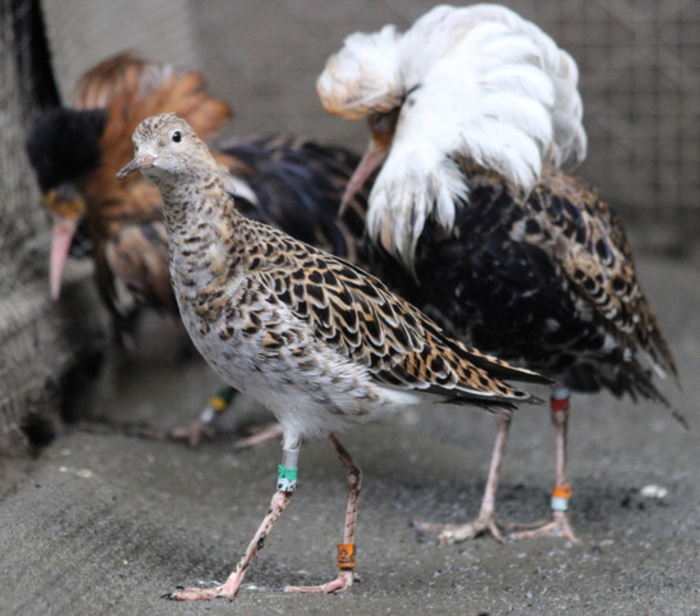
Credit: MPI for Biological Intelligence, i.f. / Clemens Küpper
Ruffs are characterized by three supergene variants that lead to different appearances and courtship behavior in males. Whether these variants affect females was previously unknown. Researchers at the Max Planck Institute for Biological Intelligence, in foundation (i.f.), now show that females of the so-called Faeder variant produce less offspring. However, this female handicap helps their males: Disguised as females, Faeder males benefit from their own rarity and obtain more matings. The contrasting effect of the variant in males and females thus contributes to its persistence over time. The study thereby provides important insights into the mechanisms that maintain biodiversity.
The question of how biodiversity arises and is maintained is not only of central importance to biologists. Biodiversity is most prominently associated with species diversity, but one can also find a substantial amount of diversity within many species. For example, there are various and pronounced differences between males and females.
Ruffs (Calidris pugnax) are a particularly vivid example of intraspecific diversity that goes beyond typically observed sex differences. In these sandpipers, males will take up one of three morphs that differ in appearance and behavior. Most males are Independents with rather dark plumage ornaments that aggressively defend a small display territory in mating arenas to impress visiting females. The somewhat smaller Satellites, recognizable by their lighter plumage, display more solemnly in an alliance with an Independent host. The rare Faeder males have an entirely different tactic: they resemble females and sneak around the mating arenas unnoticed by the other males.
Remarkably, which tactic a male ruff will use, is written in his genes. About four million years ago, a ‘supergene’ emerged through a genomic accident: a DNA fragment broke out of a chromosome and reinserted itself in the opposite direction. This inversion was the birth of the Faeder morph. The affected DNA region contains about 100 genes and is inherited as a functional unit. A rare recombination between the original and the inverted DNA sequence subsequently gave rise to the Satellites.
Interestingly, the supergene is not located on a sex chromosome, so the different genetic variants also occur in females. Unlike in males, however, little was known whether and how they affect females. An international team led by Clemens Küpper at the Max Planck Institute for Biological Intelligence, i.f., and David Lank at Simon Fraser University, now compared the reproductive success of the female morphs. They found that female Faeders have significantly lower reproductive success as they lay fewer and smaller eggs. In addition, their embryos as well, as ruff chicks hatching from smaller eggs, have lower survival rates.
Nevertheless, the Faeder variant has not gone extinct. To understand how it can persist, the researchers modeled different scenarios. The models showed that an increased reproductive success of Faeder males is necessary to maintain the Faeder variant.
“The Faeder supergene brings a big disadvantage for females, but it is an advantage for males,” explains Lina Giraldo-Deck, lead author of the study. “We think that exactly this genetic conflict between males and females contributes to the maintenance of the Faeder variant.” Indeed, the females’ low reproductive success plays into the males’ hands: the less common Faeder males are, the better their stealthy strategy works.
However, Faeders rely on the Independent ruffs. Faeder and Satellite gene variants are not viable on their own. Hence, each ruff carries at least one Independent supergene variant. In addition, male Faeders exploit the courtship efforts of the Independents, and Faeder chicks are raised primarily by female Independents.
“Today’s male Independents seem rather defenseless against the Faeders’ tactics,” says Clemens Küpper. “The extremely high competition among Independents led to the evolution of larger and more aggressive males. Meanwhile, they have become operation-blind and focus in their competition primarily on similar-looking males. This opens up a niche for deception artists like the Faeders, who exploit it very effectively.” This shows that there is no such thing as ‘the fittest’ who can cope with all challenges. “Diversity prevails even under strong selective pressure. The emergence of new forms is a principle of all life,” notes Clemens Küpper.
Next, the scientists plan to investigate the effect of the supergene variants on other life stages and how the genes involved influence the physiology of the growing animals – this, the researchers emphasize, is the only way to understand the underlying evolutionary mechanisms in their entirety.
Journal
Nature Communications
DOI
10.1038/s41467-022-29033-w
Article Title
Intralocus conflicts associated with a supergene
Article Publication Date
16-Mar-2022