


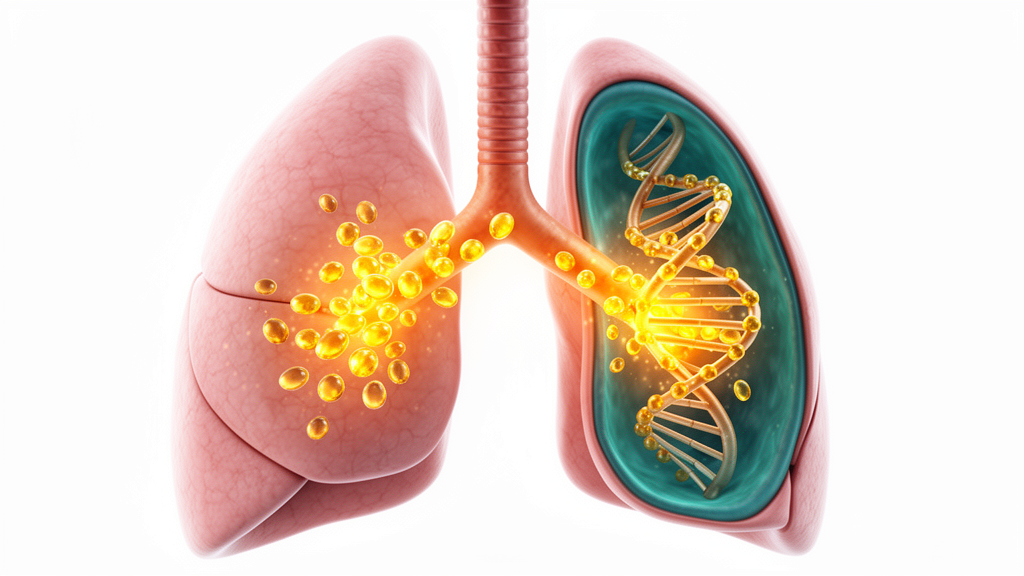
Higher levels of omega-3 polyunsaturated fatty acids in the blood are associated with better lung function, less emphysema and less airway wall thickening in people with a smoking history, according to a new observational study published in Genes & Nutrition. The study of 3,857 former and current smokers from the Genetic Epidemiology of COPD (COPDGene) study also found that both omega-3 and omega-6 fatty acids were linked to patterns of DNA methylation consistent with recovery from smoking’s epigenetic effects, and that some of the fatty acids’ associations with lung outcomes appeared to be mediated through these methylation marks.
The research team, led by Bonnie K. Patchen and Dawn L. DeMeo, analyzed blood-based omega-3 and omega-6 PUFA biomarkers measured by gas chromatography mass spectrometry, alongside spirometry, chest computed tomography measures and smoking-related DNA methylation. Cigarette smoking is known to produce epigenetic alterations that persist long after cessation, and smoking remains a major risk factor for chronic lung disease. The researchers aimed to characterize how PUFA biomarkers relate to lung phenotypes in high-risk populations and to determine whether smoking-related DNA methylation mediates these associations.
The findings pointed in contrasting directions for the two fatty acid families. Higher omega-3 levels were generally associated with higher forced expiratory volume in one second (FEV1), higher FEV1/FVC ratio and lower Pi10, a measure of airway wall thickening. In contrast, higher omega-6 levels and a higher omega-6 to omega-3 ratio were associated with worse lung phenotypes, including lower FEV1/FVC, more emphysema measured as low-attenuation area on CT scans, and lower adjusted lung density. Most of these results remained robust after multiple testing correction, and sensitivity analyses adjusting for exercise, body mass index, income and COPD status yielded largely similar results.
A key novelty of the study lies in its epigenetic findings. Higher levels of both omega-3 and omega-6 fatty acids were associated with higher DNA methylation at cg05575921 in the aryl hydrocarbon receptor repressor gene (AHRR), a well-established epigenetic marker of smoking, as well as lower epigenetic smoking scores and a slower epigenetic pace of aging measured by DunedinPACE. The omega-6 to omega-3 ratio showed the opposite associations. Because smoking is associated with hypomethylation at this AHRR site, the pattern seen with higher PUFA levels is consistent with epigenetic recovery.
Mediation analysis using the R package mediation revealed that smoking-related DNA methylation partially mediated some of the PUFA-lung phenotype associations. For omega-3 fatty acids, both the direct effects and the effects mediated through AHRR methylation tended to be beneficial, associated with higher lung function, less emphysema and lower airway wall thickness. For some omega-6 fatty acids, the direct effects were detrimental while the mediated effects remained beneficial, suggesting that the epigenetic effects of omega-6 PUFAs may operate independently of their inflammatory signaling effects. The omega-6 to omega-3 ratio showed detrimental direct and mediated effects. As a concrete example, the direct and AHRR-mediated effects on FEV1 were 0.0201 and 0.0049 for total omega-3s, -0.0049 and 0.0009 for total omega-6s, and -0.0074 and -0.0014 for the omega-6 to omega-3 ratio.
The researchers also found suggestive evidence that the timing of smoking cessation matters. Interaction analyses indicated that PUFA effects on both lung phenotypes and smoking-related DNA methylation tended to be largest closest to the time of smoking cessation, but appeared to be overwhelmed at high cumulative smoking doses. Many omega-3 associations with lung phenotypes were larger in magnitude and statistically significant only in former smokers, though the directions of effect were consistent in current smokers. The authors suggest there may be a window of opportunity around smoking cessation in which increasing omega-3 levels and lowering the omega-6 to omega-3 ratio could support epigenetic recovery.
Longitudinal models covering the baseline, five-year and ten-year follow-up visits showed that higher omega-3 levels were generally associated with slower decline in lung function and adjusted lung density, while higher omega-6 levels and a higher omega-6 to omega-3 ratio were associated with faster decline. Notably, many of these longitudinal associations, especially for omega-3 fatty acids, were significant in current but not former smokers.
Replication efforts in an independent cohort, the Lung Tissue Research Consortium (LTRC), generally supported the findings. PUFA-lung phenotype associations were consistent in direction with COPDGene, with positive associations of omega-3 EPA with FEV1/FVC and omega-3 DHA with FEV1 and FVC, and a negative association of omega-6 LA with FEV1/FVC, replicating at a significance level of 0.05. Blood-based PUFA associations with smoking-related DNA methylation also replicated, and PUFA associations with methylation measured directly in lung tissue were generally consistent in direction with those in blood, with a significant association seen for omega-3 DHA and lung AHRR methylation. Mediation analyses using lung-based DNA methylation were directionally consistent with blood but did not reach statistical significance.
The study population was deeply phenotyped: participants had a mean age of 65 years, a mean body mass index of 29 kg/m2, 51 percent were female, 71 percent self-reported white and 29 percent self-reported black, and 38 percent were current smokers with a mean smoking history of 44 pack-years. PUFA levels themselves differed by smoking status, with omega-3 fatty acids and omega-6 linoleic acid higher in former smokers, and omega-6 arachidonic acid and the omega-6 to omega-3 ratio higher in current smokers.
The authors emphasize important limitations. As an observational study, the findings demonstrate associations rather than causal effects of supplementation. Replication in LTRC relied on a targeted metabolomics panel that did not capture all PUFAs, preventing replication for ALA, total omega-3s, total omega-6s and the omega-6 to omega-3 ratio, and the smaller LTRC sample, particularly for current smokers, limited statistical power. Even so, the authors conclude that PUFAs may mitigate some smoking-related epigenetic alterations, with omega-3 fatty acids particularly associated with better lung outcomes, and that the results have implications for PUFA-focused precision nutrition strategies in high-risk populations, including potential nutritional interventions around the time of smoking cessation.
Subject of Research: Associations of omega-3 and omega-6 fatty acid biomarkers with lung phenotypes and smoking-related DNA methylation in smokers
Article Title: Polyunsaturated fatty acids modulation of smoking-related epigenetics and pulmonary outcomes
Article References: Patchen, B. K., Saw, W.-Y., Phillips, E. K., Levy, B. D., Rosario, A., Cho, M. H., Silverman, E. K., Hancock, D. B., Cassano, P. A., & DeMeo, D. L. (2026). Polyunsaturated fatty acids modulation of smoking-related epigenetics and pulmonary outcomes. Genes & Nutrition, 21(1), Article 22. https://doi.org/10.1186/s12263-026-00812-0
Image Credits: AI Generated
DOI: 10.1186/s12263-026-00812-0
Keywords: omega-3 fatty acids, omega-6 fatty acids, smoking, DNA methylation, COPD, lung function, emphysema, epigenetics, precision nutrition, COPDGene, mediation analysis, epigenetic aging
News Source: Juliet Wilcox. (October 29, 2026). Omega-3 Fatty Acids Linked to Better Lung Health in Smokers Through Epigenetic Recovery. Scienmag.



