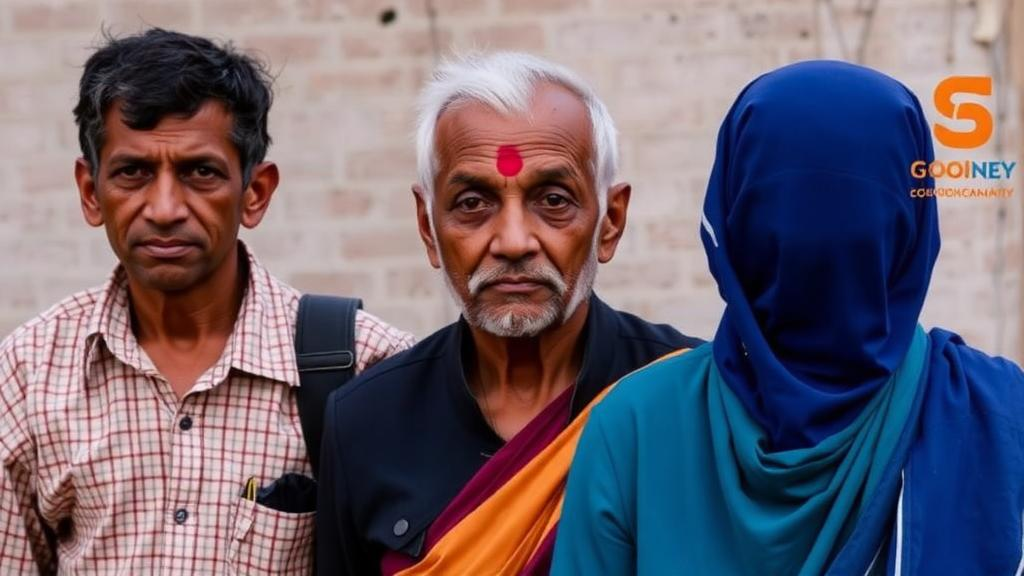
India is ageing while it is also moving. Hundreds of millions of people have left their villages, districts, and sometimes their home states in search of work, marriage, education, or safety, and a large share of them are now growing old far from where they were born. A new nationwide study published in BMC Public Health suggests that this mobility leaves a lasting mark on how older Indians are treated: people aged 45 and above who migrated within the country are substantially more likely to report experiencing everyday discrimination than those who stayed in their place of origin. The finding, drawn from one of the largest ageing surveys ever conducted anywhere in the world, adds a health-relevant dimension to India’s internal migration story, which has traditionally been discussed almost entirely in terms of wages, remittances, and urban labor markets.
The research team, led by Vasim Ahamad of the Department of Migration and Urban Studies at the International Institute for Population Sciences in Mumbai, together with Rahul Rahul, Ram B. Bhagat, and T. V. Sekher, analyzed data from 64,711 respondents aged 45 and above who took part in the first wave of the Longitudinal Ageing Study in India, conducted in 2017 and 2018. LASI, as the survey is known, was carried out with guidance and ethical approval from the Indian Council of Medical Research and is designed to follow its participants over time, making its first wave an unusually rich snapshot of mid-life and old-age wellbeing across the country. Because the study used this existing secondary dataset, no new information was collected directly from respondents, and the analysis was approved as part of the original LASI protocol.
Two design choices shaped what the study could reveal. First, migration status was defined using each respondent’s place of last residence, a standard demographic measure that classifies people as migrants if their current home differs from where they previously lived. Second, perceived discrimination was measured with an everyday discrimination scale, an instrument widely used in social epidemiology that asks people how often they encounter slights such as being treated with less courtesy or respect than others, receiving poorer service, or feeling that others act as if they are not smart or as if they are afraid of them. The everyday discrimination approach captures the routine, cumulative texture of unfair treatment rather than dramatic single events, which researchers consider especially important because chronic low-level mistreatment is thought to wear down health over years and decades.
The headline numbers are striking. Fifty-seven percent of the older adults in the sample were internal migrants who were growing older at their destination rather than in the place where they had spent their earlier lives. After adjusting for a battery of socioeconomic and demographic factors in multivariable logistic regression models, migrants had significantly higher odds of reporting discrimination than non-migrants, with an adjusted odds ratio of 1.38 and a 95 percent confidence interval running from 1.28 to 1.48. In practical terms, even when older migrants and non-migrants were compared at similar levels of income, education, and other characteristics, the experience of having moved still raised the likelihood of perceiving discrimination by a meaningful margin. That statistical adjustment matters: it indicates the effect is not simply an artifact of migrants being poorer or less educated on average, though those disadvantages certainly compound the picture.
The study’s most unexpected result concerns gender. Male migrants faced markedly higher odds of reporting discrimination, with an adjusted odds ratio of 1.59 and a confidence interval of 1.44 to 1.77, compared with an adjusted odds ratio of 1.21 and a confidence interval of 1.08 to 1.36 among female migrants, each relative to non-migrants of the same comparison. This pattern runs counter to a large body of literature in which women report more discrimination than men, and it points to something specific about the male migrant experience in India. One plausible reading, consistent with the structure of Indian migration itself, is that men who move for work enter competitive labor markets, informal settlements, and public spaces where they interact daily with strangers, landlords, employers, and officials, while many women migrate primarily through marriage and become embedded more quickly in household and neighborhood networks. The study reports the pattern without overinterpreting its causes, but the gap between the two confidence intervals is wide enough to suggest a genuine difference rather than statistical noise.
The type of move mattered as much as the fact of moving. Inter-state migrants, who cross linguistic and cultural boundaries when they relocate, reported greater discrimination than intra-state migrants, who move within a state where language, food, and social norms are more familiar. Among migration streams, rural-to-urban migrants fared worse than those moving along other routes, a result that resonates with decades of qualitative research on how city dwellers view newcomers from the countryside. And the timing of the move shaped outcomes too: recent migrants reported a higher level of discrimination than long-settled migrants, suggesting that the sharpest social friction occurs in the years immediately after arrival, when a person is still visibly an outsider, and that discrimination may fade, though not disappear, as migrants put down roots over decades.
Why should perceived discrimination concern public health researchers and not only sociologists? A substantial international literature links the chronic experience of discrimination to elevated stress, higher blood pressure, worse mental health, and earlier biological ageing, mechanisms that operate through sustained activation of the body’s stress response systems. For older adults, whose physiological reserves are already diminishing, this cumulative burden can be particularly consequential. The authors of the new study frame their findings around the idea of dual vulnerability: older migrants in India face disadvantage on two fronts simultaneously, first because of their age in a society where ageing itself can bring diminished respect and exclusion, and second because of their migrant status, which marks them as outsiders in the communities where they now live. Each form of disadvantage reinforces the other, and the everyday discrimination scale used in the study cannot always separate them cleanly, which the researchers acknowledge implicitly by treating the two as intertwined dimensions of the same lived experience.
The scale of the phenomenon gives the findings national significance. Internal migration in India involves more people than international migration to the entire rest of the world combined, with census and survey estimates consistently placing the number of internal migrants in the hundreds of millions. As the country’s population ages, the cohort of people who migrated in their youth and are now entering their later decades will keep expanding, which means the population exposed to whatever social penalties migration carries is growing rapidly. The LASI sample, with more than sixty thousand respondents aged 45 and above, provides an unusually solid foundation for detecting these patterns, and the use of variance inflation factors to check for multicollinearity among the predictors reflects standard epidemiological care in the modeling. The adjusted odds ratios were estimated with confidence intervals that exclude the null value of one in every reported comparison, indicating that the associations are statistically robust at conventional thresholds.
The authors argue that their results underscore the need for appropriate policies and legal frameworks to address and prevent discrimination against older migrants in India. That recommendation arrives at a moment when the country is still building the institutional infrastructure to serve a mobile, ageing population. Migrants frequently lack local documentation, social networks, and familiarity with grievance mechanisms, and older migrants may additionally face barriers in accessing healthcare, pensions, and social protection schemes that are tied to place of residence. The study did not test specific interventions, so the policy implications remain inferential, but the empirical pattern it documents, a consistent elevation in reported discrimination across migration types, streams, and durations, gives policymakers a clear target: the transition period after a move, and the settings where rural-to-urban and inter-state migrants concentrate.
For a study of this kind, the limitations are worth keeping in view. The data come from a single cross-sectional wave, so the analysis captures associations at one point in time rather than changes over the life course, and perceived discrimination is, by definition, a self-reported measure shaped by expectations, memory, and willingness to disclose sensitive experiences. The place of last residence measure also cannot capture the full complexity of circular or repeat migration, which is common in India. Yet even with these caveats, the study makes a contribution that is hard to dismiss: it takes a question usually asked about young workers, namely whether moving within India exposes people to unfair treatment, and asks it about people in the second half of life, where the stakes for health and dignity are arguably higher. The answer it finds, that migrants who are growing old away from home are more likely to feel treated as lesser, turns a demographic statistic into a human problem, and gives researchers a starting point for the longitudinal work that LASI’s later waves will eventually make possible.
Subject of Research: Perceived discrimination among older internal migrants in India
Article Title: The influence of migration status on perceived discrimination among older adults in India: a nationwide cross-sectional study
Article References: Ahamad, V., Rahul, R., Bhagat, R. B., & Sekher, T. V. (2026). The influence of migration status on perceived discrimination among older adults in India: a nationwide cross-sectional study. BMC Public Health. https://doi.org/10.1186/s12889-026-29800-0
Image Credits: AI Generated
DOI: 10.1186/s12889-026-29800-0
Keywords: internal migration, perceived discrimination, older adults, LASI, India, public health, ageing, rural-to-urban migration, inter-state migration, social epidemiology, migration policy, everyday discrimination scale
News Source: Beatrice Stafford. (October 5, 2026). Older Migrants in India Face Sharper Discrimination, Nationwide Study Finds. Scienmag.