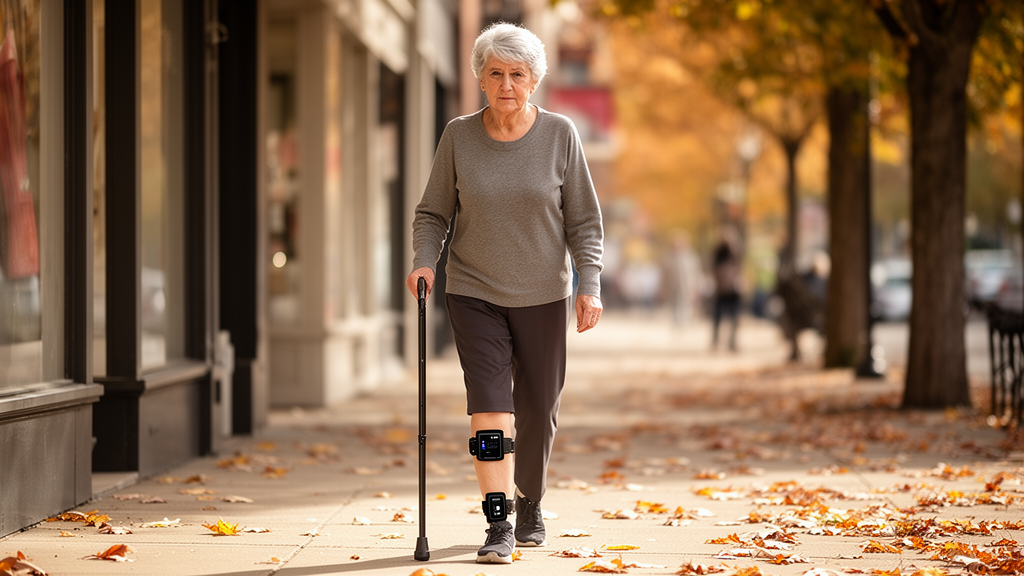
In a cross-sectional analysis of baseline data from the SMART-AGE trial, 569 adults aged 67 and older in Heidelberg and Mannheim, Germany, averaged 11,746 steps per day, with a standard deviation of 5,446. That level of activity clearly exceeds step-count thresholds associated with substantially reduced mortality risk in recent cohort studies and meta-analyses, which point to roughly 6,000 to 8,000 steps per day as a meaningful benchmark for older adults. The findings, published in the European Review of Aging and Physical Activity, offer some of the most detailed benchmarks yet for free-living walking in a robust, independently living older population.
The device combines a triaxial accelerometer with a triaxial gyroscope, sampling at 100 Hz, and was worn for one week. Measurements were included only if participants accumulated at least 12 hours of wear time on at least 3 days; the final sample averaged 6.2 days of valid monitoring per person. Walking bouts, defined as walking sequences of at least two consecutive strides of both feet, were identified using the MobGap pipeline developed by the Mobilise-D consortium, a framework specifically validated for analyzing real-world walking data in older adults.
From the raw sensor signals, the researchers computed 24 digital mobility outcomes spanning five domains: amount, pattern, pace, rhythm, and bout-to-bout variability. For the present analysis, they selected six outcomes a priori based on clinical relevance and prior validation evidence: steps per day, walking duration in minutes per day, total number of walking bouts per day, number of longer walking bouts exceeding 30 seconds per day, mean walking speed in longer bouts, and 90th percentile walking speed in longer bouts. Speed metrics were restricted to bouts longer than 30 seconds because the Mobilise-D technical validation study showed these yield more reliable and accurate speed estimates, capturing steady-state walking typically performed outside the home for activities such as shopping and leisure.
The participants, who had a mean age of 75.0 years with a standard deviation of 5.6, were 52 percent women and 56 percent higher educated. They accumulated 432.3 walking bouts per day on average, with a standard deviation of 153.8, and walked at a mean speed of 0.75 meters per second in longer bouts. Sex-related patterns emerged clearly: women recorded more total walking bouts than men, averaging 453.1 versus 410.9 per day, but men showed a higher prevalence of longer bouts exceeding 30 seconds, averaging 47.7 versus 41.5 per day. Men also showed significantly higher 90th percentile walking speed, while mean walking speed in longer bouts did not differ significantly between the sexes.
Age was consistently related to real-world walking across all six outcomes, with significant negative associations showing small to moderate standardized effect sizes ranging from -0.10 to -0.26. Visual inspection of unadjusted trend lines suggested a non-linear pattern, with a plateau reached around age 75 followed by a steady decline in both sexes. However, formal model comparisons told a more nuanced story: quadratic age terms improved fit only for the speed-related outcomes, mean and 90th percentile walking speed, and were retained only for those metrics. For the amount and pattern measures, the non-linear specification did not consistently improve model fit, and the authors caution that indications of a plateau were not statistically robust across all mobility metrics.
To identify correlates of walking, the researchers used hierarchical blockwise linear mixed-effects models, fitting separate models for each outcome with participant and weekday as random intercepts. Sociodemographic and environmental variables entered first, followed by health and function measures including Body Mass Index, locomotor capacity assessed with the Timed Up and Go test, fall-related concerns measured with the Short Falls Efficacy Scale International, and cognitive processing speed assessed with the Symbol Search Test. P-values were adjusted for multiple comparisons using the Benjamini-Hochberg false discovery rate procedure within each mobility domain. After adjustment, lower BMI and better locomotor capacity, indicated by shorter Timed Up and Go times, were the most consistent predictors, showing significant associations with higher levels across all amount, pattern, and pace outcomes, with standardized coefficients between -0.07 and -0.25.
Other correlates showed more differentiated associations. Lower fall-related concerns were weakly but significantly linked to walking amount and pattern outcomes, but not to pace. Cognitive processing speed showed no significant association with how much or how often participants walked, yet was significantly related to both mean and 90th percentile walking speed in longer bouts. The authors suggest this may reflect the cognitive demands embedded in real-world walking, which, unlike single-task laboratory gait assessments, unfolds amid everyday distractions and environmental challenges. Environmental context mattered as well: longer daylight hours showed small positive associations with walking amount, and the city of residence, Heidelberg versus Mannheim, was not associated with any outcome.
Day of the week left a visible imprint on activity. Violin plots of raw data showed largely comparable distributions from Monday to Saturday, while Sundays stood out with consistently lower levels of real-world walking, particularly for longer bouts. In the models, the fixed effect distinguishing working days from weekends revealed small but significant differences in the number of longer bouts and in mean and 90th percentile walking speed. The authors note that Sunday shopping restrictions and limited appointments in Germany may partly explain this pattern, and they suggest that walking activity in robust older adults partly reflects the execution of daily routines. They also emphasize that such group-level differences probably indicate even greater differences at the level of individual persons.
The study’s strengths include its large sample, validated open-source analytical pipeline, and comprehensive characterization of walking beyond simple step counts. Yet the authors are explicit about limitations. The sample consisted of physically robust, highly active, well-educated, and cognitively unimpaired older adults, limiting generalizability, and the observed associations were generally weak to moderate in magnitude. The stepwise modeling approach may be susceptible to instability and overfitting, so the identified correlates should be interpreted cautiously and primarily as exploratory. The pipeline captures only walking, omitting other mobility forms such as cycling, and environmental conditions were operationalized using proxy measures like city and daylight duration rather than detailed walkability characteristics.
Even so, the benchmarks provided here may prove valuable. Marginal R-squared values for the final models ranged from approximately 0.11 to 0.20, while intraclass correlation coefficients between 0.56 and 0.65 indicated that a substantial share of total variance was attributable to between-participant differences, underscoring how individualized everyday mobility is. The gap between mean and 90th percentile walking speed, averaging 0.26 meters per second, suggests real-world speed captures meaningful intra-individual variability that may reflect adaptive capacity in response to situational demands. The authors propose that such digital mobility markers could serve as reference values for community-dwelling older adults, help identify early changes in everyday mobility, and inform future mobility recommendations and preventive strategies tailored to specific domains of walking behavior.
Subject of Research: Real-world walking amount, patterns and speed measured with wearable sensors in community-dwelling older adults
Article Title: Real-world walking and activity patterns in community-dwelling older adults: a cross-sectional analysis of baseline data from the SMART-AGE trial
Article References: Eckert, T., Gordt-Oesterwind, K., Haas, A.-S., Boettinger, M. J., Schubert, A.-L., Snijder-Steinhilber, M., Wahl, H.-W., Bauer, J. M., Klenk, J., Albites–Sanabria, J., Becker, C., & Jansen, C.-P. (2026). Real-world walking and activity patterns in community-dwelling older adults: a cross-sectional analysis of baseline data from the SMART-AGE trial. European Review of Aging and Physical Activity, 23(1), Article 31. https://doi.org/10.1186/s11556-026-00431-z
Image Credits: AI Generated
DOI: 10.1186/s11556-026-00431-z
Keywords: real-world walking, older adults, wearable sensors, digital mobility outcomes, SMART-AGE trial, walking speed, steps per day, Mobilise-D, cross-sectional study, physical activity, aging, community-dwelling
News Source: Ophelia Keating. (October 29, 2026). Older adults’ real-world walking mapped in week-long wearable study. Scienmag.