The European robin’s closest relatives are found in tropical Africa. The European robin is therefore not closely related to the Japanese robin, despite their close similarity in appearance. This is confirmed by a new study of the Old World flycatcher family, to which these birds belong. The study comprises 92 per cent of the more than 300 species in this family.
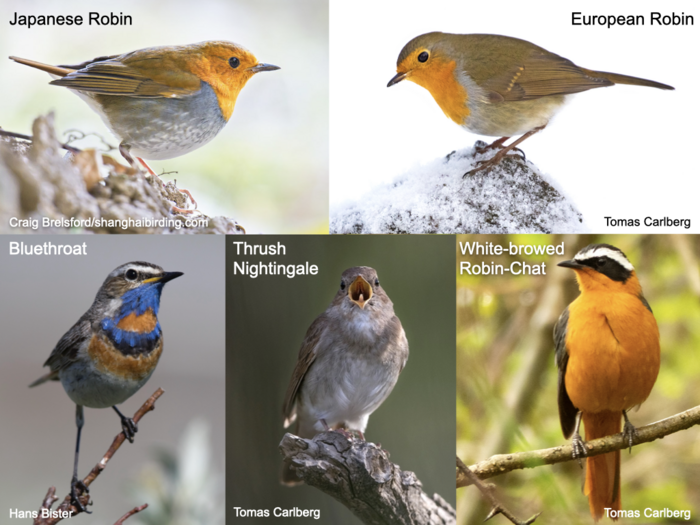
Credit: Tomas Carlberg, Hans Bister and Craig Brelsford/shanghaibirding.com.
The European robin’s closest relatives are found in tropical Africa. The European robin is therefore not closely related to the Japanese robin, despite their close similarity in appearance. This is confirmed by a new study of the Old World flycatcher family, to which these birds belong. The study comprises 92 per cent of the more than 300 species in this family.
“The fact that the European and Japanese robins are so similar-looking despite not being closely related is one of many examples of so-called convergent evolution in this group of birds. Similarities in appearance can evolve in distant relatives, e.g., as a result of similarities in lifestyle,” says Per Alström from Uppsala University, who is one of the researchers behind the study published in Molecular Phylogenetics and Evolution.
The Old World flycatcher family comprises birds belonging to more than 300 species that are distributed across Europe, Asia and Africa. The family includes not only flycatchers, but also nightingales, chats, wheatears, redstarts, whistling-thrushes, forktails and other exotic groups. Twelve species breed in Sweden, of which the European robin, the pied flycatcher and the thrush nightingale are the most well-known. All except three of these species winter in sub-Saharan Africa or southern Asia.
Researchers from Uppsala University, the University of Gothenburg and the University of Florida have used DNA to reconstruct the family tree of 92 per cent of the species in the Old World flycatcher family. This study confirms previous findings regarding relationships as well as revealing new, unexpected relationships.
“Species that are named flycatchers are placed on many different branches in the family tree, and hence belong to groups that are not closely related. With respect to the Swedish flycatchers, the pied, collared and red-breasted flycatchers are closely related to each other, while the spotted flycatcher is a more distant relative.”
Uppsala University has a long tradition of research on flycatchers, especially on pied and collared flycatchers. The present study supports the hypothesis that the bluethroat, which is colloquially called “the nightingale of the Swedish mountains”, has its closest relative in the Himalayas and the mountains of China.
“I never cease to be surprised by the many unexpected relationships that are revealed by DNA analyses,” says Per Alström
Zhao, M., Burleigh, J.G., Olsson, U., Alström, P. & Kimball, R.T. 2022. A near-complete and time-calibrated phylogeny of the Old World flycatchers, robins and chats (Aves, Muscicapidae). Molecular Phylogenetics and Evolution in press (https://doi.org/10.1016/j.ympev.2022.107646)
DOI
10.1016/j.ympev.2022.107646
Article Title
A near-complete and time-calibrated phylogeny of the Old World flycatchers, robins and chats (Aves, Muscicapidae)
Article Publication Date
6-Nov-2022