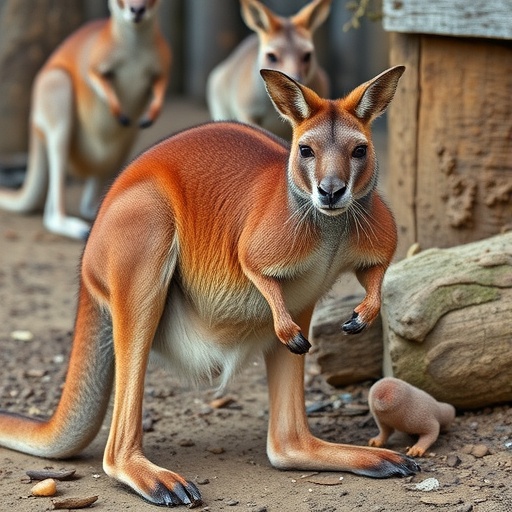
In a groundbreaking study that challenges long-held assumptions about evolutionary adaptation, researchers from Flinders University have uncovered an extraordinary tale behind the dental evolution of kangaroos. Stretching over 50 million years, their findings reveal an unconventional evolutionary strategy centered on the development of thick tooth enamel—a solution remarkable in its departure from the evolutionary paths observed in herbivores across other continents. This research not only reshapes our understanding of marsupial adaptation but also illuminates the unpredictable nature of evolutionary processes.
Herbivores face a constant and severe challenge: the wear and tear inflicted by their diet. Grasses, the primary food source for many grazing animals, are notoriously abrasive. They often contain microscopic particles of silica and are coated with dust and grit, accelerating dental erosion. For herbivores, compromised teeth are a death sentence, as effective mastication is critical for nutrient absorption. While hoofed mammals such as deer and horses have evolved molars with complex, high crowns and intricate enamel ridges to navigate this abrasive diet, kangaroos have taken a surprising detour from this path.
The Flinders team leveraged cutting-edge X-ray imaging techniques to examine fossilized teeth beneath their surfaces. This non-destructive scanning revealed that kangaroos adapted to their abrasive grass diet by evolving molars reinforced with notably thick enamel. This enamel acts as a robust shield protecting the tooth’s core structure during the intense vertical slicing motion kangaroos use to chew their food. Contrary to the lateral grinding typical in hooved mammals, the vertical chewing mechanism dictated an alternative evolutionary adaptation optimizing enamel thickness rather than crown height or complexity.
Dr. Aidan Couzens, the study’s lead author, emphasizes the significance of this adaptation. Unlike the expected evolution of tall, crested teeth to handle grass, kangaroos optimized enamel thickness. Their teeth resemble those of herbivores that consume softer foliage—animals like manatees, lemurs, and monkeys—species which generally lack the complex molar structure of typical grazers. Remarkably, while most of these groups declined or vanished over evolutionary history, kangaroos flourished, indicating that thick enamel was a successful evolutionary gamble.
One of the more intriguing comparisons uncovered by the researchers involved the enamel thickness of kangaroos and certain ancient human ancestors. Professor Gavin Prideaux highlighted that grazing kangaroos’ enamel investment parallels that observed in Paranthropus, colloquially known as ‘Nutcracker Man.’ This suggests convergent evolution driven by dietary pressures involving abrasive plant material. It bolsters hypotheses that thick enamel in human ancestors evolved primarily to withstand dietary abrasion rather than simply to process hard nuts or seeds.
Kangaroos’ journey to dominance was not straightforward. Other herbivorous marsupials, many with dental structures more akin to conventional grazers, once occupied Australia’s ecological niches. These groups—close relatives of wombats—possessed teeth presumably suited for grass consumption and seemed poised to excel with the spread of grasslands. Yet, they mysteriously perished before grasslands became widespread. The investigation posits competition from arid-adapted kangaroo species as a possible cause behind their demise, an evolutionary irony that further underscores kangaroos’ unorthodox rise.
The extensive thickening of enamel provided kangaroos with a durable dental conveyor belt, continually replacing worn cheek teeth throughout their lifetime. This mechanism ensured that the relentless assault from abrasive grasses did not doom their ability to feed. Their teeth effectively became long-lasting tools finely tuned to their unique chewing mechanics and dietary requirements. It exemplifies a distinct evolutionary response tailored not only to diet but to biomechanical function.
Kangaroos’ chewing adaptation, combining vertical slicing with robust enamel layering, contrasts sharply with northern hemisphere herbivores’ side-to-side grinding supplemented by tall crowns. This divergence portrays an “upside-down” evolutionary narrative in Australia because the expected winner—species with complex chewing adaptations seen elsewhere—fell by the wayside, while kangaroos flourished by embracing a seemingly less sophisticated but highly effective dental strategy.
The implications of this research extend beyond paleontology. It reminds us that evolutionary trajectories are contingent, shaped by a confluence of factors including environmental shifts, interspecies interactions, and sometimes sheer chance. Possessing seemingly optimal traits does not assure species’ success. Rather, survival and diversification hinge on the intricate interplay of biology and circumstance. This insight invites reflection on the evolutionary uncertainties that have also shaped human ancestry.
Through pioneering imaging analysis, the researchers demonstrated how detailed anatomical studies of fossilized remains could unlock the hidden narratives of life’s history. Their work highlights thick enamel as a critical, if overlooked, component in the evolutionary story of Australian marsupials. The study not only enriches our appreciation of kangaroo biology but sets a precedent for revisiting evolutionary strategies in other lineages with refined technological tools.
Kangaroos’ unique adaptation underscores the diverse solutions life can engineer to meet similar challenges. The discovery that vertical chewing reinforced by thick enamel is a winning adaptation encourages broader reassessments of how dietary and biomechanical needs sculpt evolution. This nuanced understanding paves the way for future studies exploring convergences and divergences across the animal kingdom.
As researchers anticipate further avenues of investigation, this study catalyzes deeper inquiry into how environmental factors and competition drive evolutionary innovation. The narrative of kangaroos reveals evolution’s dynamic character, shaped by complex, sometimes unexpected pathways. It beckons us to embrace the unpredictability inherent in natural history and appreciate the extraordinary diversity forged by life’s relentless adaptation.
Subject of Research: Animals
Article Title: Contingent evolution of thick enamel by kangaroos to resist dietary abrasion
News Publication Date: 30-Apr-2026
Web References: https://doi.org/10.1126/science.aeb2502
Image Credits: A. Couzens (Flinders University)
Keywords: Kangaroo evolution, thick enamel, dental adaptation, marsupials, herbivore evolution, tooth enamel thickness, dietary abrasion, fossil analysis, imaging techniques, evolutionary contingency
Tags: abrasive grass diet effectsevolutionary adaptation in Australiafossilized kangaroo teeth analysisherbivore molar evolutionherbivore tooth wear resistancekangaroo dental evolutionmarsupial dietary adaptationmarsupial evolutionary strategiessilica particle dental erosionthick tooth enamel adaptationunconventional herbivore evolutionX-ray imaging in paleontology