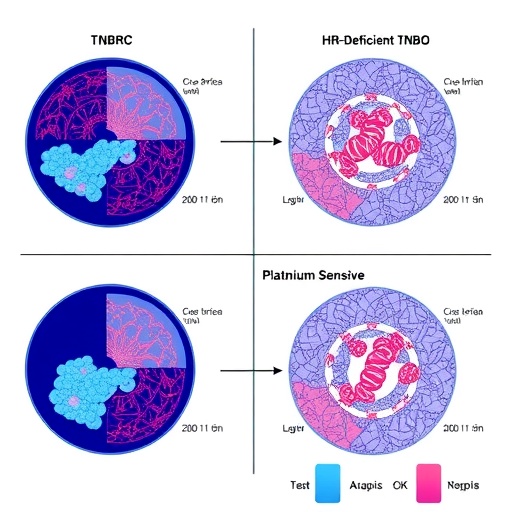
In a groundbreaking phase 2 clinical trial, researchers have demonstrated the efficacy of olaparib, a PARP inhibitor, in treating metastatic triple-negative breast cancer (TNBC) and platinum-sensitive relapsed ovarian cancers that exhibit homologous recombination (HR) deficiency but lack germline BRCA1/2 mutations. This study, known as the EMBRACE trial, challenges the traditional paradigm that limits PARP inhibitor therapy primarily to patients with inherited BRCA mutations.
The pursuit of targeted therapies in oncology has long centered on exploiting weaknesses in cancer DNA repair pathways. Olaparib’s mechanism hinges on synthetic lethality, targeting cells deficient in homologous recombination repair—a key pathway for fixing DNA double-strand breaks. Historically, olaparib’s success has been predominantly documented in tumors harboring germline BRCA1 or BRCA2 mutations, which compromise HR. However, this trial expands the therapeutic horizon to patients whose tumors are HR-deficient through other somatic alterations, yet do not carry inherited BRCA mutations.
Conducted across multiple centers, the EMBRACE trial enrolled patients with metastatic TNBC or platinum-sensitive relapsed ovarian cancer. All participants exhibited HR deficiency, identified through genomic scar assays and functional HRD testing, yet tested negative for germline BRCA1/2 mutations. These inclusion criteria aimed to determine whether HR deficiency alone, regardless of germline mutation status, could predict a favorable response to PARP inhibition.
Results revealed significant antitumor activity of olaparib in this genomically defined subset. Patients demonstrated objective response rates that challenge previous notions of patient eligibility for PARP inhibitors. Importantly, the trial’s findings underscore that platinum sensitivity—a clinical indicator of DNA repair deficiencies—is a crucial factor in predicting treatment response alongside genomic HRD markers.
Safety profiles matched prior olaparib data, showing manageable toxicities with a spectrum typical of PARP inhibitors. Patients tolerated treatment well, with adverse effects primarily including fatigue, nausea, and hematological changes. These findings reaffirm olaparib’s safety in the expanded population and emphasize the potential for wider clinical applicability.
The ramifications of the EMBRACE trial are profound. By decoupling PARP inhibitor therapy from strict dependence on germline BRCA mutations, the study opens avenues for precision medicine approaches in a broader cohort of TNBC and ovarian cancer patients. This could reshape clinical guidelines, advocating for routine HRD testing beyond germline mutation screening to identify candidates for PARP inhibition.
Moreover, the study highlights the importance of integrating molecular diagnostics into treatment algorithms. Approaches using advanced genomic assays to capture HR deficiency are pivotal to optimize patient selection, enhance outcomes, and limit exposure to ineffective therapies. This trial thus represents a step toward more nuanced, biology-driven cancer care.
Future investigations will likely focus on refining HRD detection techniques and combining PARP inhibitors with other targeted agents to overcome resistance mechanisms. As the landscape evolves, the EMBRACE trial’s insights bring renewed optimism for managing some of the most aggressive breast and ovarian cancers.
The application of olaparib beyond germline BRCA-mutated tumors fundamentally alters the therapeutic landscape. Through careful patient stratification based on DNA repair status, oncologists can now consider PARP inhibition for a previously untapped population, potentially improving survival and quality of life for many patients with historically limited options.
Subject of Research: Homologous recombination deficiency and PARP inhibitor therapy in metastatic triple-negative breast and platinum-sensitive relapsed ovarian cancers without germline BRCA1/2 mutations
Article Title: Olaparib in HR-deficient, metastatic triple-negative breast and platinum-sensitive relapsed ovarian cancers without germline mutations in BRCA1/2: phase 2 EMBRACE trial.
Article References:
Sjoquist, K.M., Dobrovic, A., Robledo, K.P. et al. Olaparib in HR-deficient, metastatic triple-negative breast and platinum-sensitive relapsed ovarian cancers without germline mutations in BRCA1/2: phase 2 EMBRACE trial. Br J Cancer (2026). https://doi.org/10.1038/s41416-026-03535-6
Image Credits: AI Generated
DOI: 10.1038/s41416-026-03535-6
Tags: cancer treatmentclinical trialEMBRACE studygermline BRCA mutationshomologous recombination deficiencyolaparib efficacyOvarian cancerPARP inhibitorssomatic DNA repair alterationssynthetic lethalitytargeted cancer therapytriple-negative breast cancer