• HOME
  • NEWS
  • EXPLORE
    • CAREER
      • Companies
      • Jobs
    • EVENTS
    • iGEM
      • News
      • Team
    • PHOTOS
    • VIDEO
    • WIKI
  • BLOG
  • COMMUNITY
    • FACEBOOK
    • INSTAGRAM
    • TWITTER
Tuesday, July 7, 2026
BIOENGINEER.ORG
No Result
View All Result
  • Login
  • HOME
  • NEWS
  • EXPLORE
    • CAREER
      • Companies
      • Jobs
        • Lecturer
        • PhD Studentship
        • Postdoc
        • Research Assistant
    • EVENTS
    • iGEM
      • News
      • Team
    • PHOTOS
    • VIDEO
    • WIKI
  • BLOG
  • COMMUNITY
    • FACEBOOK
    • INSTAGRAM
    • TWITTER
  • HOME
  • NEWS
  • EXPLORE
    • CAREER
      • Companies
      • Jobs
        • Lecturer
        • PhD Studentship
        • Postdoc
        • Research Assistant
    • EVENTS
    • iGEM
      • News
      • Team
    • PHOTOS
    • VIDEO
    • WIKI
  • BLOG
  • COMMUNITY
    • FACEBOOK
    • INSTAGRAM
    • TWITTER
No Result
View All Result
Bioengineer.org
No Result
View All Result
Home NEWS Science News Biology

Oil spill: where and when will it reach the beach? Answers to prevent environmental impacts

Bioengineer by Bioengineer
April 6, 2020
in Biology
Reading Time: 3 mins read
0
IMAGE
Share on FacebookShare on TwitterShare on LinkedinShare on RedditShare on Telegram

IMAGE

Credit: ©Svitlana Liubartseva, CMCC Foundation

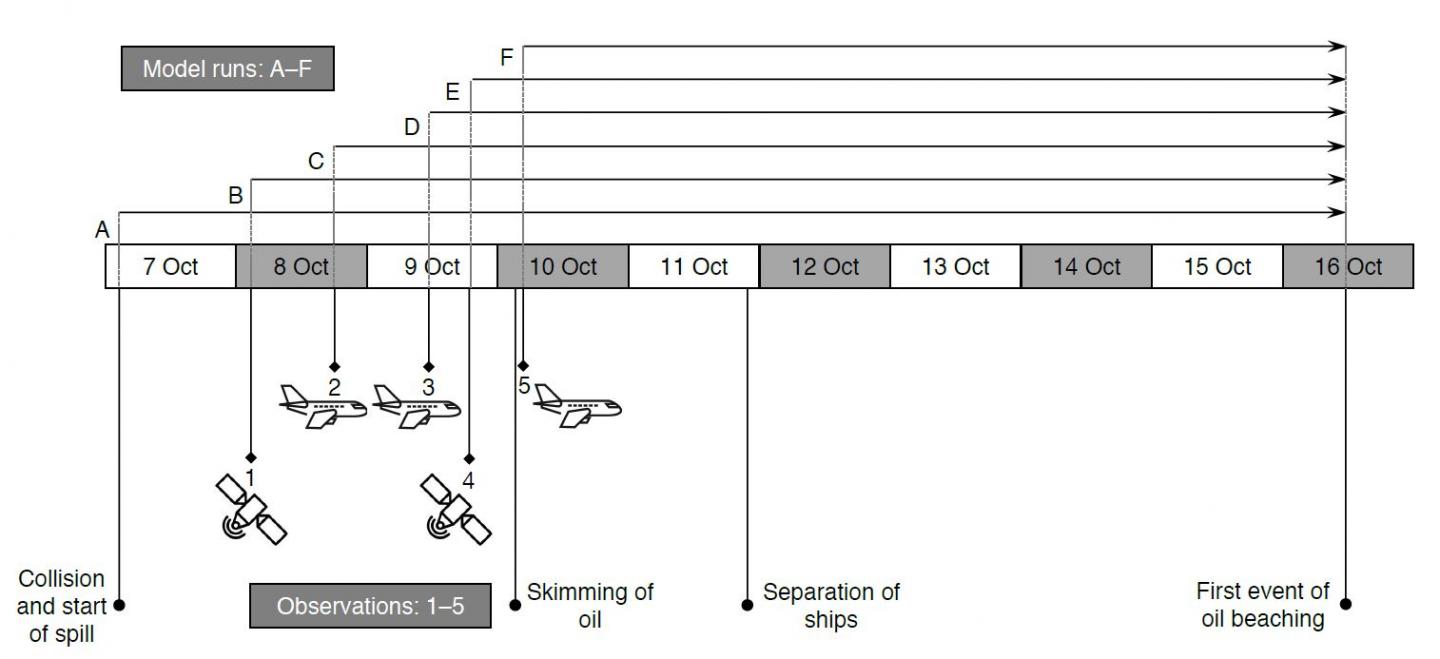
In October 2018, the Tunisian Ro-Ro passenger ship “Ulysse” rammed into the hull of the Cyprus-flagged container ship “Virginia”, which was anchored in international waters off the northern tip of Corsica, an area known for its pristine waters and beaches. Bunker fuel from Virginia leaked out of her tanks through a breach several meters long, threatening the marine environment and coastal areas. 530 m3 of oil were released, and in 36 hours the slick had lengthened to cover approximately 35 km.

Predicting the drift of oil slicks on water surfaces and in coastal zones is fundamental for responding to spill events and to mitigate their impacts on the environment, allowing for a more efficient use of emergency response resources.

A recently published scientific paper tells about the collaboration that was formed for this purpose, between the researchers of the CMCC Foundation – Euro-Mediterranean Center on Climate Change and REMPEC, the Regional Marine Pollution Emergency Response Centre for the Mediterranean Sea, based in Malta, right after the collision of Ulysse with Virginia.

“Thanks to a joint effort involving efficient and timely exchange of information, we received observational data from REMPEC and used these real observations as the starting point for our model in order to calculate the forecast”, explains Svitlana Liubartseva, researcher at the CMCC Foundation and first author of the study. “We worked day and night, and provided REMPEC with 5 forecast bulletins during the oil spill tracking and recovery operations.”

Forecast of currents, wind, waves and sea surface temperatures are critical for predicting the spread and fate of oil. The study is focused on the ability to realistically predict the times and places where oil reaches coastlines thanks to the oceanographic model MEDSLIK-II, developed by CMCC Foundation. The model results were verified by comparing available observational data.

“Using the oceanographic and atmospheric dataset provided by the Copernicus Marine Environment Monitoring Service (CMEMS) and the European Centre for Medium-Range Weather Forecasts (ECMWF) we produced forecasts of the oil drift. The CMEMS output has a high resolution of about 4 km, that allowed us to produce a rather good quality of prediction of when and where the oil reached the beaches”, specifies Dr. Liubartseva.

For the first 16 days after the accident, the model was able to generate reliable predictions, forecasting the oil movements at least 7 days in advance. Researchers were able to predict almost precisely the place and time where the oil would reach the coast for the first time. After more than 9 days drifting at sea, it landed near Saint-Tropez (France). Due to a lack of observational data in the long run there was a deterioration in the model solution, as the oil drifted for about one month. Nevertheless, the research demonstrates that the CMCC model facilitates the use and optimization of anti-pollution resource deployment and increases coastal preparedness.

CMCC researchers are now at work to further improve the predictability of oil spill drift and transformation. On the one hand, there is the need to improve the resolution of the models, making their grid finer and finer, which will involve studying more oil spill events to get better predictions.

###

For more information, read the article:

S. Liubartseva, M. Smaoui, G. Coppini, G. Gonzalez, R. Lecci, S. Cretì, I. Federico: Model-based reconstruction of the Ulysse-Virginia oil spill, October-November 2018. Marine Pollution Bulletin, Volume 154, May 2020, https://doi.org/10.1016/j.marpolbul.2020.111002

Media Contact
Mauro Buonocore
[email protected]

Original Source

https://www.cmcc.it/article/oilspill-environmental-impacts

Related Journal Article

http://dx.doi.org/10.1016/j.marpolbul.2020.111002

Tags: Algorithms/ModelsEarth ScienceMeteorologyOceanographyPollution/Remediation
Share12Tweet8Share2ShareShareShare2

Related Posts

Here are a few rewritten headlines for a science magazine post, each with a slightly different tone: Intriguing & poetic: How do organs sculpt themselves? Sea stars hold the secret Direct & research-focused: Sea stars reveal the hidden rules of organ formation Metaphorical & inviting: Tiny architects beneath the waves: What sea stars teach us about building organs Short & punchy: Star-shaped clues to how our organs take shape Question-led: Could a sea star show us how organs form? Elegant & feature-style: The body’s blueprint, glimpsed in a sea star’s arm

July 6, 2026
Bacteria evolve faster with unconventional gene copies — Biology

Bacteria evolve faster with unconventional gene copies

July 6, 2026

Neighbours rewire soil feedback via root microbiome shifts

July 6, 2026

Evolution-Inspired Biosensors Revolutionize Lipid Tracking in Real Time

July 2, 2026
Please login to join discussion

POPULAR NEWS

  • Detection of EDCs in Breast Milk and Infant Urine Up to Six Months Highlights Early Exposure Risks

    77 shares
    Share 31 Tweet 19
  • New Drug Candidate Developed at McMaster Shows Potential for Treating Brain Cancer

    58 shares
    Share 23 Tweet 15
  • Saying Goodbye to PGY-6: Pediatric Fellowship Realities

    103 shares
    Share 41 Tweet 26
  • KTU Researchers Explore Ultrasound’s Role in Enhancing Blood Flow Beyond Diagnostics

    53 shares
    Share 21 Tweet 13

About

We bring you the latest biotechnology news from best research centers and universities around the world. Check our website.

Follow us

Recent News

Flame retardant BDE-209 targets molecularly linked to ulcerative colitis

Ultra-high frequency particle impacts mimic rockbursts to shatter hard rock

Kidney transplant outcomes in older adults studied by German researchers

Subscribe to Blog via Email

Enter your email address to subscribe to this blog and receive notifications of new posts by email.

Join 83 other subscribers
  • Contact Us

Bioengineer.org © Copyright 2023 All Rights Reserved.

Welcome Back!

Login to your account below

Forgotten Password?

Retrieve your password

Please enter your username or email address to reset your password.

Log In
No Result
View All Result
  • Homepages
    • Home Page 1
    • Home Page 2
  • News
  • National
  • Business
  • Health
  • Lifestyle
  • Science

Bioengineer.org © Copyright 2023 All Rights Reserved.