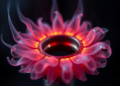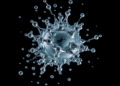

image: Microscopic oil droplets change shape simply by being exposed to a soap-like molecule, eventually closing into a sealed capsule that traps a bit of the surrounding liquid and suspended particles.
view more
Credit: Florent Fessler, NYU
NYU researchers have made microscopic oil droplets in water do something usually reserved for living cells: change shape in complex, controllable ways, and even engulf their surroundings.
The findings, published in Nature Communications, show that some of life’s signature behaviors—like morphing into complex shapes and capturing material—can emerge from physics and chemistry alone, without genes, proteins, or active cellular machinery.
One of life’s defining features is morphogenesis—the ability of cells and tissues to reshape themselves, form compartments, and engulf material from their surroundings. These remarkable transformations normally rely on a sophisticated molecular toolkit.
Can this shape-shifting behavior be replicated in synthetic particles to mimic features unique to living organisms? Yes, the researchers learned—and all you need is oil, water, and soap-like molecules.
“What surprised us is that you don’t need that cellular machinery to get the same kinds of behavior,” said Stefano Sacanna, professor of chemistry at NYU and the study’s co-senior author.
Sacanna and his colleagues combined microscopic oil droplets floating in water with a soap-like molecule named P123 block copolymer. When the soap-like molecule is added to the spherical oil droplets in water, the droplets spontaneously morph into a range of shapes, including flower-like structures, branching tree-like forms (akin to dendritic immune cells), dumbbells, discs, and cups.
This process is controllable and, unlike in cells in almost all living creatures, is reversible: by adjusting the concentration of the soap molecule, or simply warming and cooling the sample, the researchers could steer the droplets from one shape to another and back again, reversing the morphogenetic pathway.
Moreover, they found that the droplets can swallow their surroundings. Under the right conditions, a droplet folds in on itself, wraps around the surrounding fluid, and traps whatever is floating nearby inside.
“This swallowing behavior closely mirrors a cellular process called macropinocytosis, sometimes described as ‘cell drinking,’ where a cell gulps down a bit of its surroundings. Our droplets do this on their own, with no biological parts involved,” said Florent Fessler, a postdoctoral associate at NYU and the study’s first author.
The researchers note that while their experiments remind them of the morphogenesis behavior of cells, they are not reproducing cell biochemistry, nor creating artificial life. However, their discovery constitutes a model system to study how cells shape and form their structures.
“These changes are difficult to isolate in living cells, so a model system provides a simpler, more controlled platform to study the physical principles behind cellular behavior,” said Paul Chaikin, Silver Professor of Physics at NYU and the study’s co-senior author.
The findings also hold promise for developing smart, adaptive materials that can reshape in response to their environment or capture cargo upon demand.
“Under the right conditions, these droplets can restructure and engulf what’s around them, forming a protective capsule or shell. This tiny container could protect precious cargo—and because this shape change is non-specific and quite versatile, it could have many potential applications,” said Sacanna.
Additional study authors include Adam W. Hauser, Hailiang Liu, and Zhe Xu of NYU. The research was supported by the Department of Energy (DE-SC0020971).
Journal
Nature Communications
DOI
10.1038/s41467-026-75586-5
Article Title
Morphogenic colloids
Article Publication Date
18-Jul-2026
Media Contact
Rachel Harrison
New York University
Office: 212-998-6797
Journal
Nature Communications
Funder
DOE/US Department of Energy
DOI
10.1038/s41467-026-75586-5
Journal
Nature Communications
DOI
10.1038/s41467-026-75586-5
Article Title
Morphogenic colloids
Article Publication Date
18-Jul-2026
Tags
/Physical sciences/Chemistry/Chemical mixtures/Colloids
/Physical sciences
/Physical sciences/Chemistry
/Physical sciences/Physics
/Life sciences/Cell biology/Cellular physiology/Cell behavior
/Life sciences/Cell biology/Cellular physiology
Tags: biomimetic self-organizationcellular-like droplet behaviorchemical control of droplet morphologyemergent properties in soft matteremulsions and capsulesencapsulation of particlesMicroscopic oil dropletsnanotechnology and materials sciencepassive shape transformationphysics of droplet remodelingself-assembly of oil dropletsshape-shifting behavior