• HOME
  • NEWS
  • EXPLORE
    • CAREER
      • Companies
      • Jobs
    • EVENTS
    • iGEM
      • News
      • Team
    • PHOTOS
    • VIDEO
    • WIKI
  • BLOG
  • COMMUNITY
    • FACEBOOK
    • INSTAGRAM
    • TWITTER
Friday, July 3, 2026
BIOENGINEER.ORG
No Result
View All Result
  • Login
  • HOME
  • NEWS
  • EXPLORE
    • CAREER
      • Companies
      • Jobs
        • Lecturer
        • PhD Studentship
        • Postdoc
        • Research Assistant
    • EVENTS
    • iGEM
      • News
      • Team
    • PHOTOS
    • VIDEO
    • WIKI
  • BLOG
  • COMMUNITY
    • FACEBOOK
    • INSTAGRAM
    • TWITTER
  • HOME
  • NEWS
  • EXPLORE
    • CAREER
      • Companies
      • Jobs
        • Lecturer
        • PhD Studentship
        • Postdoc
        • Research Assistant
    • EVENTS
    • iGEM
      • News
      • Team
    • PHOTOS
    • VIDEO
    • WIKI
  • BLOG
  • COMMUNITY
    • FACEBOOK
    • INSTAGRAM
    • TWITTER
No Result
View All Result
Bioengineer.org
No Result
View All Result
Home NEWS Science News Chemistry

Observation of non-trivial superconductivity on surface of type II Weyl semimetal TaIrTe4

Bioengineer by Bioengineer
February 25, 2020
in Chemistry
Reading Time: 2 mins read
0
IMAGE
Share on FacebookShare on TwitterShare on LinkedinShare on RedditShare on Telegram

IMAGE

Credit: ©Science China Press

Topological superconductor, with bulk superconducting gap and Majorana fermion states on the surface or edge, is one of the most sought after quantum materials. Topological superconductivity is of fundamental importance with potentially powerful application in topological quantum computation. The discovery of Weyl semimetals, in which the conduction and valence bands contact only at Weyl points in the Brillouin zone protected against gap formation by crystalline symmetry or time reversal symmetry, has stimulated great enthusiasm for exploring topological superconductivity in these materials. Especially, the superconductivity from the topological non-trivial surface state of Weyl semimetals could be very attractive but has not been reported yet.

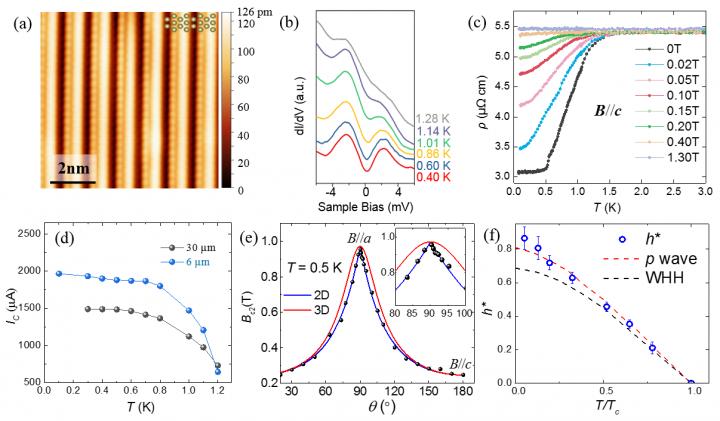
The noncentrosymmetric orthorhombic TaIrTe4, has been considered as a time-reversal invariant Weyl semimetal with the minimal 4 Weyl points. Recently, Prof. Jian Wang and Xiong-Jun Liu at Peking University in collaboration with Minghu Pan at Huazhong University of Science and Technology and others reported the experimental evidences for the unconventional superconductivity generated by the surface states in TaIrTe4 from both scanning tunneling microscopy/ spectroscopy (STM/STS) and electrical transport measurements. They demonstrated the superconductivity of TaIrTe4 by both the superconducting gap from STS and the consistent resistance drop from electrical transport. The thickness-independent of ultralow critical current and angular dependence of upper critical field (Bc2) indicate that the superconductivity occurs only in the surface states. Furthermore, the temperature dependence of Bc2 behavior, the in-plane angle-dependent critical field and the stability of the superconductivity against the magnetization together support the p-wave-like topological nature of the quasi-1D superconductivity.

This discovery of quasi-1D surface superconductivity in Weyl semimetals offers a novel platform for exploring topological superconductors and may contribute to the rapidly developing field of topological quantum computation.

###

See the article:
Ying Xing, Zhibin Shao, Jun Ge, Jiawei Luo, Jinhua Wang, Zengwei Zhu, Jun Liu, Yong Wang, Zhiying Zhao, Jiaqiang Yan, David Mandrus, Binghai Yan, Xiong-Jun Liu, Minghu Pan and Jian Wang

Surface superconductivity in the type II Weyl semimetal TaIrTe4

https://doi.org/10.1093/nsr/nwz204

Media Contact
Jian Wang
[email protected]

Related Journal Article

http://dx.doi.org/10.1093/nsr/nwz204

Tags: Chemistry/Physics/Materials Sciences
Share12Tweet8Share2ShareShareShare2

Related Posts

Graz University of Technology Deciphers the Structural Secrets of MOF Thin Films — Chemistry

Graz University of Technology Deciphers the Structural Secrets of MOF Thin Films

July 2, 2026
Breaking Thermodynamic Limits: Wavelength-Driven Catalysis Advances Ammonia Synthesis — Chemistry

Breaking Thermodynamic Limits: Wavelength-Driven Catalysis Advances Ammonia Synthesis

July 2, 2026

From Quantum Mechanics to AI-Powered Materials Discovery: MARVEL Marks 12 Years of Transforming Computational Science

July 2, 2026

Djire Recognized with National Award for Outstanding Contributions in Research and Teaching

July 2, 2026
Please login to join discussion

POPULAR NEWS

  • Detection of EDCs in Breast Milk and Infant Urine Up to Six Months Highlights Early Exposure Risks

    77 shares
    Share 31 Tweet 19
  • Saying Goodbye to PGY-6: Pediatric Fellowship Realities

    103 shares
    Share 41 Tweet 26
  • New Drug Candidate Developed at McMaster Shows Potential for Treating Brain Cancer

    58 shares
    Share 23 Tweet 15
  • KTU Researchers Explore Ultrasound’s Role in Enhancing Blood Flow Beyond Diagnostics

    53 shares
    Share 21 Tweet 13

About

BIOENGINEER.ORG

We bring you the latest biotechnology news from best research centers and universities around the world. Check our website.

Follow us

Recent News

Steatosis Drives Liver Metastasis Diversity in CRC

Unlocking the Mysteries of Alzheimer’s Disease

Pensoft Introduces New Peer-Reviewed Journal of Regeneration to Advance Restorative Biology Across Species

Subscribe to Blog via Email

Enter your email address to subscribe to this blog and receive notifications of new posts by email.

Join 83 other subscribers
  • Contact Us

Bioengineer.org © Copyright 2023 All Rights Reserved.

Welcome Back!

Login to your account below

Forgotten Password?

Retrieve your password

Please enter your username or email address to reset your password.

Log In
No Result
View All Result
  • Homepages
    • Home Page 1
    • Home Page 2
  • News
  • National
  • Business
  • Health
  • Lifestyle
  • Science

Bioengineer.org © Copyright 2023 All Rights Reserved.