Obesity is associated with an increased risk of developing female reproductive disorders, however, the roles and mechanisms of obesity in the cause(s) of reproductive conditions are unclear. A study publishing February 1st in PLOS Medicine by Samvida Venkatesh at University of Oxford, United Kingdom and colleagues suggests an etiological link between obesity and a range of female reproductive conditions, but the extent of this link differs among conditions.
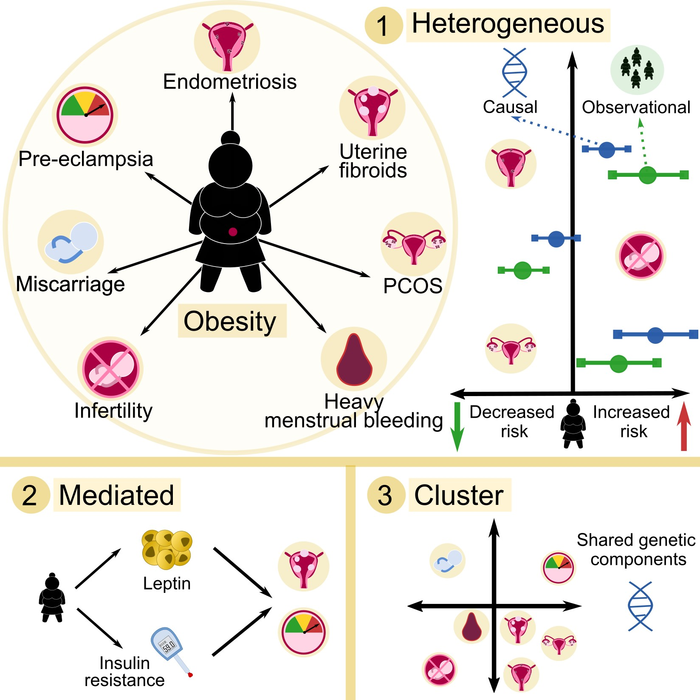
Credit: Samvida S. Venkatesh, CC BY 4.0 (https://creativecommons.org/licenses/by/4.0/)
Obesity is associated with an increased risk of developing female reproductive disorders, however, the roles and mechanisms of obesity in the cause(s) of reproductive conditions are unclear. A study publishing February 1st in PLOS Medicine by Samvida Venkatesh at University of Oxford, United Kingdom and colleagues suggests an etiological link between obesity and a range of female reproductive conditions, but the extent of this link differs among conditions.
Female reproductive disorders are common conditions affecting the health and well-being of many. However, the role of obesity in the development of female reproductive conditions is under-studied. To investigate the causal associations between obesity, metabolic hormones, and female reproductive disorders, researchers conducted a Mendelian randomization study of 257,193 women of European ancestry aged 40-69. They accessed records from UK Biobank, a large-scale biomedical database containing the medical, environmental, and genetic information of participants. The researchers then created a statistical model to estimate the association of body mass index and waist-to-hip ratio with risk of numerous female reproductive conditions including endometriosis, heavy menstrual bleeding, pre-eclampsia, and infertility.
The researchers found observational associations between obesity and a range of female reproductive disorders, including uterine fibroids, polycystic ovary syndrome, heavy menstrual bleeding, and pre-eclampsia. They also found that some inherited genetic variation associated with obesity is also associated with female reproductive disorders, but the strength of those associations differed by type of obesity and reproductive condition. The study had several limitations, such as the low prevalence of female reproductive disorders among participants, and a lack of body mass index and waist-hip-ratio data prior to disease onset.
According to the authors, “We provide genetic evidence that both generalised and central obesity play an aetiological role in a broad range of female reproductive conditions, but the extent of this link differs substantially between conditions. Our results suggest a need to explore the mechanisms mediating the causal associations of overweight and obesity on gynaecological health to identify targets for disease prevention and treatment”.
#####
In your coverage, please use this URL to provide access to the freely available paper in PLOS Medicine:
http://journals.plos.org/plosmedicine/article?id=10.1371/journal.pmed.1003679
Citation: Venkatesh SS, Ferreira T, Benonisdottir S, Rahmioglu N, Becker CM, Granne I, et al. (2022) Obesity and risk of female reproductive conditions: A Mendelian randomisation study. PLoS Med 19(2): e1003679. https://doi.org/10.1371/journal.pmed.1003679
Author Countries: United Kingdom, United States
Funding: S.S.V. is supported by the Rhodes Scholarships (https://www.rhodeshouse.ox.ac.uk/), Clarendon Fund (http://www.ox.ac.uk/clarendon/about), and the Medical Sciences Doctoral Training Centre (https://www.medsci.ox.ac.uk/) at the University of Oxford. S.B. is supported by the Li Ka Shing Foundation. M.V.H. works in a unit that receives funding from the UK Medical Research Council and is supported by a British Heart Foundation Intermediate Clinical Research Fellowship (FS/18/23/33512) and the National Institute for Health Research Oxford Biomedical Research Centre. C.M.L. is supported by the Li Ka Shing Foundation, NIHR Oxford Biomedical Research Centre, Oxford, NIH (1P50HD104224-01), Gates Foundation (INV-024200), and a Wellcome Trust Investigator Award (221782/Z/20/Z). L.B.L.W. is supported by the Wellcome Trust (221651/Z/20/Z). The research was supported by the Wellcome Trust Core Award Grant Number 203141/Z/16/Z with additional support from the NIHR Oxford BRC. The funders had no role in study design, data collection and analysis, decision to publish, or preparation of the manuscript.
Journal
PLoS Medicine
DOI
10.1371/journal.pmed.1003679
Method of Research
Observational study
Subject of Research
People
COI Statement
Competing interests: I have read the journal’s policy and the authors of this manuscript have the following competing interests: C.M.B. reports grants from Bayer AG, AbbVie Inc, Volition Rx, MDNA Life Sciences, Roche Diagnostics Inc., and consultancy for Myovant. He is a member of the independent data monitoring board at ObsEva; I.G. reports grants from Bayer AG; K.T.Z. reports grants from Bayer AG, AbbVie Inc, Volition Rx, MDNA Life Sciences, Roche Diagnostics Inc, and non-financial scientific collaboration with Population Diagnostics Ltd, outside the submitted work; M.V.H. has consulted for Boehringer Ingelheim, and in adherence to the University of Oxford’s Clinical Trial Service Unit & Epidemiological Studies Unit (CSTU) staff policy, did not accept personal honoraria or other payments from pharmaceutical companies; C.M.L. reports grants from Bayer AG and Novo Nordisk and has a partner who works at Vertex; no other relationships or activities that could appear to have influenced the submitted work. All disclosed competing interests are outside the submitted work.